In Colombian jungle, digging up the Americas' colonial past / Photo: Raul ARBOLEDA - AFP
 'Glad it's over': Kim powers to Games gold and military exemption

 After 11 World Cups, football finally comes home for one Indian fan
 Marc Marquez wins sprint at Japan MotoGP, Martin grabs pole

 Alcaraz fends off Arnaldi to reach Japan Open quarters
 Antonelli tops times in final practice at Bahrain GP

 Gauff digs deep to beat Osorio in China Open second round

 Fresh protests to hit Spain after housing measures defeated

 'He's here with me': Japan cycle queen dedicates gold to late brother

 Japan Olympic chief says 'lot more' athletes at Games than expected
 Asian carmakers besting US rivals at home, China poised to strike

 Widgets & Web Offers All-Inclusive Investor Relations Websites for Public Companies, IPOs and SPACs

 Adams named new US captain to 2030 World Cup
 China a better influence in Latin America than US: poll
 Judge pauses construction of border project in Texas national park

 Belgium's De Bruyne fires double to sink Turkey, France held by Italy
 US jobs data boosts stocks as oil prices dip

 US Supreme Court to hear high-stakes climate case
 Trump expected to name intel chief Clayton as AI czar: reports
 Argentina unveils passports-for-investment scheme

 Brazil election debate chaos sparks censorship row
 England's Carse charged by cricket body over nightclub incident

 Amazon vows $1 bn for data center towns, decries 'myths'
 Oil prices drop on G7 fuel release, US jobs data boosts stocks

 G7 agrees deal to ease global energy supply concerns

 Spain's government dealt blow as lawmakers reject housing bills
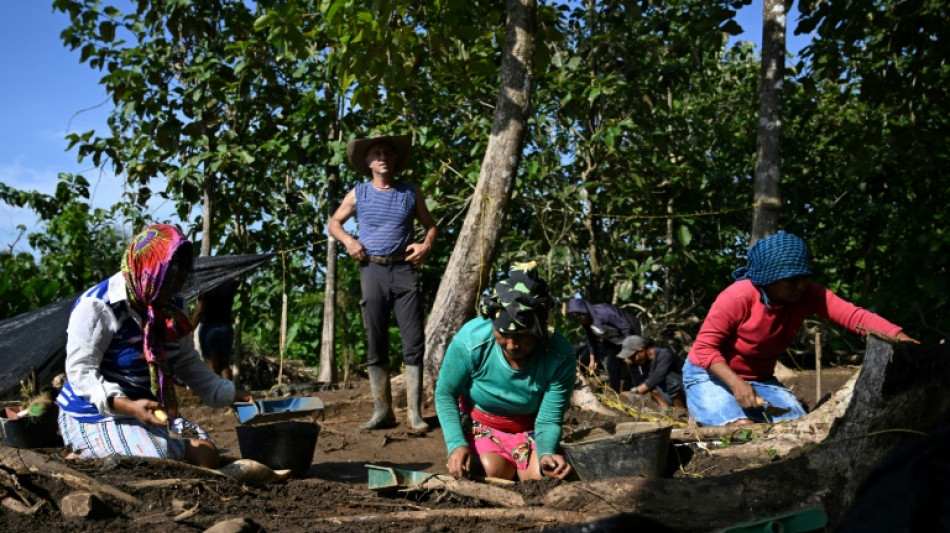
With brushes and trowels, Indigenous Colombians are unearthing traces in the jungle of a tragic period in history, when their ancestors were violently supplanted by colonists from Spain.
Working as amateur archaeologists, they carefully brush away dirt to reveal pottery and other artifacts left behind by ancient inhabitants of what in 1510 became Santa Maria la Antigua del Darien -- the first-ever city built by the conquistadores in the Americas.
Watched over by archaeologist Alberto Sarcina, an Italian with an Indiana Jones-like aura, what appears to be an ancient cobblestone road emerges from the patient tap, tap, tap of the workers' tools.
At first it was "difficult" to convince the local population of Unguia, a municipality in the middle of the Darien jungle, to get involved, recounted Sarcina, who works for the Colombian Institute of Anthropology and History, which is funding the project.
Many, he said, "didn’t want to know anything about the city that started the tragedy" of Indigenous annihilation.
But 10 years into the project, dozens now partake with gusto and pride. They are mainly of Indigenous and Afro descent. Most are women.
"I like to find things that we don't even know how to make today... they made their own clay and didn’t have to buy it. They were very resourceful," 28-year-old Karen Suarez of the Embera Indigenous community told AFP after digging up a piece of pottery.
- 'A dramatic turn' -
Christopher Columbus first arrived on the island of Hispaniola (now the Dominican Republic and Haiti), in 1492, on his ultimately unsuccessful quest to find India at a time that world maps were still being developed.
From there, he led expeditions to the mainland Americas.
Several temporary settlements were created along the way, but it was the founding of Santa Maria la Antigua del Darien that really marked the beginning of colonial entrenchment.
"It's one of those moments in history where the story takes a dramatic turn -- one of those moments with a before and an after," said Sarcina, 55.
"The conquest of an entire continent began here, which means the Indigenous genocide began here."
Researchers have estimated that European colonizers killed some 55 million Indigenous people in the Americas.
The Colombian project seeks to glean more about this period from what the colonizers, and their victims, left behind in and around the 33-hectare (80-acre) city in the northwestern Choco department.
Santa Maria la Antigua del Darien lasted for only 14 years until 1524, when the original inhabitants of the region killed the invaders and set fire to the settlement.
At its height, the city had some 5,000 inhabitants, but many had already left before its ultimate demise as the headquarters of the so-called Castilla de Oro Spanish territories moved to what is Panama today.
- 'The best thing' -
The source of much historic misery is today helping to lighten the burden for a few descendants of those who survived the Spanish invasion.
The amateur archaeologists at Santa Maria la Antigua del Darien receive payment for their efforts and can earn money from hosting tourists at their homes.
"We have felt good in this work, we benefit a little from the economy (generated) and from learning... about the history of the ancestors," said participant Antonio Chamarra, 40.
Jeniffer Alvarez, 32, told AFP her job on the project was "a respite" from the machismo and violence in an area ravaged by the Gulf Clan drug cartel.
"This site has been the best thing" to happen in a society that tends to relegate women to housework, she added.
The site also hosts a museum -- another income generator. After dark, the horseshoe-shaped museum becomes a cinema for the children of surrounding villages in a community with very basic access to services such as health and education.
The project also serves as a sort of open-air university.
It has inspired 16-year-old Hector Monterrosa from the nearby Tanela village to aspire to an career in archaeology, like his idol Sarcina.
"Here, in general, it is very difficult to get an opportunity to go to university," the teen, who spends much of his free time after school at the dig site, told AFP.
"There are very few who can go and since my family's finances are not so good, this would be a great opportunity for me to start preparing" for an academic career, he said.
D.Moore--AMWN