Phallus and the boar: Turkey digs yield clues to human history / Photo: Ozan KOSE - AFP
 'Glad it's over': Kim powers to Games gold and military exemption

 After 11 World Cups, football finally comes home for one Indian fan
 Marc Marquez wins sprint at Japan MotoGP, Martin grabs pole

 Alcaraz fends off Arnaldi to reach Japan Open quarters

 Antonelli tops times in final practice at Bahrain GP

 Gauff digs deep to beat Osorio in China Open second round

 Fresh protests to hit Spain after housing measures defeated

 'He's here with me': Japan cycle queen dedicates gold to late brother

 Japan Olympic chief says 'lot more' athletes at Games than expected

 Asian carmakers besting US rivals at home, China poised to strike

 Widgets & Web Offers All-Inclusive Investor Relations Websites for Public Companies, IPOs and SPACs

 Adams named new US captain to 2030 World Cup

 China a better influence in Latin America than US: poll

 Judge pauses construction of border project in Texas national park

 Belgium's De Bruyne fires double to sink Turkey, France held by Italy
 US jobs data boosts stocks as oil prices dip

 US Supreme Court to hear high-stakes climate case
 Trump expected to name intel chief Clayton as AI czar: reports
 Argentina unveils passports-for-investment scheme

 Brazil election debate chaos sparks censorship row

 England's Carse charged by cricket body over nightclub incident

 Amazon vows $1 bn for data center towns, decries 'myths'
 Oil prices drop on G7 fuel release, US jobs data boosts stocks

 G7 agrees deal to ease global energy supply concerns

 Spain's government dealt blow as lawmakers reject housing bills
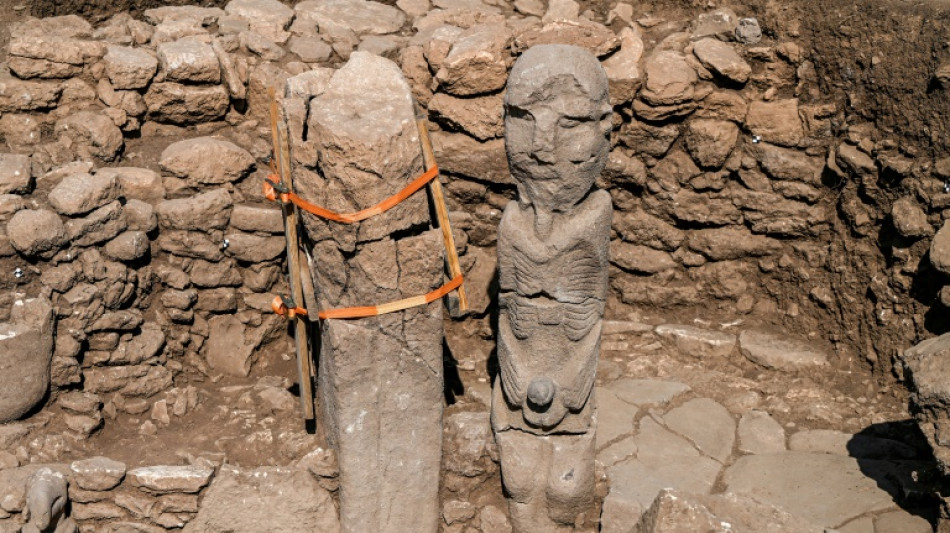
The dry expanses of southeastern Turkey, home to some of humanity's most ancient sites, have yielded fresh discoveries in the form of a stone phallus and a coloured boar.
For researchers, the carved statue of a man holding his phallus with two hands while seated atop a bench adorned with a leopard, is a new clue in the puzzle of our very beginnings.
The 2.3-meter (7.5-foot tall) work was discovered at the end of September at Karahantepe, in the heart of a complex of some 20 sites that were home to thousands of people during the Stone Age.
Karahantepe is part of the network around UNESCO-listed Gobekli Tepe, a place where our prehistoric ancestors gathered to worship more than 7,000 years before Stonehenge or the earliest Egyptian pyramids.
Necmi Karul, who heads the prehistory department at Istanbul University, found the toppled statue that was broken into three sections.
"We found several statues of this kind... but for the first time here we found the phallus," said the archaeologist, who coordinates the work of a project focused on the area's settlements.
The man lay in one of the first rectangular buildings, probably as a pillar supporting the wooden roof -- clues to how people used the site.
Karul said these settlements bear witness to "a new social order born after the Ice Age."
"The main reason to start a new kind of architecture is to build a new type of society," he noted.
- 150 more years of work -
Gobekli Tepe -- which some experts believe was never actually inhabited -- may be part of a vast sacred landscape that encompasses other nearby hilltop sites that archaeologists believe may be even older.
But the first modest photos of the statue released by Turkey's culture ministry led the local press to suspect censorship in the Muslim nation that has veered conservative under President Recep Tayyip Erdogan.
"We are archeologists, censorship doesn't exist! We had not yet found a phallus," the archaeologist said, laughing.
But there's meaning hidden in the discovery.
"Before leaving a site they (residents) used to crash the pillars and the statues -- but before, they broke the nose and the phallus," he said.
Then the site was filled in, buried under tonnes of sand and earth.
Its function remains unknown as do the reasons for the sudden abandonment and destruction of place after apparently hundreds of years of use.
The largest room at the site, surrounded by smaller rooms, seems to have been a kind of gathering place accessed via a narrow passageway, supported by a forest of phallus-shaped pillars topped by a man's head carved out of the rock.
"Those who entered here knew the symbols... they knew the meaning, it told them a story but we don't know it," he added, noting they have not found any female figures.
Perhaps they were made of wood, he noted, hazarding a guess.
No sooner had Karul unearthed the Karahantepe man, when he made another discovery the same week at Gobekli Tepe.
Archaeologists found a 1.2 metre long by 70 centimetre tall (4-foot by two-foot) depiction of a boar, with red eyes and teeth as well as a black-and-white body.
This 11,000-year-old wild pig is the first coloured sculpture from this period discovered to date, Karul said.
The site was occupied for some 1,500 years before being abandoned.
Of the 20 area sites in Tas Tepe (Stone Hills) project that is coordinated by Karul -- which stretches over 120 kilometres not far from the Syrian border -- only nine are being excavated.
"Work for the next 150 years", noted Karul, who has decided that both the man and the boar will remain where they emerged from the earth, but with the necessary measures to safeguard them.
O.M.Souza--AMWN