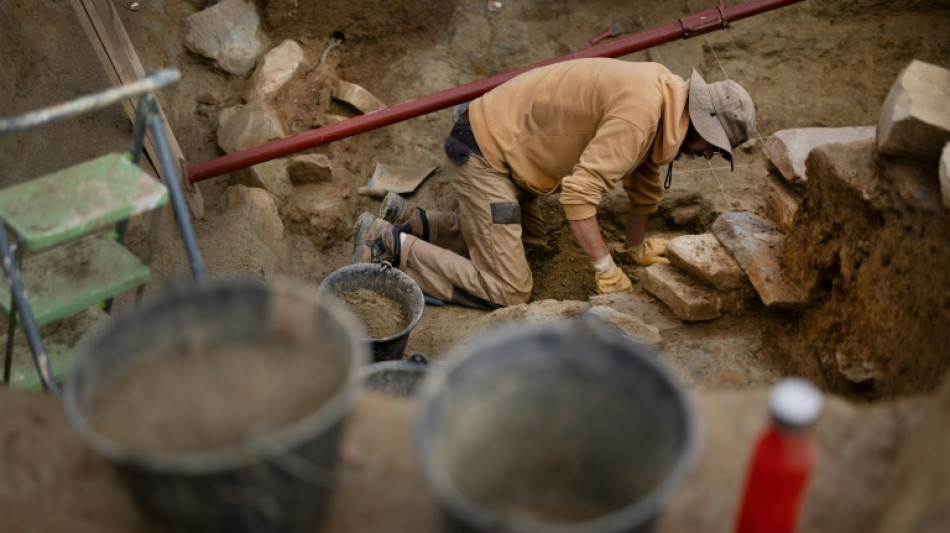
How a Bronze Age rock became a 'treasure map' for researchers / Photo: Fred TANNEAU - AFP
 'Glad it's over': Kim powers to Games gold and military exemption

 After 11 World Cups, football finally comes home for one Indian fan
 Marc Marquez wins sprint at Japan MotoGP, Martin grabs pole

 Alcaraz fends off Arnaldi to reach Japan Open quarters

 Antonelli tops times in final practice at Bahrain GP

 Gauff digs deep to beat Osorio in China Open second round

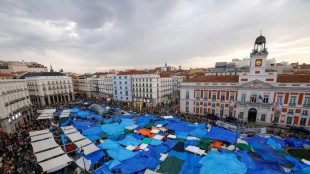 Fresh protests to hit Spain after housing measures defeated
 'He's here with me': Japan cycle queen dedicates gold to late brother

 Japan Olympic chief says 'lot more' athletes at Games than expected

 Asian carmakers besting US rivals at home, China poised to strike

 Widgets & Web Offers All-Inclusive Investor Relations Websites for Public Companies, IPOs and SPACs

 Adams named new US captain to 2030 World Cup

 China a better influence in Latin America than US: poll

 Judge pauses construction of border project in Texas national park

 Belgium's De Bruyne fires double to sink Turkey, France held by Italy
 US jobs data boosts stocks as oil prices dip

 US Supreme Court to hear high-stakes climate case
 Trump expected to name intel chief Clayton as AI czar: reports

 Argentina unveils passports-for-investment scheme

 Brazil election debate chaos sparks censorship row
 England's Carse charged by cricket body over nightclub incident

 Amazon vows $1 bn for data center towns, decries 'myths'

 Oil prices drop on G7 fuel release, US jobs data boosts stocks

 G7 agrees deal to ease global energy supply concerns

 Spain's government dealt blow as lawmakers reject housing bills

A piece of rock with mysterious markings that lay largely unstudied for 4,000 years is now being hailed as a "treasure map" for archaeologists, who are using it to hunt for ancient sites around north-western France.
The so-called Saint-Belec slab was claimed as Europe's oldest map by researchers in 2021 and they have been working ever since to understand its etchings -- both to help them date the slab, and to rediscover lost monuments.
"Using the map to try to find archaeological sites is a great approach. We never work like that," said Yvan Pailler, a professor at the University of Western Brittany (UBO).
Ancient sites are more commonly uncovered by sophisticated radar equipment, aerial photography or by accident in cities when the foundations for new buildings are being dug.
"It's a treasure map," said Pailler.
But the team are only just beginning their treasure hunt.
The ancient map marks an area roughly 30 by 21 kilometres and Pailler's colleague, Clement Nicolas from the CNRS research institute, said they would need to survey the entire territory and cross reference the markings on the slab.
That job could take 15 years, he said.
- Rivers and mountains -
Nicolas and Pailler were part of the team that rediscovered the slab in 2014 -- it was initially uncovered in 1900 by a local historian who did not understand its significance.
The French experts were joined by colleagues from other institutions in France and overseas as they began to decode its mysteries.
"There were a few engraved symbols that made sense right away," said Pailler.
In the coarse bumps and lines of the slab, they could see the rivers and mountains of Roudouallec, part of the Brittany region about 500 kilometres west of Paris.
The researchers scanned the slab and compared it with current maps, finding a roughly 80 percent match.
"We still have to identify all the geometric symbols, the legend that goes with them," said Nicolas.
The slab is pocked with tiny hollows, which researchers believe could point to burial mounds, dwellings or geological deposits.
Discovering their meaning could lead to a whole flood of new finds.
- 'Doomed' slab -
But first, the archaeologists have spent the past few weeks digging at the site where the slab was initially uncovered, which Pailler said was one of the biggest Bronze Age burial sites in Brittany.
"We are trying to better contextualise the discovery, to have a way to date the slab," said Pailler.
Their latest dig has already turned up a handful of previously undiscovered fragments from the slab.
The pieces had apparently been broken off and used as a tomb wall in what Nicolas suggests could signify the shifting power dynamics of Bronze Age settlements.
The area covered by the map probably corresponds to an ancient kingdom, perhaps one that collapsed in revolts and rebellions.
"The engraved slab no longer made sense and was doomed by being broken up and used as building material," said Nicolas.
L.Harper--AMWN