Madrid's Prado museum throws spotlight on reverse side of paintings / Photo: Thomas COEX - AFP
 Lula, Bolsonaro in final push for votes ahead of knife-edge election

 Boisterous fashion week barnstorms 'sleepy' Nigerian capital

 UAE investigators say flydubai co-pilot was planning 'terrorist act'
 Rahul smacks century in India v Windies ODI

 Daryz seeks to join exclusive club of dual Arc winners

 Russia warns diplomats to leave Kyiv over new strikes threat

 Olympic champ Zheng rebukes rowdy home crowd at China Open

 World No.1 Sinner pulls out of Shanghai Masters to delay return
 Red Bull's Verstappen grabs pole position for Bahrain GP

 India beat Pakistan in blockbuster as golfer Kim wins 'crazy' gold

 India beat arch-rivals Pakistan to win Asian Games cricket gold

 Ethiopia's Tigray rebels abandon regional capital as govt advances: journalist

 Tom Kim powers to Games gold and exemption from military service

 Split loyalties for Indian football fans at Brazil friendly

 India-Pakistan blockbuster brings cricket fever to Japan baseball field

 Wong waiting on Rafa after winning Asian Games tennis gold
 With Russia next door and rising costs, Latvia goes to the polls

 Penalty hero rues empty seats as Games hosts Japan win football gold

 North Korea fires ballistic missile after Seoul's apology demand

 US regulator finds Boeing 737 MAX software bug 'not a safety concern'

 Ohtani 'managing' injuries as Dodgers launch MLB post-season
 New "What Is a Gold IRA?" Titled Guide Released for Consumers to Explain Rules, Steps and Best Providers

 Botched US execution leaves murderer unconscious on ventilator: lawyers
 Cornell rape case exposes sexual violence at US colleges
 France held by Italy in Zidane's homecoming after Olise stunner

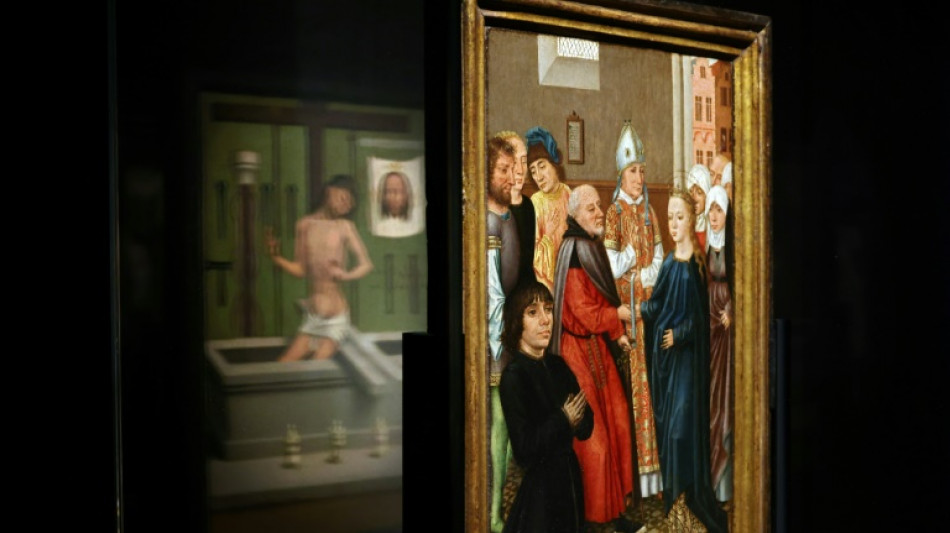
A new exhibition at Madrid's Prado museum is throwing a spotlight on the reverse side of paintings, letting visitors see labels, seals and sketches that are usually hidden from view.
The aim of the Reversos (On the Reverse) exhibition is to change the viewer's point of view and take them behind the scenes to open a "door to the secrets of art," said its curator, Miguel Angel Blanco.
"This exhibition goes far beyond simply turning the paintings over on the wall," he said.
About 100 works are on display in two rooms with black walls, including paintings on loan from 29 foreign museums and international collections such as the Van Gogh museum in Amsterdam and Boston's Museum of Fine Arts.
"We wanted to do an international project, not limit ourselves to the paintings of the Prado museum," he said.
In preparing the exhibit, Blanco said he has made an "in-depth exploration" of the Prado's vast collection over the past seven years and had seen "most of the paintings from the front and the back".
The inspiration was one of the Prado's most famous paintings, Diego Velazquez's 17th-century masterpiece "Las Meninas" depicting the Infanta Margarita and her courtiers.
In the picture, the artist himself is also visible, working on a large canvas placed on the floor. The back of the painting he is working on can be seen on the left side of "Las Meninas".
A life-size replica of the back of this huge painting forms the centrepiece of the exhibition, which opened last month and runs until March.
The rest of the works are originals. Some have their painted side to the wall while others can be seen from both sides such as Swedish-Austrian painter Martin van Meytens’ 18th-century "Kneeling Nun".
The front depicts a devout young nun, kneeling at prayer as an older nun watches over. The reverse has a surprise -- it shows the nun with her habit hitched up, revealing her naked bottom.
- 'Unknown brushstroke' -
In some cases, the backs of paintings contain labels, stamps or seals that were placed there at a later date which help trace the history of the works -- the collections they belonged to, the palaces where they were displayed or any restoration undertaken on them.
One section of the exhibition focuses on the materials that have been used over the centuries as supports for paintings, including copper, porcelain and even ivory.
The exhibition features the original stretcher frame -- the wooden structure over which a painting canvas is stretched -- of one of the world's most famous works: Pablo Picasso's 1937 masterpiece "Guernica", regarded by many critics as the most moving and powerful anti-war painting in history.
It was discovered two years ago at one of the warehouses of New York's Museum of Modern Art where the famous painting was moved for safekeeping when World War II broke out.
"They saw that there was a label that says 'Picasso, San Francisco'," he said, explaining that it was one of 30 cities the painting had been taken to.
"It was nailed onto the stretcher frame and unnailed 45 times," Blanco said, describing it as "the frame with the most nail holes in history".
The stretcher frame features a black stain which "is the unknown brushstroke of 'Guernica', it is a brushstroke that escaped Picasso and was captured here on this crossbeam," he added.
"Guernica" finally returned to Spain in 1981. Since 1992, it has been on display at the Reina Sofia museum in Madrid which is located near the Prado.
O.Norris--AMWN