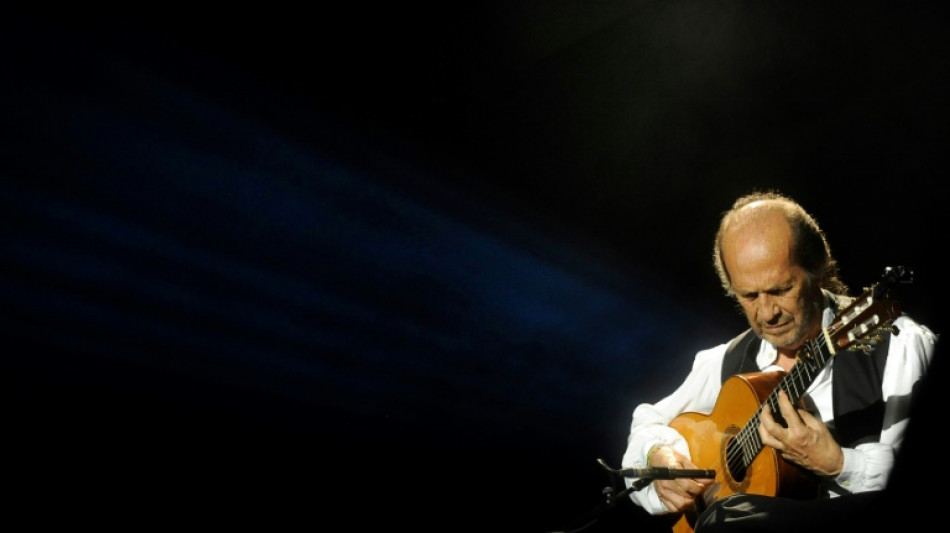
10 years on, the legend of flamenco icon Paco de Lucia lives on / Photo: RAFA RIVAS - AFP/File
 ALEX BODI ȘI AMBASADORUL REPUBLICII SUDANUL DE SUD, GUM DOMINIC MATIOK, DISCUTĂ LA BERLIN DESPRE POSIBILITATEA ÎNFIINȚĂRII UNUI CONSULAT ONORIFIC LA BUCUREȘTI

 Dodgers step up World Series three-peat bid with 5-3 win over Braves

 Spain break down Czechs as England outclass Croatia in Nations League

 Yamal on target as Spain hold off Czech Republic

 Latvian exit polls suggest pro-European choice

 Lula, Bolsonaro wrap up campaigns ahead of knife-edge election

 Tuchel hails 'complete' England after Croatia demolition

 Fury to invite Trump to lead ring walk before Joshua showdown

 Fashion industry in 'precarious moment', says Vivienne Westwood supremo
 Seventh heaven for England in Nations League rout of Croatia

 Storms, flooding cause chaos on Greek holiday island of Crete

 #IAmJaneDoe: online support campaign in US university rape case

 Brazil shine on Selecao's first visit to India
 Zverev sets up Djokovic quarter-final at China Open, Rybakina out
 Happier at home, Bordeaux hammer Lyon in Top 14

 Lula, Bolsonaro in final push for votes ahead of knife-edge election

 Boisterous fashion week barnstorms 'sleepy' Nigerian capital

 UAE investigators say flydubai co-pilot was planning 'terrorist act'
 Rahul smacks century in India v Windies ODI

 Daryz seeks to join exclusive club of dual Arc winners

 Russia warns diplomats to leave Kyiv over new strikes threat
 Olympic champ Zheng rebukes rowdy home crowd at China Open

 World No.1 Sinner pulls out of Shanghai Masters to delay return

 Red Bull's Verstappen grabs pole position for Bahrain GP
 India beat Pakistan in blockbuster as golfer Kim wins 'crazy' gold

Spanish guitar legend Paco de Lucia, who died 10 years ago on Sunday, couldn't read music but his talent revolutionised flamenco, causing its popularity to spread around the world.
Wherever he played, he filled theatres and concert halls around the world, from London to New York, Paris and Moscow, San Francisco and Tokyo, shattering the image of flamenco as something complex and only of interest to a fringe audience.
"Flamenco was always marginalised in Spain because it was the music of gypsies, of Andalusians, of poor and working-class people," he once said, referring to the southern Andalusia region where was born and raised.
But his virtuosity brought the dramatic rhythms and passion of flamenco to the most prestigious music halls and this week, the main tribute event was held in New York's Carnegie Hall, bringing together the world's best flamenco artists with others like Panamanian salsa legend Ruben Blades.
The secret of de Lucia's success was his capacity "to make beautiful melodies and then dress these up with the best harmonies," guitarist Jose Carlos Gomez told AFP in the southern port town of Algeciras.
"That's why Paco is so popular both with music connoisseurs and ordinary people."
He died of a heart attack on February 25, 2014 at the age of 66 while he was "playing with his children on the beach" at Playa del Carmen in the Mexican Caribbean where he had a house, reflecting his love of the sea, swimming and fishing.
Such were the passions he had growing up in Algeciras where he was born in 1947, spending his childhood in places like El Rinconcillo beach where AFP met Gomez, a close friend of the family, whose own latest album "Las Huellas de Dios" ("God's Fingerprints") is a tribute to his idol.
It was here that de Lucia used to frequent a beachfront bar called Casa Bernardo where he would drink beer and eat fried fish, which inspired him to write a rumba by the same name.
- ' Born to play guitar' -
Born Francisco Sanchez Gomez to a Portuguese mother and a Spanish father, he was known as Paco -- the short form of Francisco -- "de Lucia" meaning "of Lucia", his mother.
Growing up in a gypsy neighbourhood, it was his father, also a guitarist, who introduced him to music and encouraged him to practise for hours.
When he was eight, his father put a guitar in his hands and told him: "I can't send you to school, I can't teach you a career, the only thing I can give you is this guitar," he once said in an interview. The same thing happened to his brothers, Ramon and Pepe, who also went on to have careers in flamenco.
De Lucia took to it so well that it was as if he had "been born to play the guitar," says Gomez, saying he was such a natural that he could concentrate on experimenting and composing more than others.
By the time he was 12, he was earning at flamenco "tablaos" -- the intimate bars that are home to the authentic form of the tragic gypsy lament and dancing. Despite having no formal training, he moved to Madrid at 15 and by 18 had released his first album.
He was the first flamenco artist to obtain a chart topper with his instrumental rumba "Entre dos aguas" which was released in 1973 and saw him bringing flamenco closer to jazz with a sextet including wind instruments and an electric bass, in a major break with tradition.
Also revolutionary was his introduction of a cajon, a Peruvian box drum instead of two or three palmeros (rhythmic clappers) which made flamenco "more acoustic" and "more intimate in terms of staging", explains top percussionist Paquito Gonzalez who recorded an album with him.
- 'Orphaned by his death' -
When de Lucia played in Madrid's Teatro Real in 1975, it stoked controversy for being the first flamenco performance in the Spanish capital's prestigious opera house, but also because he played with crossed legs rather than the traditional posture with the guitar resting on one leg, steeply angled upwards.
He was like "one of those explorers with a machete in hand who went into the Amazon and began cutting down branches and making a path," guitarist Jose Quevedo 'Bolita' told AFP at Pena La Buena Gente, a club in Jerez de la Frontera that draws flamenco fans, of which there are many across Andalusia.
And it was after one drunken night in Jerez that de Lucia and the singer Camaron de la Isla decided to work together, going on to produce several legendary albums.
When Paco de Lucía "became a global star, almost without realising it, he created what is now the flamenco industry", says Quevedo.
"It was a total turning point which brought about the 'professionalisation' of flamenco, creating a more rewarding life for many artists", he said.
And when he died, "the flamenco world felt very orphaned", says dancer Monika Bellido who runs a flamenco academy in Algeciras.
"The whole world loved Paco."
A.Rodriguezv--AMWN