Young Rwandan artists keep the memory of genocide victims alive / Photo: Guillem Sartorio - AFP
 Asian Games set to close after records, rancour and rain

 Cry for help as French-Swiss lake dries up

 Sabalenka swept out of China Open in third round

 US urges 'restraint' as Ethiopia's Tigray crisis rocks region

 Teens on target again as USA down Mexico 3-0
 World records prove Asian Games were a hit, says top official
 US prison chief who oversaw botched execution resigns

 'Chaotic' Asian Games threaten Japan hopes of hosting Olympics again

 Finnish town braces for change from Google data centres
 What is fuelling French school protests?

 Without lawyers, migrant children face deportation from the US
 Three-peat seeking Dodgers open playoffs with a win, Rays hold off Yankees

 Brazil votes in nail-biter polls closely watched by Trump

 'Just be you': Kim reveals Tiger text that inspired him to gold

 Myanmar migrants returned to war-torn nation from Malaysia
 ALEX BODI AND AMBASSADOR GUM DOMINIC MATIOK OF THE REPUBLIC OF SOUTH SUDAN MEET IN BERLIN TO DISCUSS THE POSSIBILITY OF AN HONORARY CONSULATE IN BUCHAREST

 Lula, Bolsonaro wrap up campaigns ahead of Brazil's knife-edge vote

 Toulouse edge Castres in Top 14 derby

 Murakami homer propels White Sox to MLB playoff win over Guardians

 Israel targets top Hamas leader in deadly Gaza strike on anniversary

 Houthis say struck oil facility near Riyadh, as Saudis hit Sanaa

 AI needs safety layers like nuclear plants: ex-OpenAI engineer

 MVP Judge will miss Yankees' MLB playoff series against Rays
 New lizard species discovered in Peru

 Fernandes hails Portugal's 'greatest symbol' Ronaldo, calls for unity

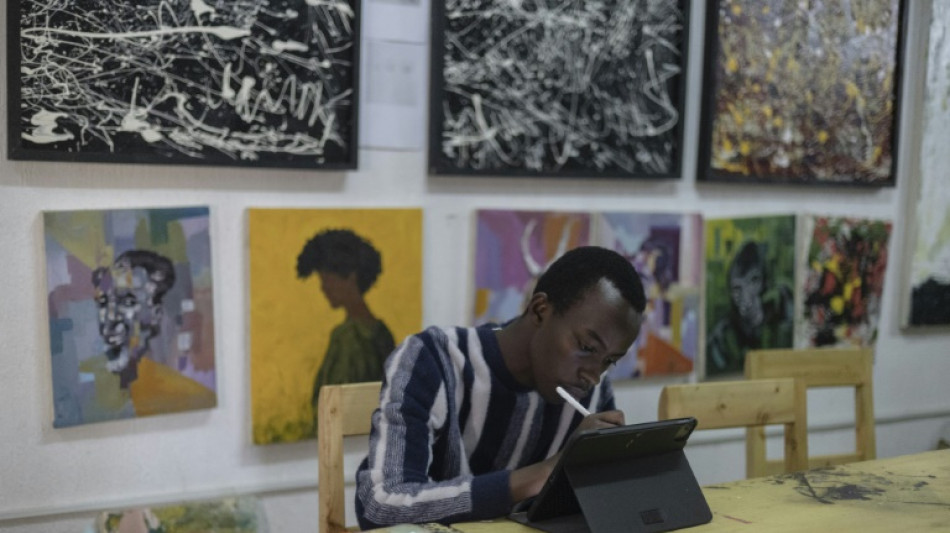
On sketch pads or computer tablets, a group of young Rwandan artists painstakingly recreate portraits of victims of the 1994 genocide for their loved ones.
The illustrators -- like the majority of Rwanda's population -- were not even born when the 100-day killing spree by Hutu extremists was unleashed against the Tutsi minority 30 years ago this month.
Their work has not only helped preserve the memories of some of the 800,000 victims of the vicious bloodletting, but also given the artists themselves a new insight into their country's deeply painful past.
The project -- to create new portraits of the dead and missing copied from old and often damaged photographs -- was the inspiration of Kigali artist King Ngabo.
The 28-year-old founded the Art for Memories initiative a year ago, during the last Kwibuka or remembrance commemorations for the genocide.
Since then, the collective says it has produced about 450 portraits of genocide victims, all for free.
Members of the team work together on a long wooden paint-smeared table in his Kigali gallery, the walls adorned with an eclectic mix of artworks.
- 'Bring back to life' -
"We invite people to send pictures of their beloved ones, on emails, on social media, on WhatsApp," says Ngabo, his charcoal-coloured overalls spattered with paint.
"And then for those damaged pictures, we bring back in the studio... and bring it back to life."
Ngabo said that before starting the project, he thought he knew a lot about the genocide, having visited many memorial sites.
But he says he never before had the "privilege" of being able to talk to survivors of the mass slaughter that still haunts the tiny nation.
"So I have learned a lot, the memories..."
Genocide survivor Nyirahabimana Aliette, 41, could not hold back the tears after she handed over old photographs of her parents and older sister, all murdered in 1994.
"I would like someone to draw these pictures for me so I can keep them with me," she said, her voice breaking.
"(My children) ask me a lot of questions about what happened with the family," she added.
"Being able to see these drawings at home will allow them to have an image (of their lost relatives)."
The murderous rampage saw families and friends turn against each other, the killings fuelled by vicious anti-Tutsi propaganda broadcast on TV and radio.
"During the genocide against Tutsi, artists of that day used illustrations to spread the ideology of genocide against Tutsi," said Mucyo Martin, a 20-year-old independent illustrator.
"So now there is us young artists who make illustrations too, we decided to correct that."
Art student Manzi Yvan Bryan, 19, said the experience was invaluable in finding out more about the events of 1994.
"When I was a child we learned about the genocide at school, and sometimes at home, my parents talk about it.
"But when I joined this initiative I learned more... some things that I didn't know."
M.A.Colin--AMWN