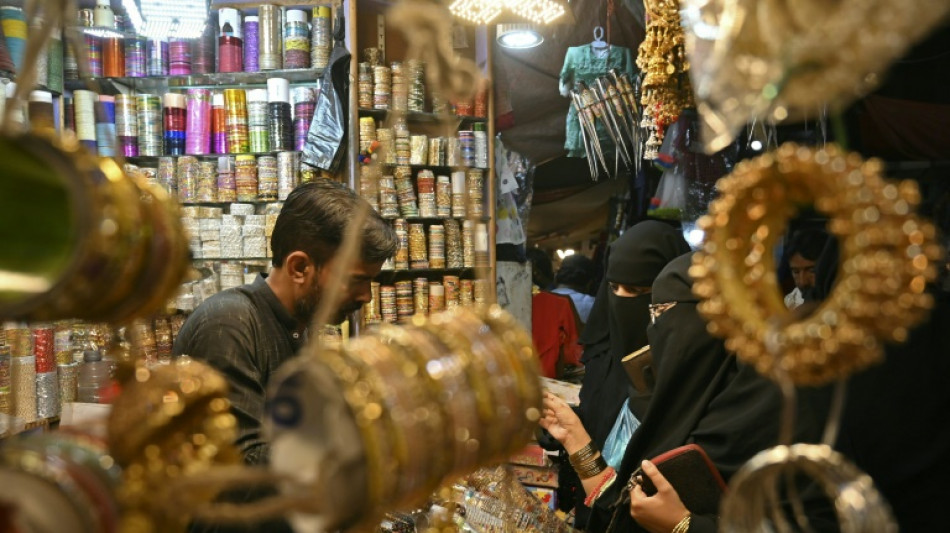
Pakistan's delicate Eid bangles go from furnace to forearms / Photo: Asif HASSAN - AFP
 Asian Games set to close after records, rancour and rain
 Cry for help as French-Swiss lake dries up

 Sabalenka swept out of China Open in third round

 US urges 'restraint' as Ethiopia's Tigray crisis rocks region

 Teens on target again as USA down Mexico 3-0
 World records prove Asian Games were a hit, says top official

 US prison chief who oversaw botched execution resigns

 'Chaotic' Asian Games threaten Japan hopes of hosting Olympics again
 Finnish town braces for change from Google data centres
 What is fuelling French school protests?

 Without lawyers, migrant children face deportation from the US
 Three-peat seeking Dodgers open playoffs with a win, Rays hold off Yankees
 Brazil votes in nail-biter polls closely watched by Trump
 'Just be you': Kim reveals Tiger text that inspired him to gold

 Myanmar migrants returned to war-torn nation from Malaysia
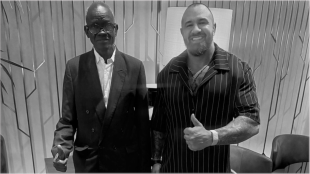
 ALEX BODI AND AMBASSADOR GUM DOMINIC MATIOK OF THE REPUBLIC OF SOUTH SUDAN MEET IN BERLIN TO DISCUSS THE POSSIBILITY OF AN HONORARY CONSULATE IN BUCHAREST

 Lula, Bolsonaro wrap up campaigns ahead of Brazil's knife-edge vote

 Toulouse edge Castres in Top 14 derby

 Murakami homer propels White Sox to MLB playoff win over Guardians

 Israel targets top Hamas leader in deadly Gaza strike on anniversary
 Houthis say struck oil facility near Riyadh, as Saudis hit Sanaa

 AI needs safety layers like nuclear plants: ex-OpenAI engineer

 MVP Judge will miss Yankees' MLB playoff series against Rays
 New lizard species discovered in Peru

 Fernandes hails Portugal's 'greatest symbol' Ronaldo, calls for unity
Layers of intricately decorated bangles are a staple fashion accessory for women in Pakistan, a carefully considered part of their Islamic Eid-al-Fitr celebrations.
More than a dozen people can be involved in the making of a single bangle, from sweltering factories to the homes of designers who skilfully decorate them by hand.
"Whatever the fashion trends, when we attend any event and wear any outfit it feels incomplete without bangles," said 42-year-old Talat Zahid, who uses beads, stitching and embroidery to embellish bangles.
"Even if you don't wear jewellery but wear bangles or a bracelet with your outfit, the outfit looks complete."
In the lead-up to this week's Eid-al-Fitr festivities that mark the end of Ramadan, market stalls are adorned with a glittering array of colourful bangles, each turned over and inspected for their beauty and imperfections by women who haggle for a good price.
They are often sold by the dozen, starting at around 150 rupees (about 50 cents) and rising to 1,000 rupees as stones and silk are added.
Hyderabad is home to the delicate "churi" glass bangle, where a single furnace can produce up to 100 bangles an hour from molten glass wire shaped around an iron rod.
The work is arduous and frustrating –- labourers are exposed to oppressive temperatures in unregulated factories prone to frequent power cuts, while the fragile glass threads can snap easily.
"The work is done without a fan. If we turn on the fan the fire is extinguished. So the heat intensity is high. As it becomes hotter our work slows down," said 24-year-old Sameer, who followed his father into the industry and earns less than the minimum wage of 32,000 rupees ($115) a month.
After the partition of British-ruled India in 1947, migrating Muslims who had produced bangles in the Indian city of Firozabad took their trade to Hyderabad –- where hundreds of thousands of people rely on the industry.
But soaring gas prices after the government slashed subsidies have forced many factories to close or to operate at reduced hours.
"The speed at which the government has increased the gas prices and taxes, (means) the work in this area has started to shrink instead of expand," said 50-year-old factory owner Muhammad Nafees.
Most bangles leave the factory as plain loops, sent off to be embellished to different degrees by women who work from home, before they're finally passed on to traders to be sold in markets.
The production is often a family affair.
Saima Bibi, 25, works from home, carefully adding stones to bangles with the help of her three children when they return from school, while her husband works at the furnaces.
"They go through a lot of hands to be prepared," she said.
Y.Aukaiv--AMWN