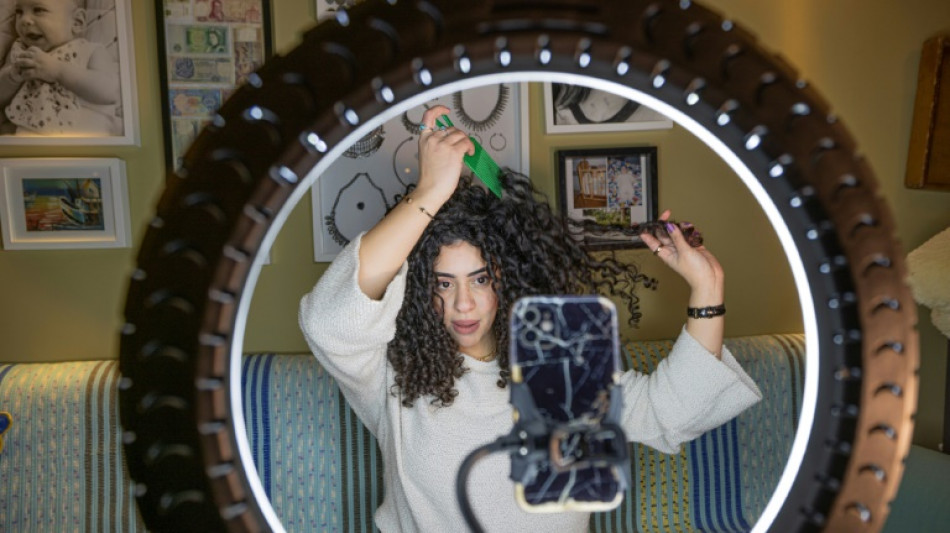
Get this straight: Curls bounce back in Cairo
/ Photo: Khaled DESOUKI - AFP
 South Korea score late to reach Asian Games football final
 Tom Kim defies jet-lag, Kho cards ace as Asian Games golf begins

 Thai teen rocker Nene aims to tour, write music... and return to school

 Ivory Coast clamps down on harmful illegal gold rush

 Nagoya mayor says sorry for Asian Games 'inconveniences'

 G20 trade officials meet under shadow of tariffs, overcapacity

 India's fat dog vote goes viral
 Asian Games crowds in spotlight as 998 see hosts in 50,000 stadium

 The eight stadiums for the 2027 Rugby World Cup

 Thieves swipe drugs under nose of Fiji police, swap with flour
 South Korea demands North apologise for DMZ mine blasts

 In Nepal's flood zone, teachers mourn students who never returned
 US Supreme Court lifts limits on third-country deportations

 Antonelli eager to 're-establish order' as F1 returns to Malaysia

 Paw-fect candidate: Australia finds new koala rescue dog

 One third of world population exposed to harmful air pollution: monitor

 North Korea denies South's claim it was apparently behind DMZ mine blasts

 West Bank's violent settlers part of a new generation fuelled by ideology
 US-led coalition ends mission in Iraq
 Pope-backed White Sox join Braves with MLB playoff wins

 Psychology Software Tools Builds on Early Bioz Success to Expand Access to Publication-Backed Product Evidence

 Alpha Growth Management Opens Rep Office in Japan
 NBA close to picking new $12-13bn Vegas team owners: report

 LA28 Olympics torch relay to visit all 50 states
 Spain brush aside Croatia in Nations League, England down Czechs

"Shaggy," "messy," "unprofessional". Natural curls were once looked down upon in Egypt, where Western beauty standards favoured sleek, straight locks. Now, things are changing.
For Rola Amer and Sara Safwat, their curls were once a career-hindering nuisance. Now part of an aesthetic liberation movement sweeping Egypt in recent years, they own a curly hair salon that caters to women and men like them.
Amer used to spend hours straightening her bouncy curls, she told AFP as she began her day at the Curly Studio, which became Egypt's first natural hair salon in 2018.
"Curly hair takes a lot longer to cut than straight hair," Amer said, meticulously snipping her way through a client's curly mane in an affluent suburb of Cairo.
Three hours later, she can finally show the result to her client, and both are delighted as the salon buzzes around them.
It's a far cry from Amer's own experience a few years ago. "If I ever left my hair curly, I'd feel shaggy, like I wasn't taking care of myself," she said.
In this rare type of salon in Cairo, the final product fits each client's curl pattern, and rollers have replaced straightening irons to prevent heat damage.
Safwat, 38, explained the dangers of straightening, adjusting her curly bangs as she spoke.
"One time, a mother brought her three-year-old daughter. She had tried a chemical treatment to straighten her hair, and now it was falling out," she said.
The obsession with straight hair, rooted in what Safwat calls "completely false beauty ideals," compelled generations of women to burn their hair to a crisp using chemical treatments and excessive heat damage.
- A marked change -
With her curls considered "unprofessional" Safwat says that, before she became a hairdresser, she would often be asked in job interviews: "Will you be coming in to work like this?"
In the early 2000s, Lebanese singer Myriam Fares was one of the first curly-haired icons in the Middle East.
Halfway across the world, Black women in the United States were increasingly embracing their curls in a natural hair care movement. Many of the biggest brands built by Black women at the time would eventually find their way onto the shelves of curly salons in Cairo.
In 2012, Egyptian actress Dina el-Sherbiny became one of the first to break the taboo on screen, flaunting her chestnut curls in hit TV series "Hekayat Banat" (Girls' Stories).
Ten years later, curly heads feature in TV shows, movies and the billboards that line Cairo's highways, a marked change in pop culture.
In Hollywood, Egyptian-Palestinian actress May Calamawy even shows off her curls in Marvel's latest series, "Moon Knight," helmed by Egyptian director Mohamed Diab.
"There has been a real social movement," Doaa Gawish told AFP. In 2016, Gawish launched a Facebook group called The Hair Addict to help women give their hair a break from harsh chemicals and blow dryers.
Within months, the online forum had grown from 5,000 to more than 80,000 members, as the local cosmetics market grew by 18 percent, according to Euromonitor International.
Two years later, Gawish launched her eponymous haircare company.
"A lot of big cosmetics companies started releasing products for curly hair, because they could see it was an essential customer base," Gawish told AFP.
This base is steadily growing in Egypt's sizable cosmetics market. With a population of 103 million, the country has about 500,000 salons and more than three million employees, as estimated in 2020 by Mahmoud el-Degwy, head of the hairdressers' division at the Cairo Chamber of Commerce.
Teacher and natural hair influencer Mariam Ashraf has seen the market's potential firsthand. Only a hobby at first, her Instagram videos quickly became "a real source of income", she told AFP before filming a new clip for her 90,000-plus followers.
"Brands are contacting me more and more to showcase curly hair products," the 26-year-old explained. "And now modelling agencies are contacting me for advertisements."
- 'Fragile masculinity' -
But the world of natural hair care is not accessible to everyone.
While the average monthly income in Egypt is 6,000 pounds ($325), a haircut at the Curly Studio can cost up to one-tenth of that.
Since he inadvertently discovered his curls during Covid-19 lockdown, cybersecurity expert Omar Rahim has been gladly paying to maintain his style.
Today, he maintains an intricate regimen, despite jeers from his friends in a conservative and patriarchal society.
"We have a problem with fragile masculinity; people think a man shouldn't take care of his hair or buy products," he told AFP.
"I want people to understand that this is normal, but I'm not ready to fight this fight just yet."
A.Mahlangu--AMWN