World's oldest artwork discovered in Indonesian cave / Photo: - - GRIFFITH UNIVERSITY/AFP
 'Act before it's too late': Tokyo residents fight for more trees

 'Disappointing' as South Korea flag mishap sees Games end on sour note

 Pre-COP host Tuvalu at frontline of climate change

 Hungary's dwindling paprika producers battle to save signature spice

 Cornell president vows review in wake of alleged student gang rape

 Latvian partial election results suggest pro-European choice

 In Egypt's Sinai, Gazan builds school for children displaced by war

 Trump tariffs a mixed bag for US auto industry

 Yemen government forces say struck Houthi targets

 Music links past, present for Pedro Pascal's cellist in 'Behemoth!'

 ALEX BODI ȘI AMBASADORUL REPUBLICII SUDANUL DE SUD, GUM DOMINIC MATIOK, DISCUTĂ LA BERLIN DESPRE POSIBILITATEA ÎNFIINȚĂRII UNUI CONSULAT ONORIFIC LA BUCUREȘTI

 Dodgers step up World Series three-peat bid with 5-3 win over Braves

 Spain break down Czechs as England outclass Croatia in Nations League

 Yamal on target as Spain hold off Czech Republic

 Latvian exit polls suggest pro-European choice

 Lula, Bolsonaro wrap up campaigns ahead of knife-edge election

 Tuchel hails 'complete' England after Croatia demolition

 Fury to invite Trump to lead ring walk before Joshua showdown

 Fashion industry in 'precarious moment', says Vivienne Westwood supremo

 Seventh heaven for England in Nations League rout of Croatia

 Storms, flooding cause chaos on Greek holiday island of Crete

 #IAmJaneDoe: online support campaign in US university rape case

 Brazil shine on Selecao's first visit to India

 Zverev sets up Djokovic quarter-final at China Open, Rybakina out

 Happier at home, Bordeaux hammer Lyon in Top 14

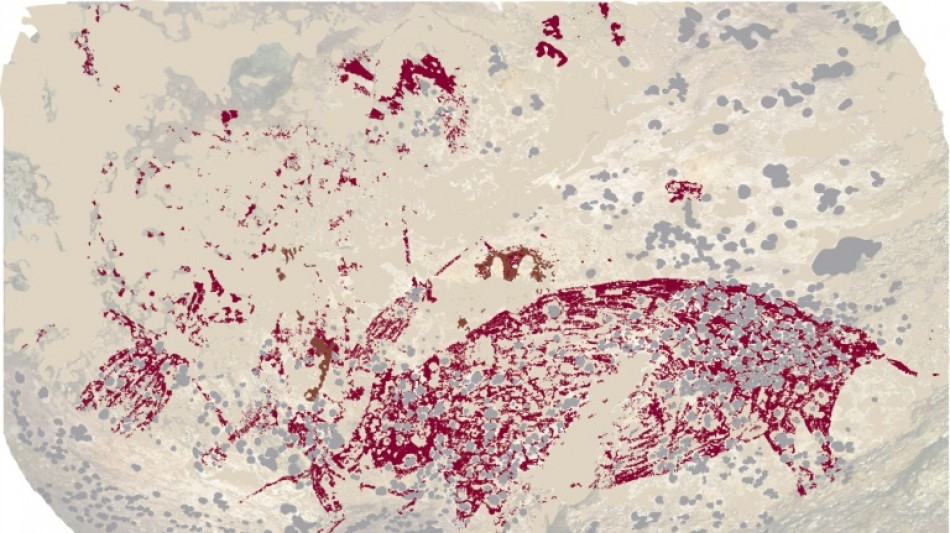
It may not look like much -- just a flaking image of three people around a big red pig.
But the humble cave painting discovered in Indonesia is the oldest known narrative artwork ever made by human hands, dating back more than 51,000 years, new research said on Wednesday.
"This is the oldest evidence of storytelling," Maxime Aubert, an archaeologist at Australia's Griffith University, told AFP.
Aubert was part of the team that identified the previous record holder in 2019, a hunting scene found in a nearby Indonesian cave then estimated to be nearly 44,000 years old.
The latest discovery, which was dated using a new laser technique, marks "the first time we've passed the 50,000-year barrier," said Aubert, a co-author of a new study in Nature describing the find.
That early humans were able to tell such a "sophisticated" story through art could rewrite our understanding of human cognitive evolution, he added.
"Our discovery suggests that storytelling was a much older part of human history... than previously thought," study co-author archaeologist Adam Brumm told a press conference.
- New laser dating -
For the discovery, the researchers used a new method that uses lasers and computer software to create a "map" of rock samples.
This laser ablation technique is more precise, easier, quicker, cheaper, and requires much smaller rock samples than the previous uranium series method, Aubert said.
The team first tested the new technique on the previous record holder.
It determined that the hunting scene was actually at least 48,000 years old -- 4,000 years older than the uranium series method determined in 2019.
The team then tried the laser method out on a previously undated painting first spotted in a cave on Indonesia's Sulawesi island in 2017.
It was found to to be least 51,200 years old, smashing the previous record.
The painting, which is in poor condition, shows three people around a wild pig.
"We don't know exactly what they're doing," Aubert admitted.
He speculated that the paintings were likely made by the first group of humans who moved through Southeast Asia before arriving in Australia around 65,000 years ago.
"It's probably just a matter of time before we find samples that are older," Aubert added.
- Art gap mystery -
Humans first evolved in Africa more than 300,000 years ago.
The first images known to have been made by humans are simple lines and patterns made in ochre found in South Africa dating back 100,000 years.
But then there is a "huge gap" in human art until the Indonesian cave paintings 50,000 years later, Aubert said.
"The question is, why is it not everywhere?"
One theory is that artwork elsewhere did not survive all those millennia. Another is that ancient art could still be out there waiting to be discovered.
Previously the first narrative art was thought to have emerged in Europe. A "lion man" statue found in Germany has been dated to around 40,000 years ago.
The date given for the Indonesian cave art is "quite provocative" because it is so much older than what has been found elsewhere, including in Europe, said Chris Stringer, an anthropologist at London's Natural History Museum.
Stringer, who was not involved in the research, said the experienced team's findings looked sound but needed to be confirmed by further dating.
"In my view this find reinforces the idea that representational art was first produced in Africa, before 50,000 years ago, and the concept spread as our species spread," he told AFP.
"If that is true, much new supporting evidence from other areas including Africa has yet to emerge..."
P.Martin--AMWN