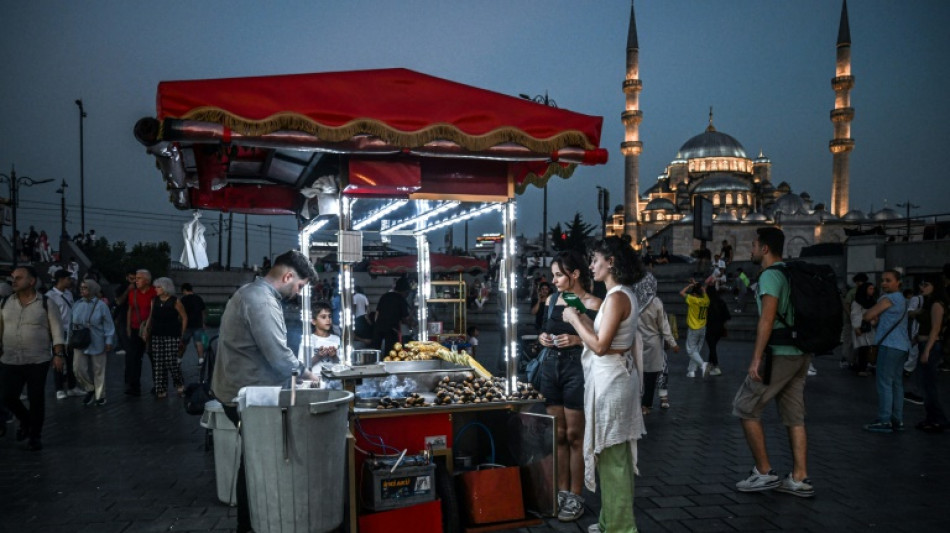
Hungry times for Istanbul's street food sellers / Photo: Ozan KOSE - AFP
 Lula, Bolsonaro wrap up campaigns ahead of Brazil's knife-edge vote

 Toulouse edge Castres in Top 14 derby

 Murakami homer propels White Sox to MLB playoff win over Guardians

 Israel targets top Hamas leader in deadly Gaza strike on anniversary

 Houthis say struck oil facility near Riyadh, as Saudis hit Sanaa

 AI needs safety layers like nuclear plants: ex-OpenAI engineer

 MVP Judge will miss Yankees' MLB playoff series against Rays

 New lizard species discovered in Peru

 Fernandes hails Portugal's 'greatest symbol' Ronaldo, calls for unity

 Grandidier-Nkanang double takes Pau to Top 14 summit despite Vannes fightback
 Trainer Scott gets perfect Arc boost with top notch double

 Ex-PM says Putin cannot admit 'mistake' over Ukraine

 Houthis say Saudi Arabia launches dozens of strikes on Yemen capital

 Qatar and Abu Dhabi F1 Grand Prix to go ahead - F1 boss

 South Korea lift gloom with smash-and-grab Games football gold

 Ireland news conference before Israel game cut short amid tensions
 Protests over housing flare in Spain after relief measures rejected

 Zverev thrashes Shang to set up Djokovic quarter-final at China Open

 Turkey football ref chief jailed pending trial for graft

 North Korea says test of intermediate-range strategic missile included use of AI

 Rampant Sayers leads Hong Kong to third men's rugby gold in a row

 Ethiopia's Tigray rebels abandon regional capital as govt advances

 Bulgaria's Tsar Samuel returns 'home' after 1,000 years

 'Glad it's over': Kim powers to Games gold and military exemption

 After 11 World Cups, football finally comes home for one Indian fan

The enticing smell of grilled corn and chestnuts wafted from Hakan Deniz's red and gold food cart near a mosque in Istanbul's old city. But local customers are hard to come by these days.
With Turkey mired in sky-high inflation, Istanbul's ubiquitous street vendors, who have been part of the cityscape since the Ottoman Empire, are worried about their future.
"Our tomorrows are uncertain," said Deniz, 18, after pushing his cart past the Rustem Pasha mosque.
"I have lost almost half of my customers because of inflation," Deniz said as he weighed and handed a bag of chestnuts to an American tourist.
He wondered aloud if vendors like him would "still exist in the future".
Inflation rose across the world after the Covid pandemic and soared further after Russia invaded Ukraine in 2022, but it has been particularly bad in Turkey.
Officially, it rocketed to 85 percent in October 2022 before slowing and rising again to reach 75 percent in May this year. Inflation has since fallen, with data on Tuesday showing it at 52 percent in August.
- 'Ottoman tradition' -
The streets of Istanbul, a metropolis of 16 million people, would not be the same without its street vendors.
At night, mobile stalls with bright neon signs form constellations of light along the picturesque city's streets.
They fill the air with an array of smells -- from stuffed mussels to simit, rings of delicious sesame-encrusted bread.
The merchants enjoy a "positive image" in general, said Osman Sirkeci, a researcher at the Izmir University of Economics.
Some, such as sellers of the sweet toffee paste known as macun, are seen as heirs of an "Ottoman tradition", Sirkeci said.
Their ranks grew after the Covid pandemic, with one million people becoming street vendors, the researcher said.
Turkey now counts seven million street vendors, working legally or illegally, he said.
Inflation, however, has hit professions already known for low wages and small margins very hard.
"The expenses of mobile merchants are much lower than those of traditional shops because they don't have rent or electricity bills to pay," Sirkeci said.
But they have other high costs such as raw materials that they get from intermediaries who pass on the cost of inflation, instead of buying them directly from producers.
"The price of sesame has skyrocketed. Same for flour. Everything is too expensive," said Nuri Geyik, a 54-year-old simit seller.
He used to sell his bread for one lira a piece a few years ago.
"Now I'm forced to sell them for 15 lira," he said.
Mithat Atilgan sells fruits and vegetables that are grown in Bursa, a region around 150 kilometres (90 miles) south of Istanbul.
"The cost of transport has also increased," Atilgan said.
"Sales are bad," he added, noting that Turkish customers cannot keep up with the price increases.
"Only the rich can buy my fruits today," said Atilgan, who sells figs from his cart.
- 'I'm ashamed' -
Mustafa Demir wondered for how much longer his usual Turkish customers would buy his jars of pickles.
"I'm ashamed of selling the jars for 40 liras to my loyal customers," he said, recalling how he used to sell them for 15 cents.
Deniz said his customers were mostly Turkish in the past.
"It's not the case anymore. Now 70 percent are tourists," Deniz admitted.
While Sirkeci, the researcher, believes that street vendors will survive, Deniz is not so sure.
"This job will disappear," he said. "Look at the sellers of boza (a fermented cereal drink). There are almost none of them left in Istanbul."
A.Jones--AMWN