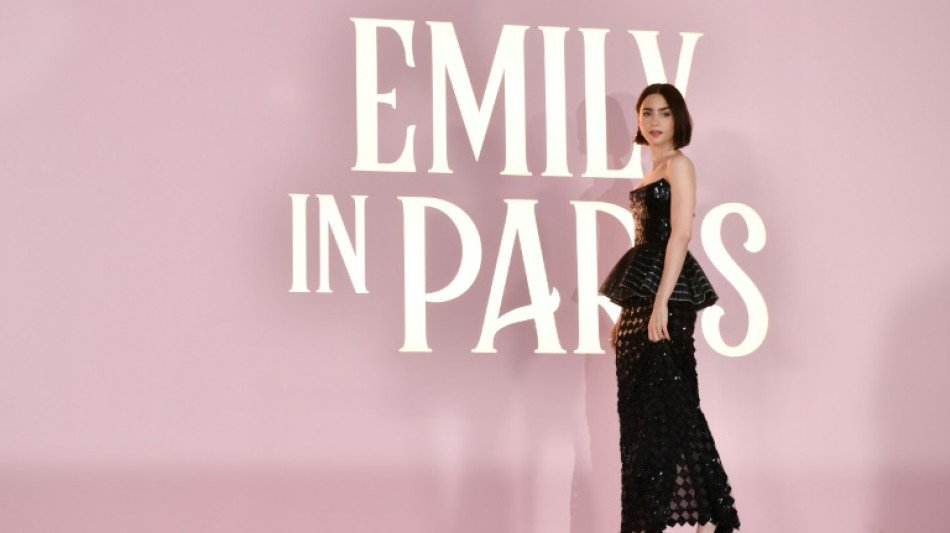
'Emily in Paris' spotlights designer looks with product placement / Photo: Valerie Macon - AFP
 Review: Fly, You Fools! Delivers Fast-Paced Lord of the Rings Parody at Southwark Playhouse

 Netanyahu Proposes Rotating Premiership to Eisenkot Amid Coalition Talks
 Gold Falls 35% and Silver Crashes 65% as Macro Drivers Shift

 Belgian Cyclist Robrecht Viaene in ICU After Training Crash in Spain

 Executive Health Edge Partners With EndlessDX on a 94-Result At-Home Blood Panel
 Author Reflects on Loss of Two Close Friends, Urges Kindness Before It Is Too Late
 Aaron Rodgers Holds $15M Price Tag on Jersey Estate Despite Unemployment

From Google and Samsung to LVMH, AMI, Jacquemus and even Lidl, brands galore take centre stage in the latest season of Netflix hit series "Emily in Paris", outshining its plot and characters.
The US streaming giant has teamed up with Google to redirect viewers, using its Lens tool, to a website selling every outfit worn by the protagonists simply by photographing the screen.
With clicks spiking, Netflix is cashing in on commissions and a "next-level kind of engagement", the firm said in a statement.
Emily Cooper, the series' ditzy American heroine who relocates to Paris from Chicago to work for fictional luxury marketing agency "Savoir", is conveniently tasked in the show with developing innovative partnerships for real brands.
Such practices are restricted by French law regulating product placement and surreptitious advertising in film and television productions -- but that legislation does not apply to streaming content.
"This way of working is new, for us French people, but it is common in American markets where brands are integrated very early on, from scriptwriting, and where advertisers put down significant amounts" of cash, Jean-Dominique Bourgeois, who heads a French agency dedicated to product placement, told AFP.
Bourgois, whose firm Place to Be Media developed the partnership between "Emily in Paris" and McDonald's in season three, says companies have budgets ranging from 500,000 to one million euros (between $550,850 and $1.1 million) for a "scripted placement".
"It's a good deal for brands that would spend a lot more for a multi-country campaign," he said.
- New clients -
Second-hand designer clothing platform Vestiaire Collective paid for a few minutes of fame when Emily's best friend Mindy -- supposedly broke -- sold pieces from her designer wardrobe in a detailed scene.
The French company, contacted by AFP, did not reveal the cost of the deal but said it aimed to boost its brand's reputation, targeting growth in the US, which makes up 20 percent of its sales.
The fashion firm, which offers 900 reference pieces inspired by Emily's wardrobe, has recorded an increase in new clients, sellers and buyers.
Emily's ever-more extravagant looks across four seasons are nevertheless high-selling hits.
Memorable clothes include a passe Kangol bucket hat in the first season, a plethora of bright yellow looks and berets in the second season, as well as a masquerade ball striped suit and Mindy's fuzzy blue hat in season four.
- Making 'eyes bleed' -
The programme's costume designer Marilyn Fitoussi, who says she makes "eyes bleed" with her bold fashion choices, has turned Emily's wardrobe into a character in its own right.
"I am often called up by brands whose visibility has slightly declined or that are looking to reach different, younger customers," Fitoussi told French financial newspaper Les Echos.
The designer pointed out that the first season's limited budget meant she had to dress the protagonist only in second-hand and vintage clothing.
"I don't get paid by brands and I don't want to be," she said.
Since then, fashion magazines have picked apart each and every attire as they would a runway show -- with every branded scene, displaying a Louis Vuitton belt or Emily's running gear, carefully shot.
"Watching the series gives you the troubling impression of wandering around a massive mall," GQ journalist Adam Sanchez told AFP.
The culture and cinema reporter says the practice "has amped up insanely" in the most recent season, with four product placements in the first four minutes of episode one.
But viewers know what to expect, Sanchez says -- and they are asking for more.
"It is a particular kind of viewing experience," he said.
"They don't really come for the plot, which is minimal, as much as for what Emily is wearing and consuming."
M.Thompson--AMWN