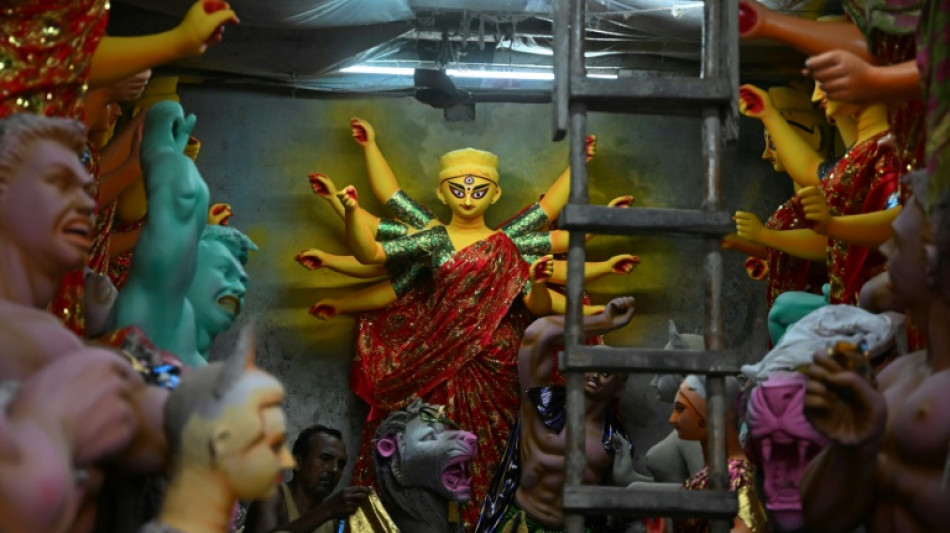
Sacred filth offers India's sex workers brief respect / Photo: Dibyangshu SARKAR - AFP
 Tuchel hails 'complete' England after Croatia demolition

 Fury to invite Trump to lead ring walk before Joshua showdown

 Fashion industry in 'precarious moment', says Vivienne Westwood supremo

 Seventh heaven for England in Nations League rout of Croatia

 Storms, flooding cause chaos on Greek holiday island of Crete

 #IAmJaneDoe: online support campaign in US university rape case

 Brazil shine on Selecao's first visit to India

 Zverev sets up Djokovic quarter-final at China Open, Rybakina out
 Happier at home, Bordeaux hammer Lyon in Top 14

 Lula, Bolsonaro in final push for votes ahead of knife-edge election

 Boisterous fashion week barnstorms 'sleepy' Nigerian capital

 UAE investigators say flydubai co-pilot was planning 'terrorist act'

 Rahul smacks century in India v Windies ODI

 Daryz seeks to join exclusive club of dual Arc winners

 Russia warns diplomats to leave Kyiv over new strikes threat

 Olympic champ Zheng rebukes rowdy home crowd at China Open

 World No.1 Sinner pulls out of Shanghai Masters to delay return

 Red Bull's Verstappen grabs pole position for Bahrain GP

 India beat Pakistan in blockbuster as golfer Kim wins 'crazy' gold

 India beat arch-rivals Pakistan to win Asian Games cricket gold

 Ethiopia's Tigray rebels abandon regional capital as govt advances: journalist

 Tom Kim powers to Games gold and exemption from military service

 Split loyalties for Indian football fans at Brazil friendly

 India-Pakistan blockbuster brings cricket fever to Japan baseball field

 Wong waiting on Rafa after winning Asian Games tennis gold

Every year in India's megacity Kolkata, the world's oldest trade gets fleeting respect from an ancient custom -- when soil outside brothels is considered sacred and collected for Hindu rituals.
Those working in the eastern port city's ever-busy red light district say the coveted earth is a bitter reflection of society's discriminatory attitudes -- desired when needed, downtrodden filth when not.
The doorstep dirt is seen as holy by Hindu devotees, who believe it is imbued with special qualities because it is where men leave behind all that is good before entering for sex.
This scooped-up soil is included in clay to make brightly-coloured idols of the beloved goddess Durga, or used to give an earth "bath" of the statues made for the festival.
Sex worker Salima, a lady in her thirties working in Kolkata's Sonagachi red light district, is angered at the dirt-gathering tradition.
In the eyes of society, she is seen as having "no dignity", said Salima, not her real name.
Gathering the soil is part of the celebrations for Durga Puja, the biggest festival in the eastern state of West Bengal, with celebrations this year beginning in October.
"When you want the soil from my hand, you suddenly respect me," she said.
"What kind of a rule is this?"
A spokeswoman for sex worker association Durbar Mahila Samanwaya Committee said its members tried to stop artisans from taking the soil.
- 'Not the dark side' -
The week-long festival celebrates the victory of Durga -- a powerful multi-armed goddess often depicted riding a lion, revered as a protective mother -- over a demon.
"The men who enter the sex worker's house leave all the good in them at her doorstep," said Jayanta Kushary, 64, founder of the Sarva Bharatiya Prachya Vidya Academy, which teaches Indian culture.
"That is why that soil from outside the sex worker's house is considered holy."
Kushary said the soil should be used to "wash" idols.
But families in Kolkata also use the soil to make idols themselves, which are venerated before being immersed into the holy River Ganges at the festival's culmination.
Samar Dutt's family has used the soil both for idols and holy baths for more than a century -- and he for one decries how sex workers are often shunned and looked down on.
"They are not the dark side of society," he said. "They are equal with other people."
Dutt said modern construction with concrete and tarmac roads meant that sometimes finding a good place to collect the soil was hard.
So artists have found a solution.
"The sex worker goes to take a bath in the Ganges, and gets soil from there," he said.
"Then she keeps it outside her house, from where it is collected."
- 'Social worker' -
Kushary insisted that it was important for the society to respect sex workers.
"They are very, very important to our society," he said. "The sex worker is a social worker."
The Hindu festival is a busy time in the red light zone.
Soliciting for sex is illegal, but workers say police often turn a blind eye in exchange for cash.
But the sex workers say none of the men collecting dirt have invited them to join a Durga Puja celebration.
"They don't even recognise us," said Pushpa, whose name has been changed to protect her identity, adding the men "look at us with disgust".
"The women think we will snatch their husbands if we talk to them," she said. "But we have no such thoughts in our mind."
Salima said her family has little idea how she earns her living, work she turned to because she had no alternative.
"We don't like doing this work," Salima said.
"When the men come, they ask us to do many things. They say they won't use a condom, that they don't like it. Helpless, we say 'okay', but we don't feel right."
P.Mathewson--AMWN