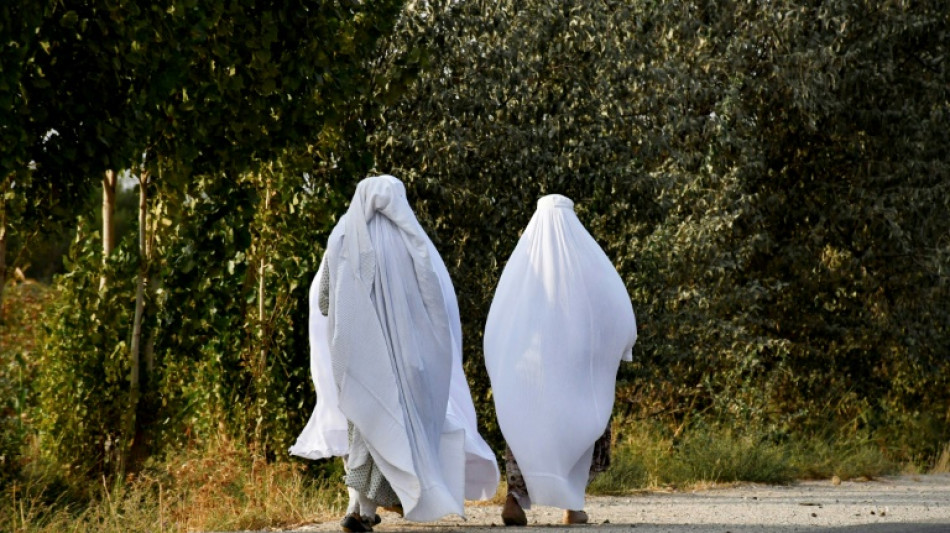
Paris show spotlights Afghan women who 'lost hope' / Photo: Atif Aryan - AFP
 Lula, Bolsonaro in final push for votes ahead of knife-edge election

 Boisterous fashion week barnstorms 'sleepy' Nigerian capital

 UAE investigators say flydubai co-pilot was planning 'terrorist act'

 Rahul smacks century in India v Windies ODI

 Daryz seeks to join exclusive club of dual Arc winners

 Russia warns diplomats to leave Kyiv over new strikes threat
 Olympic champ Zheng rebukes rowdy home crowd at China Open

 World No.1 Sinner pulls out of Shanghai Masters to delay return
 Red Bull's Verstappen grabs pole position for Bahrain GP

 India beat Pakistan in blockbuster as golfer Kim wins 'crazy' gold

 India beat arch-rivals Pakistan to win Asian Games cricket gold

 Ethiopia's Tigray rebels abandon regional capital as govt advances: journalist

 Tom Kim powers to Games gold and exemption from military service

 Split loyalties for Indian football fans at Brazil friendly

 India-Pakistan blockbuster brings cricket fever to Japan baseball field
 Wong waiting on Rafa after winning Asian Games tennis gold
 With Russia next door and rising costs, Latvia goes to the polls

 Penalty hero rues empty seats as Games hosts Japan win football gold
 North Korea fires ballistic missile after Seoul's apology demand

 US regulator finds Boeing 737 MAX software bug 'not a safety concern'

 Ohtani 'managing' injuries as Dodgers launch MLB post-season
 New "What Is a Gold IRA?" Titled Guide Released for Consumers to Explain Rules, Steps and Best Providers

 Botched US execution leaves murderer unconscious on ventilator: lawyers
 Cornell rape case exposes sexual violence at US colleges
 France held by Italy in Zidane's homecoming after Olise stunner

Posing in a pink hijab in front of a window, 14-year-old Muska will soon be married "in exchange for a well and some solar panels", explains the caption on her photograph.
There are dozens of images of Afghan women and girls like Muska at the Paris exhibition "No Woman's Land", which offers a glimpse into their private lives, despair and rare moments of joy.
Iranian-Canadian photographer Kiana Hayeri, 36, lived in Kabul for seven years and has regularly contributed to outlets including the New York Times and National Geographic.
Many tough stories are told in the exhibition but Hayeri said her feelings had been worsened by the changes in Afghanistan during the six months she worked on the project.
"Some of the women that, even two and a half years into Taliban's returning to power, were still trying to do things and making it happen... well they also lost hope," she added.
The photographer worked with French researcher Melissa Cornet, 32, to interview over 100 women and girls in seven Afghan provinces.
"One of the questions we asked the women was: '"Do you have any hope that your situation can improve under the Taliban?'," said Cornet, a lawyer who lived in Kabul for over two years until the hardliners reclaimed Kabul.
"And almost systematically the answer was no."
- 'Locked up' -
The Taliban have established what the UN has called "gender apartheid" since taking power in August 2021.
Women have been barred from education beyond primary school, visiting parks, gyms and beauty salons, or even going outside at almost any time without a chaperone.
One recent measure -- following a hyper-strict interpretation of Islamic law like the others -- even forbids women from speaking loudly in public.
For now, "there's barely any light at the end of the tunnel," Hayeri said.
Cornet said the haphazard layout of the exhibition, running until November 18 at the Refectoire des Cordeliers in Paris, recalls "how confined (Afghan women) now are to these interior spaces," Cornet said.
"All of the women we met, except for a couple of encounters, it happened in their homes or at our home for security reasons, because there's just no third places where we could safely meet," she added.
Some photos show women or teenagers smiling, dancing or celebrating a birthday indoors.
Such moments claim "their right to joy, to freedom and to the celebration of their femininity," one caption reads.
- 'Change nothing' -
Other pictures focus on silent acts of resistance, such as study in underground schools.
Most photos simply show how tragic everyday life can be for Afghan women.
In one, two cupped hands hold a ring belonging to Halima, who is "holding the wedding band of her husband, who died of a heart attack the day of his release from jail for activism," the caption explains.
The portrait of Muska shows a girl recently expelled with her family from Pakistan, where she was born.
"Because her family is struggling financially, they accepted the marriage offer from the son of the landlord," Cornet said.
Muska was effectively sold for "a well and solar panels... the equivalent of probably $300-$400," she added.
Hayeri and Cornet's knowledge of Afghanistan and their contacts allowed them to secure the poignant photos. Hayeri said she felt "heartbroken and helpless".
"How's it going to change anything?," she asked.
"We know exactly how the situation is... it's just that there's no political will right now to do more to help them in Afghanistan, but also to help them leave Afghanistan and be welcome in Europe or in the US," Cornet added.
The NATO coalition that fought a Taliban insurgency for 20 years before withdrawing in 2021 highlighted women's rights as one of its major causes.
Critics say that has now been forgotten. "We just don't talk enough about the responsibility we have" to Afghan women, Cornet said.
Y.Kobayashi--AMWN