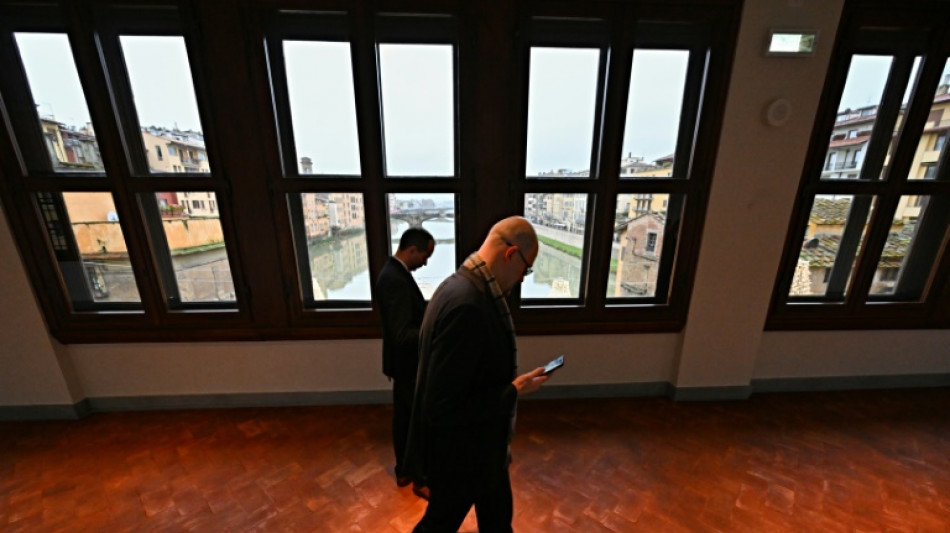
Medici secret passageway in Florence reopens after refit / Photo: Andreas SOLARO - AFP
 Durosinmi and Isah Combine for 13 Goals in Belgian Pro League Spotlight
 Jadee Rohner on Cotton’s Resilience in an Always Changing Arizona

 ALIX LASERS GERMANY TAKES OVER CUSTOMER CARE FOR ALL ALIX LASERS AUSTRIA CUSTOMERS

 Hong Kong Court Orders Activist Eddie Tse to Pay Legal Fees After Dropped Challenge

 Nvidia’s Board Fails Governance Standards Amid Jensen Huang Reinstatement

 ANC’s Adolph Marema Frontrunner for Johannesburg Council Speaker in Coalition Deal

 9th Circuit Court Orders Review of FBI Files in Hawaii Bribery Cases

 Kauaʻi Mayor-Elect Mel Rapozo Prioritizes Infrastructure and Waste Management
A secret passageway built 500 years ago to allow the Medici family to pass through the Italian city of Florence unhindered reopens to the public Saturday after an 10-million-euro restoration.
The Vasari Corridor, which is more than 700 metres (nearly half a mile) long and runs above the famous Ponte Vecchio, has been closed for eight years.
Designed in 1565 by Giorgio Vasari, a commission by Duke Cosimo I to mark his son's wedding, the corridor begins at what is now the Uffizi Galleries and ends up in the Pitti Palace across the Arno river.
Its 73 windows offer unrivalled views over the city centre, a UNESCO World Heritage site, and will now finally be accessible to the general public.
It had since the 1970s held the large collection of the Uffizi's self-portraits, but was closed in 2016 to allow for upgrades to meet modern safety standards.
"Now restored to its original simplicity, the corridor presents itself to visitors as a plain 'aerial tunnel'," the Uffizi said in a statement on Friday.
It passes above the heart of the city, "just as it appeared when the Florentine rulers used it for quick, safe, and uninterrupted passage between their residence and the seat of government".
The works, which began in 2022, include new disability access, emergency exits, toilets, energy-efficient LED lighting and video surveillance.
"After an eight-year wait, the reopening of the Vasari Corridor returns a masterpiece within a masterpiece to Florence and Italy," Italian Culture Minister Alessandro Giuli said.
L.Miller--AMWN