Experts warn 'AI-written' paper is latest spin on climate change denial / Photo: Lionel BONAVENTURE - AFP
 Samsung Galaxy S27 Series Camera Design Leaked via Lens Protectors

 French Economy Shrinks 0.1% as Consumer Confidence Slumps

 Wall Street Ends Turbulent Week Higher Despite Inflation and AI Jitters

 Kansas City Fed Chief Says Inflation Is Still Running Too Hot

 Asian Markets Slide as AI Concerns Hit Chip Stocks

 Canada Signals Openness to Chinese Automakers if US Trade Talks Fail

 Canada Expands Asian Trade Push as US Negotiations Resume

 US Jobless Claims Rise to 200,000 but Layoffs Remain Historically Low

 Italy Raises 2026 Growth View but Warns Energy Will Keep Inflation High

 UK Economy Grows 0.7% in Third Quarter as Services Lead Expansion

 India's Retail Inflation Reaches 6.09% as Food Prices Accelerate

 China's October Activity Data Reveal a Weak Start to the Fourth Quarter

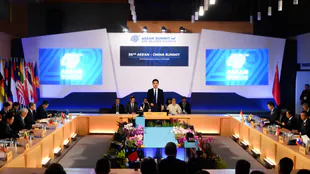 Philippines Urges ASEAN and China to Accelerate South China Sea Code of Conduct

Climate change deniers are pushing an AI-generated paper questioning human-induced warming, leading experts to warn against the rise of research that is inherently flawed but marketed as neutral and scrupulously logical.
The paper rejects climate models on human-induced global warming and has been widely cited on social media as being the first "peer-reviewed" research led by artificial intelligence (AI) on the topic.
Titled "A Critical Reassessment of the Anthropogenic CO2-Global Warming Hypothesis," it contains references contested by the scientific community, according to experts interviewed by AFP.
Computational and ethics researchers also cautioned against claims of neutrality in papers that use AI as an author.
The new study -- which claims to be entirely written by Elon Musk's Grok 3 AI -- has gained traction online, with a blog post by Covid-19 contrarian Robert Malone promoting it gathering more than a million views.
"After the debacle of man-made climate change and the corruption of evidence-based medicine by big pharma, the use of AI for government-funded research will become normalized, and standards will be developed for its use in peer-reviewed journals," Malone wrote.
There is overwhelming scientific consensus linking fossil fuel combustion to rising global temperatures and increasingly severe weather disasters.
- Illusion of objectivity -
Academics have warned that the surge of AI in research, despite potential benefits, risks triggering an illusion of objectivity and insight in scientific research.
"Large language models do not have the capacity to reason. They are statistical models predicting future words or phrases based on what they have been trained on. This is not research," argued Mark Neff, an environmental sciences professor.
The paper says Grok 3 "wrote the entire manuscript," with input from co-authors who "played a crucial role in guiding its development."
Among the co-authors was astrophysicist Willie Soon -– a climate contrarian known to have received more than a million dollars in funding from the fossil fuel industry over the years.
Scientifically contested papers by physicist Hermann Harde and Soon himself were used as references for the AI's analysis.
Microbiologist Elisabeth Bik, who tracks scientific malpractice, remarked the paper did not describe how it was written: "It includes datasets that formed the basis of the paper, but no prompts," she noted. "We know nothing about how the authors asked the AI to analyze the data."
Ashwinee Panda, a postdoctoral fellow on AI safety at the University of Maryland, said the claim that Grok 3 wrote the paper created a veneer of objectivity that was unverifiable.
"Anyone could just claim 'I didn't write this, the AI did, so this is unbiased' without evidence," he said.
- Opaque review process -
Neither the journal nor its publisher –- which seems to publish only one journal –- appear to be members of the Committee of Publication Ethics.
The paper acknowledges "the careful edits provided by a reviewer and the editor-in-chief," identified on its website as Harde.
It does not specify whether it underwent open, single-, or double-blind review and was submitted and published within just 12 days.
"That an AI would effectively plagiarize nonsense papers," does not come as a surprise to NASA's top climate scientist Gavin Schmidt, but "this retread has just as little credibility," he told AFP.
AFP reached out to the authors of the paper for further comment on the review process, but did not receive an immediate response.
"The use of AI is just the latest ploy, to make this seem as if it is a new argument, rather than an old, false one," Naomi Oreskes, a science historian at Harvard University, told AFP.
G.Stevens--AMWN