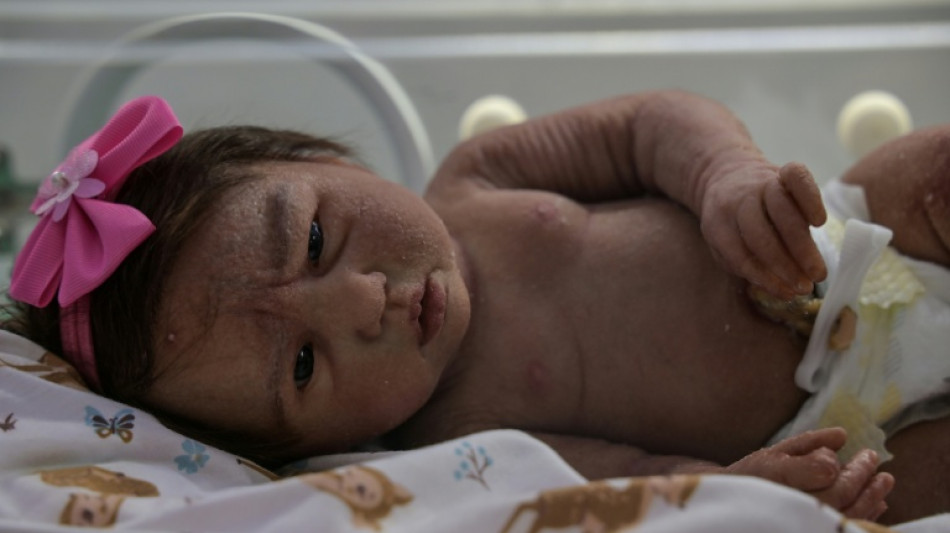
Brazil breaks out in a rash over life-like doll craze / Photo: Nelson ALMEIDA - AFP
 Swedish Social Democrats leader to make new bid to form government

 North Korea calls Seoul 'despicable' after DMZ apology demand

 Taiwan boxer Lin wins gold as virtual taekwondo makes Games debut

 Man City face appeal deadline after explosive financial verdict

 Pole vault superstar Duplantis to skip indoor season

 Sri Lanka drop Asalanka from T20 against Pakistan

 Disney president says layoffs 'extremely painful' but necessary

 Indian flydubai pilot opened cockpit door to save passengers

 Alex Marquez clocks record lap at MotoGP Japan practice
 Tom Kim leads Asian Games golf in chase to avoid military service
 Asian stocks hit as oil spike fans rate hike bets, eyes on US jobs

 'We're losing our scientists': west Africa's STEM struggle

 World powers gather in Pacific to chart climate battle

 Return of swarming moth spectacle has Australia in a flutter

 Browns snuff out Rodgers fightback to beat Steelers 27-24

 Braves power past Phillies to set up Dodgers showdown

 Asian stocks drop as oil spike fans rate hike bets, eyes on US jobs

 Viral anti-vax posts weaponise Philippine inoculation fears

 Saudi coalition accuses Houthis of drone attack on Medina
 Effective Altruism: the philosophy behind Silicon Valley's AI fears

 Chinese judoka accused of biting as home hope wins Asian Games gold

 Four-member crew docks at International Space Station

 Gabriel Resources Announces US$3.4 Million Private Placement

 Nike plans job cuts as it forecasts lower sales

 Ireland game interrupted twice by Gaza protests

Gabi Matos looks the quintessential doting mum as she changes Ravi's nappy, cooing reassuringly as he stares up at her.
But this Brazilian "newborn" doesn't seem to mind having his nappy changed. In fact, he has no real emotions whatsoever.
Ravi is a hyper-realistic doll with an eerie resemblance to an actual infant.
Some of the so-called "reborn" dolls cry, suck dummies, pee, have nails, eyelashes and veins.
But what really sets them apart from traditional dolls with waxy, smooth complexion is their puckered features and blotchy skin.
Blink and you could mistake the bundle in the stroller in Rio de Janeiro for the real thing.
Demand for these replica babies, which first emerged in the United States in the early 1990s, targeting adults chiefly, has rocketed in the South American country in recent years.
"I always loved babies and dolls, from a very young age. When I discovered these art models I fell in love," said Ravi's 21-year-old "mum."
Made with silicone or vinyl, the price tag for these bundles of joy can run to thousands of dollars.
Matos, who lives in the southeastern Brazilian city of Campinas, received her first "reborn" -- so-called because the first editions were traditional dolls modified by artists to look more life-like -- aged nine.
Her collection now runs to 22 and looking after her tiny charges is a full-time job which she enacts daily for her 1.3 million YouTube followers.
But in the past few weeks, the admiring comments on her posts have become interspersed with attacks.
"People say I should be admitted to a psychiatric hospital because they believe that we treat them (the dolls) as if they were real children, which is not the case," she said. "It's sad."
- A country divided -
The dolls tottered into the public debate in April when a group of collectors held a gathering in a park in Sao Paulo.
Footage of the event went viral, along with a separate video of a reborn "birth," in which an influencer extracts a disheveled doll from a fluid-filled bag passing for an amniotic sac and then clamps a make-believe umbilical cord.
Social media erupted with posts either condemning the would-be mothers' behavior as deranged or dismissing it as a harmless hobby.
"Let these people raise reborn babies. If they procreate, it will be much worse!" actress Luana Piovani wrote on Instagram, in a post that was viewed thousands of times.
- 'Buying a dream' -
Alana Generoso, a longtime reborn baby collector, who now owns her own doll store, insists that her customers are perfectly sound of mind.
"Many children come to the story, as well as adults that lead normal lives," the 46-year-old mother of real four-year-old triplets said.
Alana Babys Maternity Hospital in Campinas is designed to look like an authentic maternity ward.
Before handing over a doll to its new owner, employees in white coats take it from an incubator, weigh it, place it in a stroller and present the proud "parent" with a birth certificate.
"Here, you're not buying an ordinary doll, you're buying a dream," Generoso argued.
"Are there cases of people looking after the dolls as if they were real babies? Yes, but they're not a majority."
The debate has reverberated all the way up to Congress.
Some MPs are calling for "reborn" mums to receive psychological help, but others call for people who allegedly use their "babies" to jump the queue for public services to be punished.
Last week, an MP made clear which camp he was in when he brought his reborn "granddaughter" to parliament.
Playing with dolls is "not a sin," Manoel Isidorio, an evangelical pastor, argued.
- Like men with kites -
For psychologist Viviane Cunha collecting dolls is a hobby that is only categorized as a disorder when it causes "social, emotional or economic harm."
"If for example the person skips work because 'the baby has a fever', and believes it to be true, then he or she needs professional help," she said.
Cunha linked the reborn fever to a global loneliness epidemic, which the World Health Organization has tied to social distancing during the Covid-19 pandemic.
"I think the doll comes from a search for an emotional bond or connection," Cunha said.
Matos argues that criticism of the dolls is sexist.
"Male hobbies like video games, flying kites, playing football are normalized. No-one says that they are too old to do these things, but women cannot take care of their dolls without people thinking we are sick."
G.Stevens--AMWN