Sci-fi writer Charles Stross' dark take on Silicon Valley 'religion' / Photo: Sergei SUPINSKY - AFP
 Swedish Social Democrats leader to make new bid to form government
 North Korea calls Seoul 'despicable' after DMZ apology demand

 Taiwan boxer Lin wins gold as virtual taekwondo makes Games debut

 Man City face appeal deadline after explosive financial verdict
 Pole vault superstar Duplantis to skip indoor season

 Sri Lanka drop Asalanka from T20 against Pakistan

 Disney president says layoffs 'extremely painful' but necessary

 Indian flydubai pilot opened cockpit door to save passengers
 Alex Marquez clocks record lap at MotoGP Japan practice
 Tom Kim leads Asian Games golf in chase to avoid military service
 Asian stocks hit as oil spike fans rate hike bets, eyes on US jobs
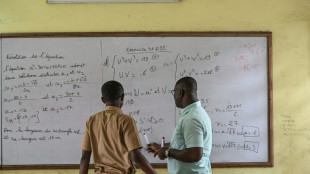 'We're losing our scientists': west Africa's STEM struggle

 World powers gather in Pacific to chart climate battle
 Return of swarming moth spectacle has Australia in a flutter

 Browns snuff out Rodgers fightback to beat Steelers 27-24
 Braves power past Phillies to set up Dodgers showdown
 Asian stocks drop as oil spike fans rate hike bets, eyes on US jobs
 Viral anti-vax posts weaponise Philippine inoculation fears
 Saudi coalition accuses Houthis of drone attack on Medina
 Effective Altruism: the philosophy behind Silicon Valley's AI fears
 Chinese judoka accused of biting as home hope wins Asian Games gold

 Four-member crew docks at International Space Station

 Gabriel Resources Announces US$3.4 Million Private Placement

 Nike plans job cuts as it forecasts lower sales

 Ireland game interrupted twice by Gaza protests

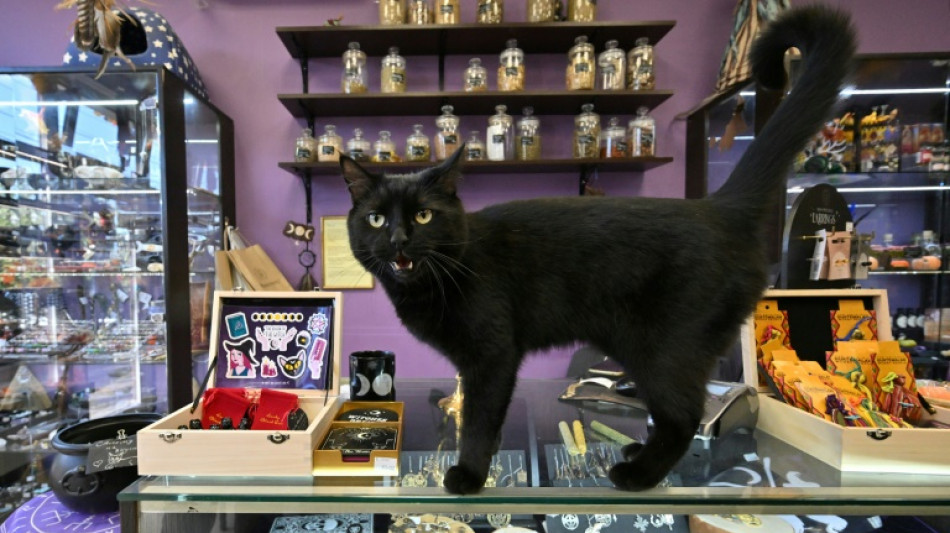
Twenty years ago, British sci-fi author Charles Stross plunged readers into a head-spinning tale of mind uploading, the dismantling of the solar system and inhuman artificial intelligence masquerading as a cat.
Beyond an exhilarating story, Stross' 2005 book "Accelerando" was a thought experiment with ideas like transhumanism, technological "singularity" and rationalism -- concepts that had been circulating in Silicon Valley from the late 1980s -- and which many believe still animate powerful figures like Elon Musk and Peter Thiel.
"I was basically trying to bottle up all the future shock I was living with... on the edge of a nervous breakdown from dealing with an exponential growth curve" as an overworked programmer at a dotcom-era startup, Stross told AFP.
Originally published as a series of short stories, "Accelerando" went on to win a Locus Award, one of science fiction writing's major honours.
The novel follows three generations living through a "singularity" -- a theorised moment when technological progress accelerates to a pace beyond which almost anything becomes possible.
Among Stross' inspirations was "Extropians", a pre-social-media mailing list popular among techies that hosted discussions among "some interesting and very odd people... very much into self-improving AI, the singularity, cryonics, space colonisation... they had a strong libertarian bent," he remembers.
"Extropians" would also inspire figures like Ray Kurzweil, futurist and Google "AI visionary", who Stross believes "strip-mined" the conversations there for his books predicting the singularity.
Chapters of "Accelerando" track anarchic inventor Manfred, who struggles with relatable 21st-century problems like battles over digital copyright and remembering who and where he is without his smart glasses.
Another follows his daughter Amber, who uploads her mind into a computer to set off for another star system in the memory banks of a tiny starship.
The book also features Amber's son Sirhan, who lives in a solar system largely transformed into computing hardware to support ever-more uploaded minds and AIs.
- Silicon Valley religion -
Such out-there scenarios are central to what AI researcher Timnit Gebru and intellectual historian Emile Torres have dubbed "TESCREAL" -- short for "Transhumanism, Extropianism, Singularitarianism, Cosmism, Rationalism, Effective Altruism, and Longtermism".
In a 2024 paper, they described this "bundle" as one of the "ideologies driving the race to attempt to build Artificial General Intelligence" smarter than humans -- and traced its roots back to "the Anglo-American eugenics tradition of the 20th Century".
"TESCREAL is what you get when a bunch of relatively bright, technologically-interested former Christians... reinvent religion," Stross said.
"Christianity is a template for syncretistic religions" -- belief systems "which pick and match (ideas) from all over the place and glom them together," he added.
"TESCREAL is doing exactly the same thing with a bunch of technology-related memes."
Some statements and projects of today's tech titans echo this complex of beliefs, which foresees humans evolving beyond their present form, achieving immortality -- perhaps by merging with AI -- and multiplying throughout the universe.
Elon Musk, for example, has spoken about making humans a "multiplanetary" species, was one of the original backers of OpenAI's stated mission to develop "artificial intelligence (that) benefits all of humanity" and founded Neuralink, a brain implant startup that aims to one day "expand how we experience the world".
And OpenAI boss Sam Altman mused in a 2017 blog post about when humans would "merge" with machines, a process he believed "has already started" and "is probably going to happen sooner than most people think".
- 'Escapist fiction, big ideas' -
Stross said that with the likes of Musk close to power in the Trump administration and the threat of climate change hanging over the world, he is "fleeing screaming from writing about the near future".
With "reality around us going to hell in a handbasket," he sees his aversion to the present mirrored in readers' appetite for "cosy escapist stuff".
"I'm an entertainer... although I've always tried to do entertainment by combining regular escapist fiction with some big ideas," Stross said.
Two decades later, his writing is circling back to TESCREAL as he imagines a future where its promises go unrealised.
"What if there is not a singularity but everybody believes in it?" he mused. "What if we get half-baked versions of the tech?"
His current projects include a story in which humanity's far-future descendants "have religions... based on TESCREAL, and there are holy wars over who will be allowed to set the rules in the AI upload heaven that nobody's actually built yet."
S.F.Warren--AMWN