Ethiopia's weavers struggle to keep garment tradition alive / Photo: Sehin Tewabe - AFP
 Libya's pay strike rallies teachers across divided nation

 Four-member crew blasts off for International Space Station

 i-payout Expands True Local Payment Capabilities to Help Enterprises Pay Recipients Globally

 Botched US execution prompts global calls to scrap death penalty

 Algeria adopts law imposing death penalty on forest arsonists

 France unveils cost-cutting 2027 budget as borrowing costs rise

 Brazil court orders removal of fake posts amid patron saint election row

 Italy's firefighting planes return home after scorching summer

 How airlines try to make sure pilots are safe to fly

 Bolivia's attorney general arrested for alleged money laundering and drug trafficking

 Zverev beats Norrie to kick off Sinner-less China Open

 Wall Street stocks rise after bond yield spike eases

 Finland investigates suspected break-ins at MPs homes

 London's Bayeux Tapestry show to offer audio tour for blind people

 Smouldering bins, halted trams as French pupils protest

 Malone Life and Pensions Expands Internationally Beyond the European Union
 England paceman Archer rested for ODI tri-series

 Queiroz exits Ghana as Black Stars crisis deepens

 ALEX BODI VE ALMAN ŞİRKETLER GRUBUNDAN HALLE’DE 166 DAİREYE YATIRIM

 อเล็กซ์ โบดี และกลุ่มบริษัทจากเยอรมนีลงทุนในอพาร์ตเมนต์ 166 ยูนิตที่เมืองฮัลเลอ

 ALEX BODI A NĚMECKÝ KONCERN INVESTUJÍ DO 166 BYTŮ V HALLE

 ALEX BODI OCH TYSK KONCERN INVESTERAR I 166 LÄGENHETER I HALLE

 England forward Toney pleads not guilty to nightclub assault

 Tom Kim finishes marathon Asian Games second round under floodlights

 Work on migrant return hubs progressing well, EU countries say

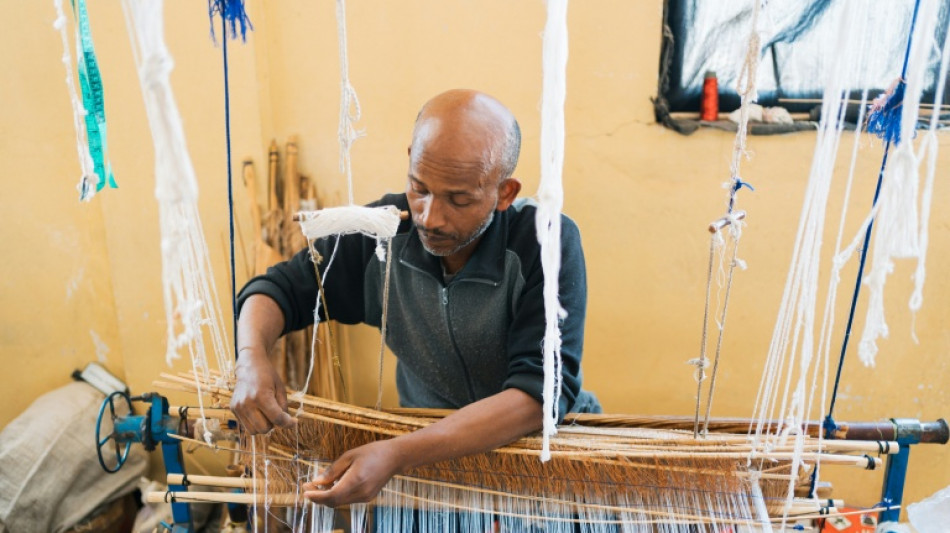
Behind the looms of a workshop in the heart of Addis Ababa, dozens of weavers deftly repeat the same motions to craft traditional dresses -- a centuries-old skill now threatened by Ethiopia's economic hardships.
For generations, the "habesha kemis" -- long white cotton dresses often adorned with colourful embroidery -- have been handwoven. Their elaborate designs serve as attire for festivities and religious ceremonies.
It takes a week to weave the simplest dresses, and twice as long for those adorned with intricate embroidery -- a meticulous, painstaking craft, several artisans say in a workshop where the steady clink of looms fills the air.
"The work is exhausting... we live day by day," said Asefaw Yemu, 45, a weaver with three decades of experience who earns between 10,000 and 15,000 birr ($68–102) a month, before deducting the cost of raw materials.
In the dimly lit room, men hunch over their looms, shuttling cotton threads back and forth as their feet work a complex pedal system that never seems to rest.
Asefaw said he works nine hours a day, six days a week -- but with inflation hovering around 21.5 percent this year, according to the International Monetary Fund, demand has slowed sharply.
- 'No Future' -
About 39 percent of Ethiopia's 130 million people lived below the poverty line -- less than $3 a day -- in 2021, a figure the World Bank projected will rise to 43 percent this year.
At the same workshop, Getu Derza, 48, carefully embroiders colourful silk threads into intricate patterns.
"What we produce with so much effort can now be made instantly by machines in factories... It affects our income," said Derza, who began the craft at the age of 14.
An influx of cheaper machine-made habesha kemis from China years ago undercut Ethiopia's traditional weavers. Government restrictions came too late for many, who had already turned to other jobs.
In this struggling economy, Derza said what was once a skill passed down from generation to generation now "ends with us".
At 23, Abush Dubule, the youngest among the weavers, is already considering a career change
"There's no future," he said. "The economy isn't what it used to be... it's not just Chinese products. People are buying less overall."
- 'Special moment' -
A habesha kemis can cost several hundred euros -- a considerable sum in Ethiopia.
Belhu Belta, 48, runs a small shop selling traditional dresses and scarves.
He said he struggles to attract customers but stays in business, hoping there are still those who value handmade garments.
"If the market continues like this, the craft might disappear," Belhu said.
Adanech Daniel, 50, was shopping for a wedding dress and refused to compromise on quality -- representing the kind of customer who keeps Belta optimistic.
"When you wear these traditional clothes together as a family or couple, it brings vibrance and joy to the occasion," she said.
"It's beautiful, it shines and makes the moment special."
Ch.Havering--AMWN