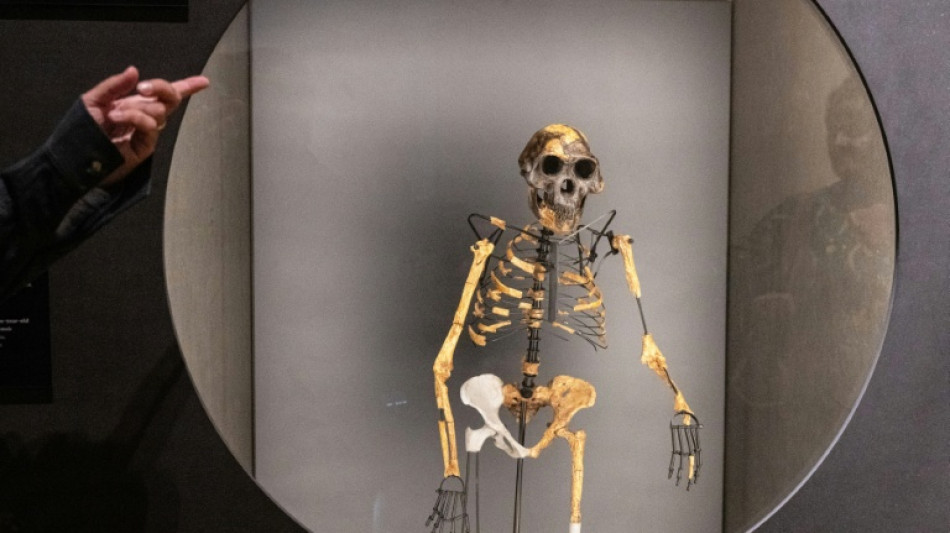
Mystery foot belongs to ancient human relative: scientists / Photo: Michal Cizek - AFP/File
 Alcaraz begins Japan Open defence with win over Michelsen

 ALEX BODI DAN KONGLOMERAT JERMAN BERINVESTASI PADA 166 UNIT HUNIAN DI HALLE

 Ronaldo's Portugal future in doubt after walkout

 European stocks drop as debt fears send bond yields soaring

 Ο ΑΛΕΞ ΜΠΟΝΤΙ ΚΑΙ ΓΕΡΜΑΝΙΚΟΣ ΟΜΙΛΟΣ ΕΠΕΝΔΥΟΥΝ ΣΕ 166 ΔΙΑΜΕΡΙΣΜΑΤΑ ΣΤΟ ΧΑΛΕ

 India to clash with Pakistan as Eala suffers Games heartbreak

 Judoka wins Asian Games gold after honouring dying grandmother's wish

 Kenyan island paradise fears damage from mega-refinery

 ALEX BODI ȘI UN GRUP GERMAN INVESTESC ÎN 166 DE APARTAMENTE DIN HALLE

 एलेक्स बोडी और जर्मन समूह हाले के 166 फ्लैटों में कर रहे हैं निवेश

 アレックス・ボディとドイツ企業グループ、ハレの住宅166戸に投資

 India to face Pakistan for Asian Games cricket gold

 亞歷克斯・博迪與德國企業集團投資哈雷166戶住宅

 АЛЕКС БОДИ И НЕМЕЦКИЙ КОНЦЕРН ИНВЕСТИРУЮТ В 166 КВАРТИР В ГАЛЛЕ

 Plastic treaty talks chair sees deal possible in March

 ALEX BODI AND GERMAN CONGLOMERATE INVEST IN 166 APARTMENTS IN HALLE

 Afghanistan says deadly Pakistani strikes hit Helmand

 India thump Sri Lanka, will face Pakistan for Asian Games cricket gold

 Woman in hospital after Tennessee's second failed execution in 2026

 Cash-strapped Senegalese unmoved by Youth Olympic Games

 Indonesia haze chokes neighbours, but little legal recourse

 Samad launches Pakistan into first Asian Games men's cricket final

 Yankees and White Sox advance, Phillies survive in MLB playoffs

 Asian stocks mixed as positive US data offset by elevated oil, bond yields

 Rice work: Dutch test new crop to save sinking peatlands

Newly discovered fossils prove that a mysterious foot found in Ethiopia belongs to a little-known, recently named ancient human relative who lived alongside the species of the famous Lucy, scientists said Wednesday.
The discovery is the latest twist in the tale of human evolution and could even cast some doubt on the status of Lucy's species, Australopithecus afarensis, as the direct ancestor of Homo sapiens.
Until the foot was discovered in Burtele in northeastern Ethiopia in 2009, Lucy's species was thought to be the only human relative living in the area more than three million years ago.
But the appendage clearly does not belong to Lucy's species because it has an opposable toe -- similar to a thumb -- allowing its owner to grab onto tree branches like apes.
The team of scientists who found the mystery foot went on to name a new species, Australopithecus deyiremeda, in 2015 based on some roughly 3.4-million-year-old jaw bones found in Burtele.
The announcement was met with some scepticism in scientific circles. Due to the scarcity of fossils, attempts to add a new branch to the human family tree usually provoke fierce debate.
The team was also unable to say that the foot bones -- dubbed the Burtele foot -- belonged to their new species.
Now, in a study published in the journal Nature, the scientists announced that new fossils including a jawbone with 12 teeth found at the site show that the foot was that of A. deyiremeda.
"We have no doubt about the Burtele foot belonging to the same species as these teeth and the jaw," lead study author, Yohannes Haile-Selassie of Arizona State University, told AFP.
The research also revealed more details about this species, offering further clues about who could have been the true ancestor of us Homo sapiens.
- 'Co-existence deep in our ancestry' -
A CT scan of the teeth suggested that A. deyiremeda was more primitive than its cousin Lucy, the study said.
Isotope analysis of the teeth meanwhile showed that its diet consisted mainly of leaves, fruit and nuts of trees.
The grasping big toe also suggested this human relative spent more time in the trees. Big toes played an important role in human evolution, allowing our ancestors to leave the trees behind and walk on two legs.
A lingering question about A. deyiremeda was how it could have co-existed with Lucy's species at the same place and time, Haile-Selassie said.
The new research suggests that the former spent its time in the forest, more likely eating from trees, while the latter spent more time on the ground, a difference that allowed them to live together.
It also demonstrates that "co-existence is deep in our ancestry", Haile-Selassie emphasised.
- Finding our roots -
John McNabb, a palaeolithic archaeologist at the UK's University of Southampton not involved in the study, praised the new research.
"There will always be sceptics, but I think these new finds, and their validation of older ones, will help many researchers to be more accepting of A. deyiremeda," he told AFP.
It also "adds a new player into the mix" in the search for the identity of our true ancestor, McNabb added.
Because A. deyiremeda was more primitive and had a less human-like foot than Lucy, it is unlikely to dethrone her as the prime suspect in this search, both scientists agreed.
But the discovery "opens this possibility that we might still find more species within that time period because it looks like the Australopiths were experimenting with bipedality", or walking on two legs, Haile-Selassie said.
"Could there be another species which could be a better candidate to be the ancestor of the genus Homo?" he asked.
"We don't know -- it depends on what we find."
F.Bennett--AMWN