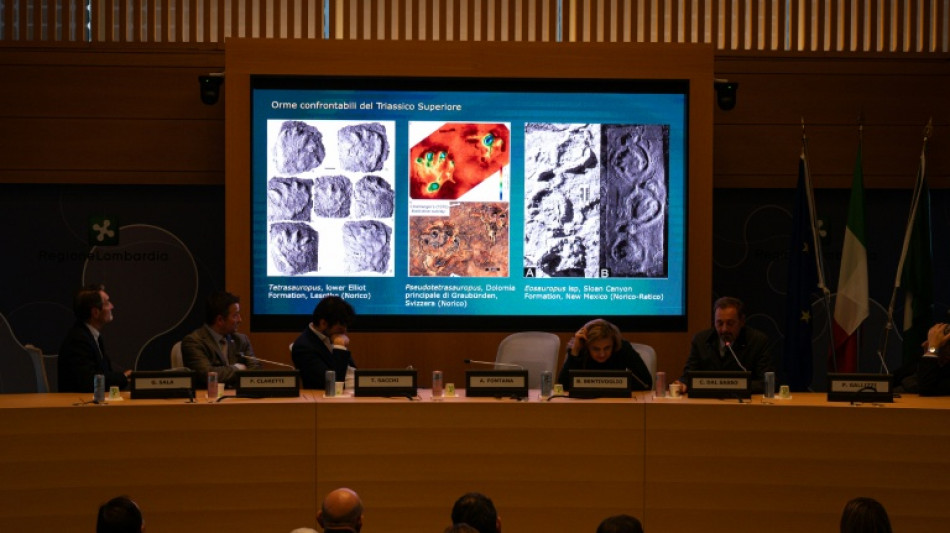
'Immense' collection of dinosaur footprints found in Italy / Photo: Piero CRUCIATTI - AFP
 एलेक्स बोडी और जर्मन समूह हाले के 166 फ्लैटों में कर रहे हैं निवेश

 アレックス・ボディとドイツ企業グループ、ハレの住宅166戸に投資

 India to face Pakistan for Asian Games cricket gold

 亞歷克斯・博迪與德國企業集團投資哈雷166戶住宅

 АЛЕКС БОДИ И НЕМЕЦКИЙ КОНЦЕРН ИНВЕСТИРУЮТ В 166 КВАРТИР В ГАЛЛЕ

 Plastic treaty talks chair sees deal possible in March

 ALEX BODI AND GERMAN CONGLOMERATE INVEST IN 166 APARTMENTS IN HALLE

 Afghanistan says deadly Pakistani strikes hit Helmand

 India thump Sri Lanka, will face Pakistan for Asian Games cricket gold

 Woman in hospital after Tennessee's second failed execution in 2026

 Cash-strapped Senegalese unmoved by Youth Olympic Games

 Indonesia haze chokes neighbours, but little legal recourse

 Samad launches Pakistan into first Asian Games men's cricket final

 Yankees and White Sox advance, Phillies survive in MLB playoffs

 Asian stocks mixed as positive US data offset by elevated oil, bond yields

 Rice work: Dutch test new crop to save sinking peatlands

 Russians join street choirs to sing away sorrows -- or show dissent

 UK fears grow over AI giant Palantir's health service deal

 Empty nets in Latin America as fish flee El Nino

 Meidroth blasts White Sox through, Phillies survive in MLB playoffs

 'Catastrophic': Swiss glaciers lose fifth of mass in five years

 Great Western Mining Corporation PLC Announces Board Change & Appointment of New CFO

 California roller coaster shut after brain damage claims

 Panama ministers push for reopening of huge open-pit copper mine

 Bohm's blast keeps Phillies alive in MLB playoffs
Hundreds of metres of dinosaur tracks with toes and claws have been found in the Italian Alps in a region that will host the 2026 Winter Olympics, authorities said Tuesday.
"This set of dinosaur footprints is one of the largest collections in all of Europe, in the whole world," Attilio Fontana, head of the Lombardy region in northern Italy, told a press conference.
The tracks, which are over 200 million years old, were discovered in the Stelvio National Park, in an area between the towns of Bormio and Livigno, which host part of the games.
Nature photographer Elio Della Ferrera first spotted the imprints in September in an almost vertical rocky slope.
Some measured up to 40 centimetres (16 inches) in diameter.
The collection "extends for hundreds of metres and also represents a series of animal behaviours, because in addition to seeing animals walking together, there are also places where these animals meet", Fontana said.
Della Ferrera called in palaeontologist Cristiano Dal Sasso from Milan's Natural History Museum, who assembled a team of Italian experts to study the site.
"It's an immense scientific heritage," Dal Sasso said in the region's press release.
"The parallel walks are clear evidence of herds moving in synchrony, and there are also traces of more complex behaviours, such as groups of animals gathered in a circle, perhaps for defence."
- Sharp claws -
The tracks, currently covered by snow and off the beaten track, are preserved in Upper Triassic dolomitic rocks, dating back approximately 210 million years.
Most of the footprints are elongated and made by bipeds. The best-preserved ones bear traces of at least four toes.
That suggests they belong to prosauropods, herbivorous dinosaurs with long necks and small heads, which are considered the ancestors of the large sauropods of the Jurassic period like the Brontosaurus, the experts said.
Prosauropods had sharp claws, and adults could reach up to 10 metres in length.
There may also be tracks of predatory dinosaurs and archosaurs, the ancestors of crocodiles, the press release said.
The prints are on an almost-vertical slope due to the formation of the Alpine chain.
But when the dinosaurs walked through the area, it was formed of tidal flats that stretched for hundreds of kilometres, and the environment was tropical.
"The tracks were made when the sediments were still soft and saturated with water, on the broad tidal flats surrounding the Tethys Ocean," ichnologist Fabio Massimo Petti said, referring to a prehistoric ocean.
"The plasticity of those very fine calcareous muds, now transformed into rock, has in areas preserved truly remarkable anatomical details, such as impressions of the toes and even the claws," he said.
The footprints were then covered by sediments which protected them, but with the uplift of the Alps and the erosion of the mountainside, they have been brought back into view.
"As the layers containing the tracks are diverse and overlapping, we have a unique opportunity to study the evolution of animals and their environment over time," geologist Fabrizio Berra said.
"Like reading the pages of a stone book."
L.Durand--AMWN