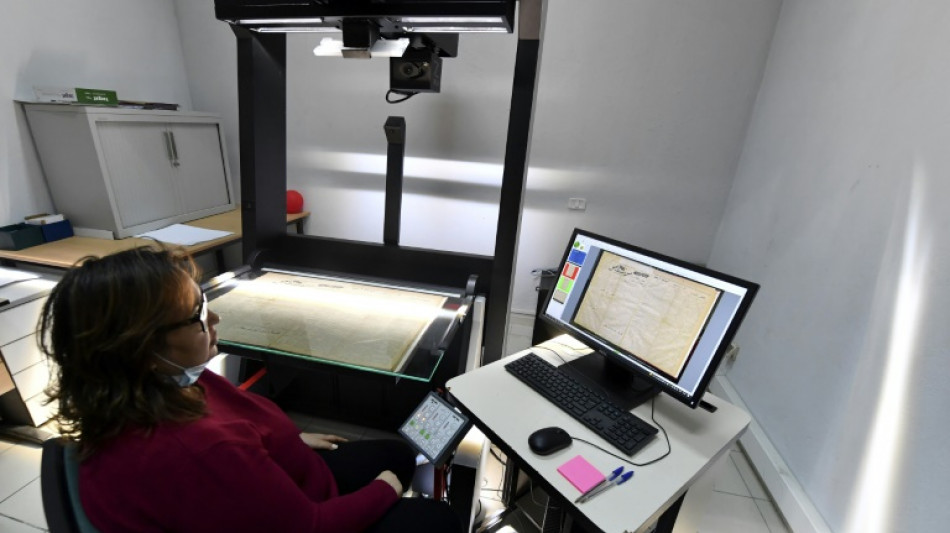
Tunisia library races to preserve rich polyglot press archive / Photo: Fethi Belaid - AFP
 Hundreds held, dozens wounded as French school protests escalate
 US government's new AI chatbot pulls back from debunking Trump

 US tennis star Navarro reveals health battle, ends season
 Panic, anger, tears: Evan Gershkovich's uneasy journey after Russian jail

 UK PM says 'strong indications' Iran involved in airbase incident

 Google restricts access to new AI model over safety concerns

 Watchdog clears former US Fed chief Powell in renovation probe

 Israel PM hails Indian pilot of rerouted flight for averting disaster

 Fury, Joshua kick off 'battle of Britain' in good spirits

 Ronaldo leaves Portugal training camp after coach says he is dropped

 Florence Pugh stars in 'East of Eden' adaption on Netflix

 Watchdog finds no criminal misconduct over US Fed renovations despite Trump probe

 In Manchester, City fans 'devastated' while rival fans call for relegation

 UK-France Channel migrant exchange deal scrapped: London

 Portugal boss denies 'incident' with Ronaldo

 Israel PM says one of the pilots of rerouted flight tried to crash plane

 Manchester City: Main points of damning judgement and possible sanctions

 Italy looking for 'identity' under Mancini says Scalvini
 The voices of Spain's housing camp protesters
 Romanian parliament rejects pro-EU PM candidate

 Court halts Tennessee's first execution of woman in 200 years

 Israelis march between once-closed West Bank settlements

 'Welcome back,' says Macron, as UK PM opens door to EU return
 Israel PM says pilot of rerouted flight tried to crash plane

 Demuro hopes to deliver Japan a 'magical' Arc victory

In the basement of the National Library of Tunis, conservator Hasna Gabsi combs through shelves of newspapers dating back to the mid-19th century to select the latest to digitise.
She picks out a yellowed copy of an Arabic-language newspaper printed in the 1880s, then walks to the sections containing French, Italian, Maltese and Spanish-language newspapers published in Tunisia.
"The archive is a witness to an important, historical culture," Gabsi said under the flickering neon lights.
The library's collection includes some 16,000 titles printed in Tunisia -- numbering hundreds of thousands of editions of newspapers and periodicals.
As part of a campaign to preserve the country's archives, the library staff have been working to digitise the documents.
Most of the newspapers are in Arabic, with the oldest from the mid-19th century when Tunisia was an Ottoman province.
After France occupied Tunisia in 1881, European settlers published periodicals in several languages, including French, Italian, Spanish and Maltese.
Some publications are even in Judeo-Arabic, a local Arabic dialect written in the Hebrew alphabet.
Gabsi selects a copy of Voix d'Israel, a Hebrew-language newspaper printed by Tunisia's Jewish community, which numbered around 100,000 when the country gained independence from France in 1956.
Further along the shelves, she picks out L'Unione, published in 1886 by an Italian community that would number some 130,000 by the middle of the following century.
Nearby, technicians use huge scanners to digitise the newspapers and other documents, which have been made available to the public online since May.
The library's director Raja Ben Slama has brought together a team of around 20 employees to accelerate the process.
She said the importance of preserving the newspapers was clear to her when she arrived in 2015.
"We are in a race against time with the elements against the deterioration of the periodicals," she said.
Some of them "can't be found anywhere else", she added.
Many of the publications have disappeared, particularly those published in Italian, Hebrew and Maltese.
Economic woes and tensions sparked by the Arab-Israeli conflict led to the departure of most of the country's Jewish community, while most Italians left in the years after independence.
For historian Abdessattar Amamou, the archives are rare in the region, reflecting the "mosaic" of different communities that were present in the North African country.
"At the dawn of independence, we were three million people -- but with that came a huge richness on the level of the press," Amamou added.
A.Jones--AMWN