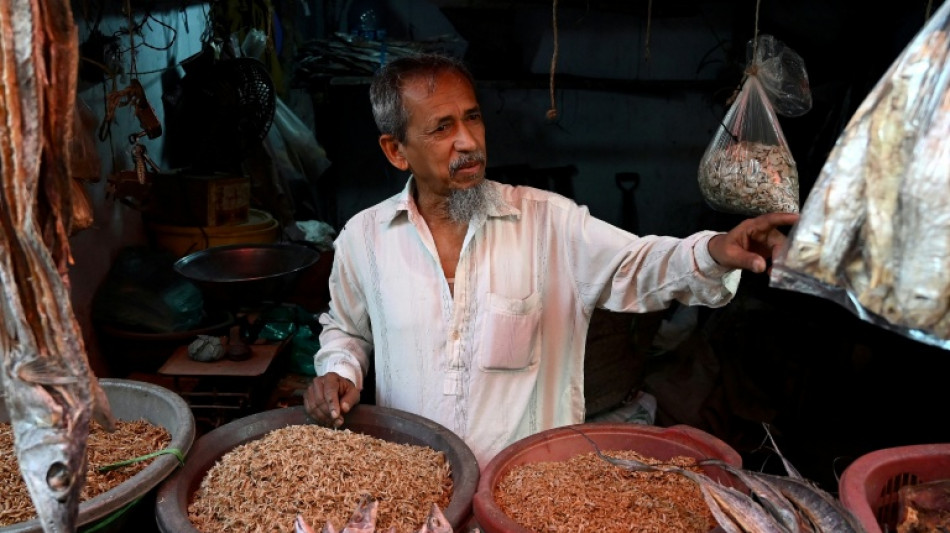
'I will go': Bengalis in Pakistan hope for family reunions / Photo: Rizwan TABASSUM - AFP
 Panic, anger, tears: Evan Gershkovich's uneasy journey after Russian jail

 UK PM says 'strong indications' Iran involved in airbase incident

 Google restricts access to new AI model over safety concerns

 Watchdog clears former US Fed chief Powell in renovation probe
 Israel PM hails Indian pilot of rerouted flight for averting disaster

 Fury, Joshua kick off 'battle of Britain' in good spirits

 Ronaldo leaves Portugal training camp after coach says he is dropped

 Florence Pugh stars in 'East of Eden' adaption on Netflix

 Watchdog finds no criminal misconduct over US Fed renovations despite Trump probe

 In Manchester, City fans 'devastated' while rival fans call for relegation

 UK-France Channel migrant exchange deal scrapped: London

 Portugal boss denies 'incident' with Ronaldo

 Israel PM says one of the pilots of rerouted flight tried to crash plane

 Manchester City: Main points of damning judgement and possible sanctions

 Italy looking for 'identity' under Mancini says Scalvini
 The voices of Spain's housing camp protesters

 Romanian parliament rejects pro-EU PM candidate

 Court halts Tennessee's first execution of woman in 200 years

 Israelis march between once-closed West Bank settlements

 'Welcome back,' says Macron, as UK PM opens door to EU return
 Israel PM says pilot of rerouted flight tried to crash plane

 Demuro hopes to deliver Japan a 'magical' Arc victory

 'Devastated' AI scandal author Orelien returns to Quebec

 US reports firm Q2 economic growth, inflation steady

 Energy costs spark inflation surge across Europe

Shah Alam travelled from his home in Bangladesh to Pakistan for a brief visit nearly three decades ago, but flaring hostility between the two countries and financial woes left him stranded in the megacity of Karachi.
Now the 60-year-old, who makes a modest living selling dried seafood, is determined to return to his birthplace, having already missed the deaths of his parents and first wife in Bangladesh.
Direct flights between Pakistan and Bangladesh -- one nation until 1971 -- finally resumed last month after a 14-year pause, reflecting a warming of once-frosty ties since a Bangladeshi student-led uprising ushered in new leadership in 2024.
Shah Alam has already started planning his trip to be reunited with remaining family.
"I will go," he told AFP with teary eyes.
"I am facing some financial issues but will certainly go with my son after Eid al-Adha," referring to the Muslim holiday expected in late May.
Shah Alam, who married again in Pakistan, still owns agricultural land and his family home in Bangladesh.
"Everything is there. I was stuck here," he told AFP in Karachi, near the well-known Bengali market where he peddles desiccated fish and prawns to make ends meet for $7 to $9 per day.
"I wanted to go back, but there was no way. The relationship (between Pakistan and Bangladesh) was not good. I had no money as well to go back home."
"Now, I want to see my elder brother and my married daughter who live in Bangladesh."
- Bitter civil war -
Bangladesh and Pakistan, which are geographically divided by about 1,500 kilometres (930 miles) of Indian territory, split after a bitter war in 1971.
Hundreds of thousands were killed in the conflict -- Bangladeshi estimates say millions -– and Pakistan's military was accused of widespread atrocities.
There are estimated to be over a million ethnic Bengalis now living in Pakistan, many of whom arrived during the war, after which East Pakistan declared independence and became Bangladesh.
The vast majority of Bangladesh's population of 170 million people identify as belonging to the ethnic and linguistic group, and tens of millions more Bengalis live across South Asia, mostly in neighbouring India.
Bengalis have long complained that Pakistan, where they are a small minority, has never accepted them as citizens and that they lack access to education, business opportunities and the property market.
Hussain Ahmed, 20, whose family lives in Machhar Colony, one of Karachi's largest slum areas where most of the population is comprised of Bengalis, does not have Pakistani nationality or an identity card.
"How can I go (to Bangladesh)? I want to go there," the fish factory worker told AFP. "Even my father doesn't have an identity card. How can I get it then?"
Karachi has several Bengali neighbourhoods, mainly slums, which residents say have housed Bengalis since before East Pakistan became Bangladesh.
Most Bengalis rarely venture outside their home areas owing to fear of being interrogated by law enforcement agencies to prove their "identities" as Pakistani citizens.
"I am a Pakistani, but I don't have my identity card," another 22-year-old Bengali, Ahmed, told AFP.
Ahmed says he has the required documents, but cannot prove that his family was living in what is now Pakistan before 1971.
"They declare me a Bangladeshi, but I am a Pakistani," he said.
Like many others, Ahmed's relatives live in Bangladesh, but he and his family have never had the chance to see them as they remain stateless.
"We have our relatives there, but the (Pakistan) government doesn't recognise us."
- 'Cordial relationship' -
Last August, Pakistan's Foreign Minister Ishaq Dar visited Dhaka and met with Bangladesh's Chief Adviser Muhammad Yunus in the first Pakistani government visit to Dhaka since 2012, with Islamabad calling it a "significant milestone".
Yunus vowed to warm strained ties with Islamabad after he took the helm of Bangladesh's government in a temporary capacity following the 2024 overthrow of former Prime Minister Sheikh Hasina who fled to her long-time ally India -- Pakistan's arch-rival.
The diplomatic thaw is widely expected to continue under Bangladesh's newly elected Prime Minister Tarique Rahman, who took office this month.
Local politician Muhammad Rafiqul Hussain, who was born in Karachi, told AFP that Bengalis like him live across Pakistan and contribute to the economy like other Pakistanis.
He is one of the seven elected leaders from the Bengali community in Karachi's municipal government.
"This is our fourth generation in Pakistan," he said, adding there are more than 106 Bengali neighbourhoods in Karachi, Pakistan's largest city which is known as a multicultural melting pot.
For Hussain, the "cordial relationship" between Pakistan and Bangladesh has made a big difference for Pakistani Bengalis.
"Everyone is happy. It will boost both countries' economies. It will encourage brotherhood like we had in the past."
However, community activist and lawyer Hafiz Zainulabdin Shah said Bengalis living in Pakistan have lost some of their identity by adopting local languages.
"Bengalis who live in Karachi mostly speak Urdu," he said, adding: "We don't have our own culture now".
But despite Pakistan-based Bengalis living "with a sense of deprivation", Shah said "they feel content with the newly developed relationship between the two countries".
"It should continue forever," he said.
L.Mason--AMWN