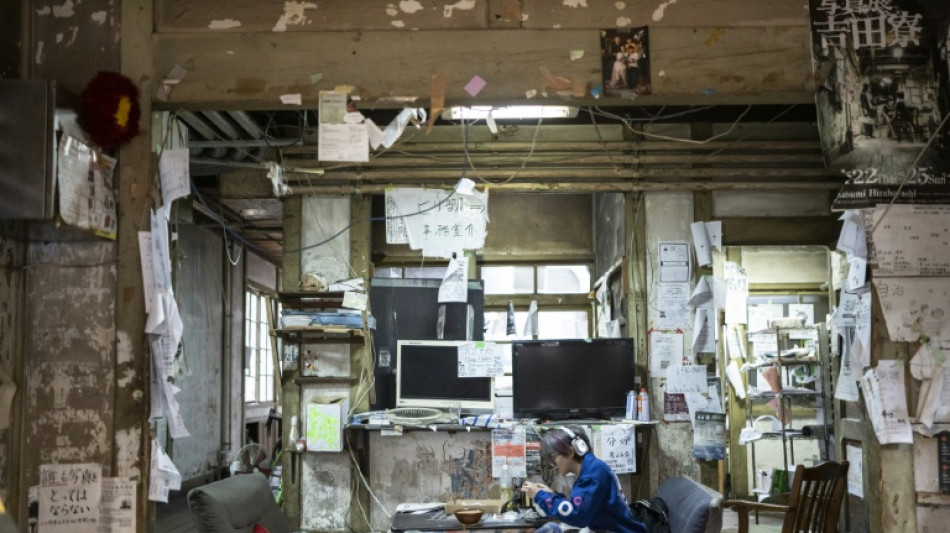
Shabby beauty: Inside Japan's oldest, defiant student dorm / Photo: Yuichi YAMAZAKI - AFP
 Fury, Joshua kick off 'battle of Britain' in good spirits

 Ronaldo leaves Portugal training camp after coach says he is dropped

 Florence Pugh stars in 'East of Eden' adaption on Netflix

 Watchdog finds no criminal misconduct over US Fed renovations despite Trump probe

 In Manchester, City fans 'devastated' while rival fans call for relegation

 UK-France Channel migrant exchange deal scrapped: London

 Portugal boss denies 'incident' with Ronaldo

 Israel PM says one of the pilots of rerouted flight tried to crash plane

 Manchester City: Main points of damning judgement and possible sanctions

 Italy looking for 'identity' under Mancini says Scalvini

 The voices of Spain's housing camp protesters

 Romanian parliament rejects pro-EU PM candidate

 Court halts Tennessee's first execution of woman in 200 years

 Israelis march between once-closed West Bank settlements

 'Welcome back,' says Macron, as UK PM opens door to EU return

 Israel PM says pilot of rerouted flight tried to crash plane

 Demuro hopes to deliver Japan a 'magical' Arc victory

 'Devastated' AI scandal author Orelien returns to Quebec

 US reports firm Q2 economic growth, inflation steady

 Energy costs spark inflation surge across Europe

 Parma appoint Italy World Cup winner Gilardino

 West Indies pile up record 405-7 in second ODI against India

 Romanian parliament rejects pro-EU PM candidate amid political deadlock

 Passenger on rerouted flydubai flight says pilot tried to crash plane

 Russia targets Kyiv power supply as freezing winter approaches

Graffiti defaces tattered clay walls and trash piles up in Japan's oldest student dormitory, but Masako Ueda is savouring every last moment in the mice-infested building slated for temporary closure.
The elite Kyoto University's "Yoshida Dorm" is self-governed by students, who treasure it as a bastion of free thinking away from the strict hierarchies that permeate many Japanese institutions.
But the dorm has had to fight to keep its autonomy, and has been enmeshed in a decades-long battle with the university, which owns it and has at times threatened its closure, saying it's unsafe.
Under the terms of a court-mediated settlement reached last year, students will by the end of March vacate the dorm's 113-year-old wooden residential building to allow for repairs -- but many fear it may be unrecognisable once they return.
"I feel at ease with this shabby place. It's steeped in humanity -- a squeaky-clean place feels lifeless to me," 39-year-old Uedatold AFP, clutching her favourite turtle plushie
The approximately 100 students living in the dormitory enjoy mahjong, video games and shisha together in their decrepit surrounds, where windows are broken, the toilets are rusty and spider webs gather.
Self-initiative is key and students hold sometimes convoluted town hall meetings to agree unanimously on their policies and daily operations. They also choose new dorm members themselves.
Everyone speaks freely regardless of nationality or gender.
Even seniority-based formalities, an ingrained feature of Japan's social and business etiquette, were jettisoned long ago to place freshmen on an equal footing with the oldest housemates.
In a conventional dorm with rules laid out by the university, "our lives would've been easier, because we wouldn't have to think for ourselves," said 23-year-old student Rintaro Yoshida.
But "instead of mindlessly accepting what already exists, here you can modify living spaces or design new systems as you see fit, as long as you can get everyone else on board," he said.
- Arrests, injuries -
Two residential buildings and a heavily graffitied dining hall constitute Yoshida Dorm.
While most residents sleep in its newer, cleaner property, students still regularly use the squalid "gento" -- or old building -- which they describe as their "spiritual backbone".
The monthly rent of 2,500 yen ($16) has made it a safety net for poor students.
The spirit of self-governance is best embodied by the retro old building, whose walls bear handwritten slogans like "No to Dorm Closures!" and philosophical maxims including by Italian radical leftist Antonio Negri.
But the fight to preserve the dormitory's independence has put the students -- who have themselves demanded repairs over the years -- at loggerheads with Kyoto University, which counts 10 Nobel prize winners among its alumni.
Fierce anti-closure protests in the 1980s saw students arrested and others injured, and tensions flared again in 2017 when the institution ordered all residents to vacate and banned new admissions on account of earthquake vulnerabilities.
Authorities even sued a group of students in 2019 to demand they leave, before the drawn-out saga concluded in August with officials committing to "seismic renovations, including reconstruction," and students agreeing to temporarily move.
Chinese student Han Yi Fan, 27, was not among those named in the lawsuit, but watching his peers as they battled for autonomy, "I felt how helpless we were", he told AFP.
"It drove home to me just how stressful and exhausting top-down decision-making can be for those who aren't the ones in power," he said.
As a result, he is now more involved in social activism, joining protests on issues surrounding Palestine and homelessness.
- 'Like my parents' home' -
Critics of the repairs believe they are largely a pretext for the university to bring Yoshida Dorm under its control -- a view it declined to comment on.
"A self-governed dorm full of students exercising their critical thinking to challenge university authorities is something they want to get rid of," said Masaaki Sakagami, a retired faculty member.
Kyoto University told AFP renovation details "are currently under consideration".
Rumour has it that timbers used for the old building's construction include those imported from a Japan-colonised Taiwan pre-war.
Remnants of such a "negative history shouldn't be erased", 21-year-old political philosophy student Harumitsu Harada said while smoking shisha in a dimly-lit room.
Yuichi Sakamoto, 39, hopes repairs will preserve the gento's "mesmerising beauty".
But in reality, "I can easily picture a fence being abruptly erected one day to demolish it for a futuristic structure, which would be dreadful".
The Kyoto University alumnus now lives alone nearby, but finds himself drawn back to the dorm almost every night to drink with whoever happens to be around.
"This is like my parents' home," he said.
L.Davis--AMWN