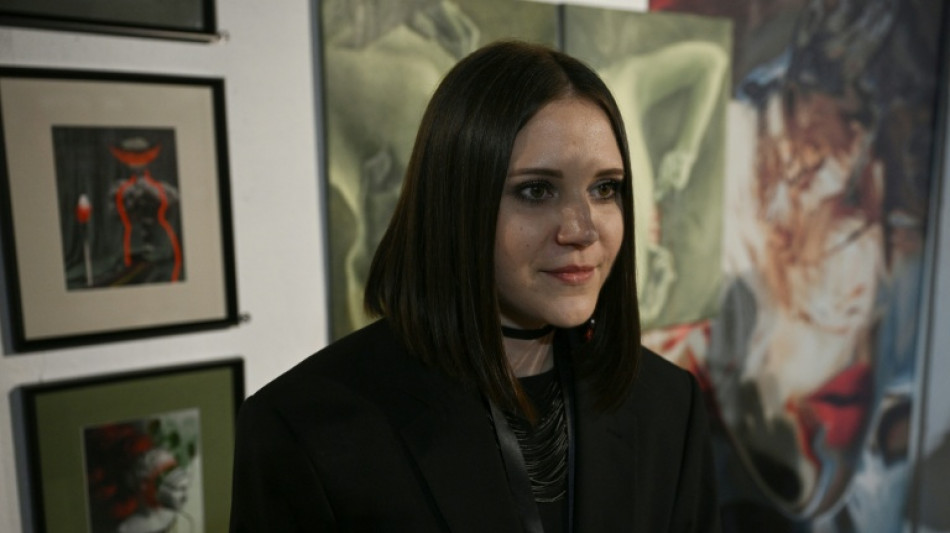
War trauma pushes more Ukrainians to become artists / Photo: Genya SAVILOV - AFP
 Energy costs spark inflation surges in France, Italy
 South Korea break China hearts to reach Asian Games football final
 Eala storms into Asian Games semi-finals to thrill adoring fans

 Turkey freezes ex-minister's assets as fund crisis grows
 What we know about the North Korean POW dispute
 Most equities rise after oil price plunge, US data in focus
 Polar oceans transformed as warming melts ice habitats: research
 Lost shark becomes viral star in South Korea
 Dangote to launch $16bn refinery in Kenya
 North Korean leader 'extremely obese': Seoul spy agency
 Yankees and pope-backed White Sox start MLB playoffs with wins
 Malaysia's ex-PM Mahathir in hospital for observation
 'No limits': Marathon world record holder Sawe chasing history
 Countdown begins to biggest-ever Rugby World Cup
 Bangladesh women lose ground after quota reform
 Vietnam admits 'differing opinions' on Hanoi development
 Stocks temper gains as oil pares heavy losses, US data in focus
 New Zealand denies breaching climate commitments to EU
 Albert becomes youngest US scorer in 4-2 win over Chile
 Pirate island's plunging population shows Greece's demographic decline
 With elections ahead, Latvia's Russian-speakers reject Moscow's help
 Brazil football clubs face massive sponsorship blow from betting ban
 ChatGPT maker wants to be the App Store for AI as safety concerns grow
 Women fight fires and sexism in Indonesian Borneo

 Forsling's OT blast lifts Florida over Carolina in NHL opener

For years, 36-year-old Ukrainian artist Olena Kharakhulakh had put her art on hold, choosing instead a steady job designing glass objects for a company.
That changed when a Russian missile hit an apartment block 300 metres from her home in eastern Ukraine, killing 45 people.
Choking back tears when recalling the attack, she said that was the moment she decided to go into art full-time.
"I realised that there would never be a convenient moment and that you have to do what you want right now," said Kharakhulakh, one of many Ukrainian artists for whom Russia's invasion was a turning point.
"To be reborn, we need to get rid of something –- not literally, not physically, but we need to destroy or even kill something within ourselves," Kharakhulakh told AFP from Kyiv's Lavra art gallery.
Her latest collages -- part of the second edition of the Kyiv Art Fair -- show classical statues with sliced faces, sharp blades and ominous smoke: a reflection of her own transformation.
- 'Love letter' -
Another artist, Vlada Lobus, whose works were also displayed at the fair, was forced to leave Dnipro and seek refuge in Poland.
A graduate in political economy, she turned to painting and then analogue photography to process the shock of war and displacement.
In one self-portrait, she reassembles cyanotype photographs of herself in a disjointed order: an eye, hands, an elbow, the soft curves of a body.
"There is a change of perception after a traumatic event, a deconstructing and reconstructing of ourselves," she told AFP on the sidelines of the fair.
Now in its fifth year, the war has killed hundreds of thousands of people and forced millions to flee their homes.
Ukrainian authorities say at least 346 artists have been killed.
But Russia's full-scale invasion has not brought Ukraine's art scene to a standstill, said Anna Avetova, director of Art Kyiv.
Instead, it has placed Ukraine at the centre of international attention, helping artists and galleries become better known abroad, especially in the early years of the war.
The invasion is no longer always an obvious theme in Ukrainian art, Avetova said.
But it remains "a narrative, a common thread running through all projects, all artists, all new works".
On a back wall of the Lavra gallery hangs a collage by Iuliia Shulga from a series she describes as a "love letter" to Kyiv, her hometown.
It shows the Hotel Salute, known for its distinctive Soviet-era architecture, rising out of a coral reef against a bright pink background, with an astronaut on its roof and a disco ball for a moon.
The hotel, she said, reminds her of childhood walks with her father in the nearby park.
Shulga works in human resources and has no formal artistic education.
She started collaging a few months after Russia's invasion began as a way to "glue" her broken world back together.
Since then, her life has been split between Britain and Ukraine, art and human resources.
"Collage is an honest medium for our reality. It reflects the fragmentation of life," she said.
"We are trying to rebuild ourselves from our broken pieces."
Her works, exhibited as far away as Japan, have become a way for Shulga to "communicate with the world".
- 'Survive' -
For Irina Cheremisina, the priority is to show her art in her home country.
In 2014, Moscow-backed separatist forces seized control of part of eastern Ukraine, including her native Donetsk.
She left for Kyiv with her family, then left Ukraine for Spain in 2022 to keep her children safe.
Raised on the idea that art is not a "respectable" career, she had worked in international trade, with her creative impulses confined to the category of "hobby".
"Everything changed in 2022. I lost my father, my job, my house because of the war," she told AFP.
Her house in Ukraine, she said, was destroyed and burned down.
"Only photography helped me survive the loss and grief."
Now 45, she has devoted herself to art, with several of her works selected for Art Kyiv.
She adds paper cut-outs, collage and embroidery to her self-portraits.
"People can see textures, layers, they can feel the presence of my hands," she said.
Her works have been exhibited in different parts of the world, including the United States, France and Spain, but her "number one" place is her home country.
"It's important for me to leave a part of myself in Ukraine," she said.
"It's my way of telling people to survive."
S.Gregor--AMWN