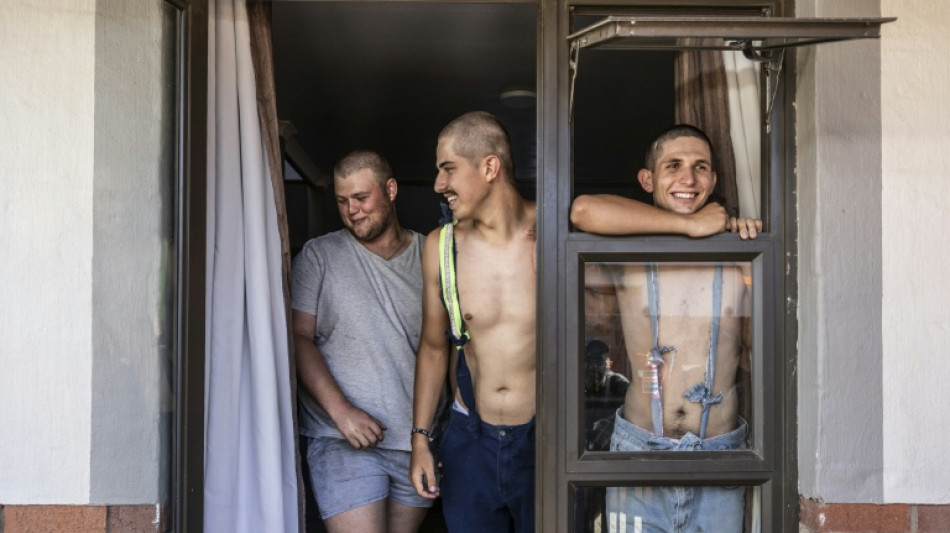
South Africa's closed white enclave attracting Afrikaner youth / Photo: CAMILLA RICHETTI - AFP
 Energy costs spark inflation surges in France, Italy

 South Korea break China hearts to reach Asian Games football final
 Eala storms into Asian Games semi-finals to thrill adoring fans

 Turkey freezes ex-minister's assets as fund crisis grows

 What we know about the North Korean POW dispute

 Most equities rise after oil price plunge, US data in focus

 Polar oceans transformed as warming melts ice habitats: research
 Lost shark becomes viral star in South Korea
 Dangote to launch $16bn refinery in Kenya
 North Korean leader 'extremely obese': Seoul spy agency
 Yankees and pope-backed White Sox start MLB playoffs with wins
 Malaysia's ex-PM Mahathir in hospital for observation
 'No limits': Marathon world record holder Sawe chasing history
 Countdown begins to biggest-ever Rugby World Cup
 Bangladesh women lose ground after quota reform
 Vietnam admits 'differing opinions' on Hanoi development
 Stocks temper gains as oil pares heavy losses, US data in focus
 New Zealand denies breaching climate commitments to EU
 Albert becomes youngest US scorer in 4-2 win over Chile
 Pirate island's plunging population shows Greece's demographic decline
 With elections ahead, Latvia's Russian-speakers reject Moscow's help
 Brazil football clubs face massive sponsorship blow from betting ban
 ChatGPT maker wants to be the App Store for AI as safety concerns grow
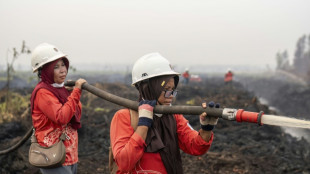 Women fight fires and sexism in Indonesian Borneo

 Forsling's OT blast lifts Florida over Carolina in NHL opener

A generation has grown up in the closed world of Orania, South Africa's whites-only Afrikaner enclave on the margins of the rainbow nation that this year celebrates its 35th anniversary.
And more young people from the white minority are moving to the small town, drawn by a new college and a sense of home carved out of the country's melting pot of cultures.
The Friday night crowd at Stokkies bar appeared mostly aged under 30, all Afrikaans-speaking descendants of the early European colonisers.
Bathed in blue light and lulled by country music, sons and daughters of Orania mingled in the tobacco smoke with students in engineering or plumbing.
The owner of Stokkies, where a table is set aside for arm-wrestling bouts to "settle disputes", has the profile of many of Orania's young people: someone who left only to return.
After moving to the town with his parents at the age of eight, Thomas de Villiers left as an adult for the cosmopolitan metropolis of Cape Town.
But the high cost of living drove him back, the 31-year-old told AFP.
- 'Not so wonderful out there' -
Charlotte van Niekerk, 22, also chose to return to the arid town, which was founded in the Northern Cape province in 1991 and now counts just over 3,000 residents.
She lived here with her parents between the ages of four and 14 before they moved to outlying farms.
"Lot of kids that grew up with me can't wait to be 18 so they can just leave this place," said the Taylor Swift lookalike who works in marketing.
"But it's funny because they go away and then a lot of the time they just come back after a couple of years when they've seen it's not so wonderful out there," she added.
She misses the cinema most of all but says the launch of a training college in 2019 has brought new energy to the town.
Nearly all its 250 students come from elsewhere, selected -- as are all residents -- on the basis of ethnicity, religion, a strong work ethic and a clean criminal record.
The college is planning for an intake of 800 students within four years, town spokesman Joost Strydom told AFP, pointing to dormitories under construction.
Few are likely to stay after graduation: jobs are scarce and the biggest nearby town, Hopetown, with 10,000 inhabitants, is 40 kilometres (25 miles) away.
But at least while they are here, the students are spending money at the petrol pump, the minimarket and at Stokkies.
"The social life is quite different from Pretoria or Joburg," said David Loock, 21.
"We go fishing in our free time," he said, as a friend took out a photograph of a huge catfish pulled from the adjoining Orange River. Motocross is another favourite pastime.
Orania's small-town feel has won over 19-year-old Divan van der Westhuizen, originally from sprawling Johannesburg about 600 km to the northeast.
"It's been a big change coming from where you mingle with a lot of people," he said.
"It did me good to be back with my own people, the Afrikaners," said van der Westhuizen, wearing a moustache and "Boere-style" shorts.
- 'We are the majority here' -
Orania's inhabitants make up only a fraction of South Africa's Afrikaner population, estimated at around 2.6 million of 62 million people in 2022.
But its reinforcement of identity appeals to young Afrikaners in much the same way as MAGA conservatives in the United States and European far-right parties, both attracting a younger demographic.
The Afrikaner minority led South Africa through much of the stark apartheid-era oppression of the black majority, who were only given the vote in 1994.
The establishment of the new "rainbow nation" led some Afrikaners to fear for the future of their culture and language.
While thousands of Afrikaners are seduced by US President Donald Trump's offer of refuge, 23-year-old Doret Le Cornu found a harbour in Orania when she moved in three years ago.
"This is a place where we want to build on that culture and not lose it," she told AFP. "We are the majority here, without having to fear that there are a bigger majority around us."
For Cara Tomlinson, 25, "Orania is a place where you can be yourself."
"In your house you can just lay down on the couch, watching TV," she said. "But at a stranger's home you should sit upright, talk to them nicely, and I think that's the difference."
M.A.Colin--AMWN