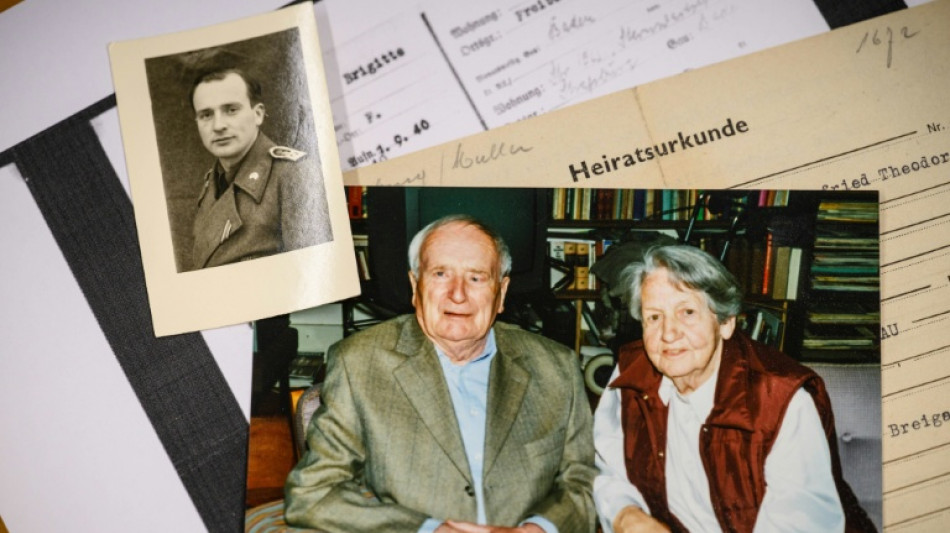
Nazi party records released online shatter German family myths / Photo: ANTHONY WALLACE - AFP
 South Korea score late to reach Asian Games football final

 Tom Kim defies jet-lag, Kho cards ace as Asian Games golf begins

 Thai teen rocker Nene aims to tour, write music... and return to school
 Ivory Coast clamps down on harmful illegal gold rush
 Nagoya mayor says sorry for Asian Games 'inconveniences'
 G20 trade officials meet under shadow of tariffs, overcapacity

 India's fat dog vote goes viral
 Asian Games crowds in spotlight as 998 see hosts in 50,000 stadium

 The eight stadiums for the 2027 Rugby World Cup

 Thieves swipe drugs under nose of Fiji police, swap with flour

 South Korea demands North apologise for DMZ mine blasts
 In Nepal's flood zone, teachers mourn students who never returned

 US Supreme Court lifts limits on third-country deportations

 Antonelli eager to 're-establish order' as F1 returns to Malaysia

 Paw-fect candidate: Australia finds new koala rescue dog

 One third of world population exposed to harmful air pollution: monitor
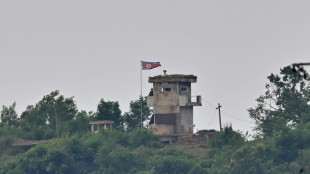 North Korea denies South's claim it was apparently behind DMZ mine blasts

 West Bank's violent settlers part of a new generation fuelled by ideology

 US-led coalition ends mission in Iraq
 Pope-backed White Sox join Braves with MLB playoff wins

 Psychology Software Tools Builds on Early Bioz Success to Expand Access to Publication-Backed Product Evidence

 Alpha Growth Management Opens Rep Office in Japan

 NBA close to picking new $12-13bn Vegas team owners: report
 LA28 Olympics torch relay to visit all 50 states
 Spain brush aside Croatia in Nations League, England down Czechs

Many German families have faced the uncomfortable question: What did grandpa do during the war? Now, the answer may be just a few clicks away -- but it may not be what they wanted to hear.
In March, the US National Archives posted online the digital scans of roughly 12 million membership cards from Adolf Hitler's Nazi party.
The records, seized by American troops after the Nazis were defeated in World War II, had previously only been available on microfilm.
Since the mass online release, secrets buried for decades were suddenly just a simple search away.
The Die Zeit and Der Spiegel media outlets quickly launched online tools to help Germans sift the archive.
"Was grandpa a Nazi?" asked the headlines on news stories across Germany.
Since then, hundreds of thousands of Germans have searched the records for names of ancestors, well aware they may face unpleasant truths.
One of them, Corinna, 60, said she learnt that her father had joined the Nazis in 1935 -- two years after Hitler seized power.
Her 26-year-old daughter Helena had found proof in the digitised archive.
"When my younger daughter told me about it on the phone, and then sent me a screenshot of the file, I was quite surprised," said Corinna, who asked that AFP not use her last name.
Corinna said she knew her father had been wounded fighting in France and Russia with the German army, but she said he had never mentioned having Nazi sympathies.
She always believed that the man, from a mining family in Germany's western Saarland region, was a lifelong member of the Social Democrats, Germany's labour party.
- Decades of silence -
While the German state has gone to great lengths to remember and atone for the country's past under the Nazis, including the Holocaust, German families have often preferred not to mention the war -- or even lie about it.
By the time Hitler's Third Reich was defeated in 1945, more than one in 10 had joined the Nazi party.
But after the war, this generation "made it clear through the atmosphere within the family that certain things should not be discussed", said historian Johannes Spohr, who has long helped families trace their ancestors' Nazi past.
Spohr said that many ex-Nazis "often didn't just remain silent, as is often claimed, but also told a different version of history" -- often portraying themselves as victims of Nazism or even members of the small anti-Nazi resistance movement.
Recent polls have shown that an implausibly high percentage of Germans -- between 11 and 18 percent -- think their grandparents tried to help those being persecuted by the Nazi regime, Spohr noted.
The real figure, according to latest historical research, is less than one percent, he said.
Felix Puelm, a 42-year-old history professor, told AFP that he discovered his now-deceased grandmother had joined the Nazis in 1940 when she was 19.
By then, he said, "she had already seen that the Nazis started war on the neighbouring countries" and "seen a great deal about where things are headed".
"And yet she still made her decision," he said.
- Complex questions -
Puelm said he wished he had known earlier and been able to "ask more questions" of his grandmother before her death.
He said his grandparents showed no sympathy for Hitler's regime after the war. "But they hadn't revealed everything they did at the time," said Puelm, who works at Thailand's Silpakorn University.
Spohr said the date that someone joined the Nazis can provide clues about their level of commitment.
"If someone joined in the 1920s or early 1930s, before Hitler came to power, it tends to indicate a conviction, that they really wanted to actively fight for the cause," said Spohr.
From 1933 onward, more people may have acted out of opportunism, to secure jobs or otherwise benefit from the Nazi hierarchy.
"There were certain professional fields where there were a lot of party members, for example civil servants and teachers," the historian told AFP.
"And you can certainly say that there was a kind of social pressure -- but nobody was forced to join the party."
Puelm told AFP that the new window into the Nazi archives might lead more Germans to reflect on the current rise of the far-right Alternative for Germany, which now leads most polls.
Puelm said he hoped revelations might prompt "many families to take the time to consider the reasons that lead them to join such a party".
Y.Nakamura--AMWN