From rubble to music: Gaza's Oud repairman / Photo: Eyad Baba - AFP
 South Korea score late to reach Asian Games football final

 Tom Kim defies jet-lag, Kho cards ace as Asian Games golf begins

 Thai teen rocker Nene aims to tour, write music... and return to school

 Ivory Coast clamps down on harmful illegal gold rush
 Nagoya mayor says sorry for Asian Games 'inconveniences'

 G20 trade officials meet under shadow of tariffs, overcapacity

 India's fat dog vote goes viral
 Asian Games crowds in spotlight as 998 see hosts in 50,000 stadium

 The eight stadiums for the 2027 Rugby World Cup

 Thieves swipe drugs under nose of Fiji police, swap with flour
 South Korea demands North apologise for DMZ mine blasts

 In Nepal's flood zone, teachers mourn students who never returned

 US Supreme Court lifts limits on third-country deportations

 Antonelli eager to 're-establish order' as F1 returns to Malaysia

 Paw-fect candidate: Australia finds new koala rescue dog

 One third of world population exposed to harmful air pollution: monitor
 North Korea denies South's claim it was apparently behind DMZ mine blasts

 West Bank's violent settlers part of a new generation fuelled by ideology

 US-led coalition ends mission in Iraq
 Pope-backed White Sox join Braves with MLB playoff wins

 Psychology Software Tools Builds on Early Bioz Success to Expand Access to Publication-Backed Product Evidence

 Alpha Growth Management Opens Rep Office in Japan

 NBA close to picking new $12-13bn Vegas team owners: report

 LA28 Olympics torch relay to visit all 50 states
 Spain brush aside Croatia in Nations League, England down Czechs

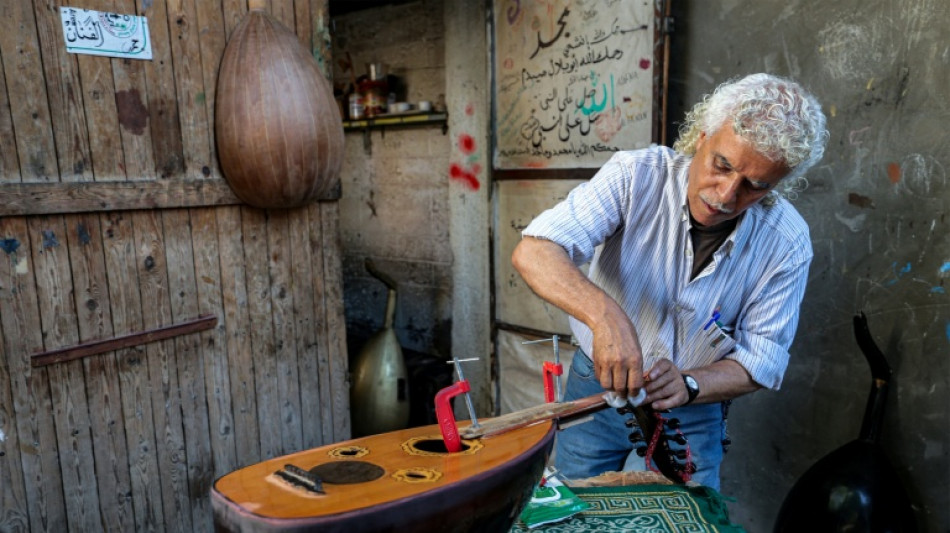
In a modest makeshift workshop tucked inside the crowded Nuseirat refugee camp in central Gaza, the soft sound of an oud echoes through the ruins of war.
Surrounded by wooden pallets, fragments of crates that held humanitarian aid, and the pieces of damaged instruments, Palestinian craftsman Suhail Abu Shawish bends carefully over a battered oud, tuning its strings after days of painstaking repair.
The treasured instrument -- scarred by shelling and destruction during the war in Gaza -- is one of many that have found their way to his workshop.
"Young people have started sending their instruments to me for repair," Abu Shawish told AFP, as a customer walked into his workshop carrying damaged instruments wrapped in black plastic bags.
Several restored instruments, bright and shining, hang on the workshop walls -- symbols of resilience, music and craftsmanship in the shadow of war.
For the 60-year-old Abu Shawish, repairing ouds is far more than a profession.
His repairs are a mission to preserve a cherished part of Palestinian cultural identity at a time when so much else has been lost.
A father of five, Abu Shawish learnt to play the oud in the 1980s. He later worked with several institutions, where he became an expert in the conservation and restoration of musical instruments.
With no proper workshop, scarce materials and frequent power shortages, the craftsman relies almost entirely on hand tools.
During the war, he was displaced to the southern city of Rafah before eventually returning to his home in Nuseirat camp.
Working in his workshop, he cuts wood manually with a saw, smooths surfaces with a file, and painstakingly glues together shattered pieces that many would deem beyond repair.
"Despite the shortage of wood and its high prices, they turn to me," Abu Shawish said.
"Despite the hardship of war, we continue to work," said the white haired musician, dressed in a blue shirt and jeans.
For him, every restored instrument is a small victory against the devastation surrounding him.
"I love buying ouds, and I am also an oud player," Abu Shawish said.
- 'Made in Gaza' -
Customers arrive hoping he can restore the warm, distinctive sound that has echoed through Arab culture for centuries.
Yet the challenges facing the craftsman are immense.
Wood traditionally used in oud-making has become nearly impossible to obtain.
Import restrictions and shortages have forced Abu Shawish to become resourceful.
He now scavenges wood from discarded food aid crates, transforming waste scraps into replacement parts.
Pieces salvaged from severely damaged ouds are carefully reused to repair others.
"There is no wood available," Abu Shwaish explained.
"We buy scrap wood from aid boxes and use damaged instruments to repair other instruments."
The soaring cost of materials has compounded the struggle.
Glue that once cost 20 shekels ($6.7) now sells for around 60, while the price of thinner has risen dramatically, placing essential supplies beyond the reach of many craftsmen, he said.
Electricity, another necessity for modern woodworking, is largely unavailable in Gaza.
"We work manually with a saw and a file using our hands, which is very difficult for us," he said, which adds hours of labour while repairing each instrument.
Still, Abu Shawish refuses to give up.
As sunlight filters through the workshop, he applies the final touches to a restored oud before gently strumming its strings.
The instrument responds with a sound that momentarily transcends the hardships outside.
Abu Shawish hopes one day to manufacture high-quality Palestinian instruments that can compete internationally and showcase Gaza's craftsmanship to the world.
"We hope conditions improve and they will allow us to import wood, glue and other materials," he said.
"We want to work like the rest of the world, compete globally, and start manufacturing products that we can proudly say are Palestinian-made and made in Gaza," he said, his fingers gently tuning the strings of a restored oud.
L.Durand--AMWN