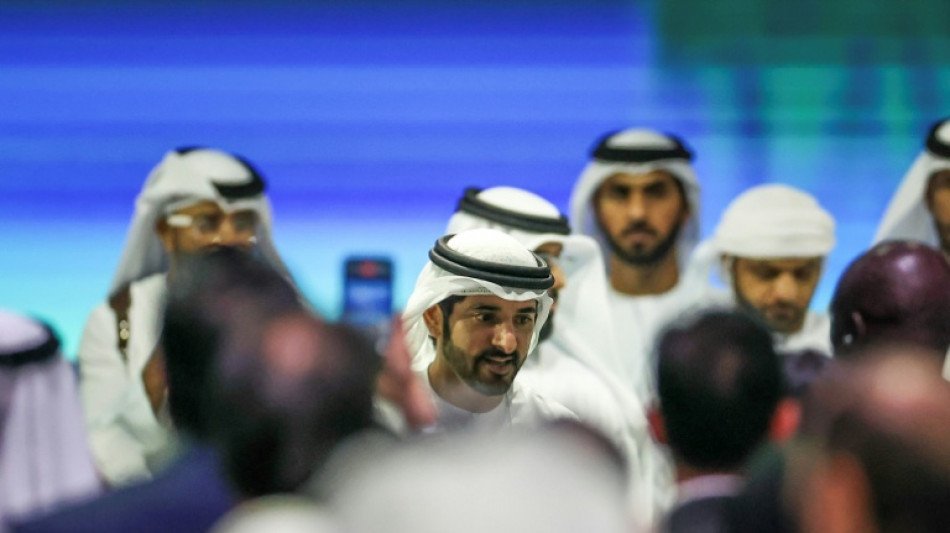
AI romance scam impersonating Dubai prince ensnares victims / Photo: FADEL SENNA - AFP
 South Korea score late to reach Asian Games football final

 Tom Kim defies jet-lag, Kho cards ace as Asian Games golf begins

 Thai teen rocker Nene aims to tour, write music... and return to school
 Ivory Coast clamps down on harmful illegal gold rush
 Nagoya mayor says sorry for Asian Games 'inconveniences'

 G20 trade officials meet under shadow of tariffs, overcapacity

 India's fat dog vote goes viral

 Asian Games crowds in spotlight as 998 see hosts in 50,000 stadium

 The eight stadiums for the 2027 Rugby World Cup

 Thieves swipe drugs under nose of Fiji police, swap with flour

 South Korea demands North apologise for DMZ mine blasts

 In Nepal's flood zone, teachers mourn students who never returned

 US Supreme Court lifts limits on third-country deportations

 Antonelli eager to 're-establish order' as F1 returns to Malaysia

 Paw-fect candidate: Australia finds new koala rescue dog

 One third of world population exposed to harmful air pollution: monitor

 North Korea denies South's claim it was apparently behind DMZ mine blasts

 West Bank's violent settlers part of a new generation fuelled by ideology

 US-led coalition ends mission in Iraq

 Pope-backed White Sox join Braves with MLB playoff wins

 Psychology Software Tools Builds on Early Bioz Success to Expand Access to Publication-Backed Product Evidence

 Alpha Growth Management Opens Rep Office in Japan

 NBA close to picking new $12-13bn Vegas team owners: report
 LA28 Olympics torch relay to visit all 50 states
 Spain brush aside Croatia in Nations League, England down Czechs

Maria believed she was romancing a prince from Dubai, captivated by his flirtatious smile and declarations of affection he showered on her during live video calls. But the suitor was an AI deepfake, making her yet another victim of an online romance scam.
The case illustrates how fraudsters posing as the real-life crown prince of Dubai ensnare victims by cultivating online relationships before swindling them out of money, with researchers tracing some of the scams to crime syndicates in Nigeria.
Maria met the scammer impersonating Prince Hamdan bin Mohammed, also known by his pen name Fazza, on a dating site before the conversation moved to a messaging app where he bombarded her with romantic messages.
"He kept on messaging me even when I was sleeping," the Filipino domestic worker told AFP, requesting that her real name and age be withheld.
"It felt like there was a love spell that connected our minds."
In one recording of a WhatsApp video call seen by AFP, the scammer, appearing lifelike as the prince, flickered on the screen. His words matched his lip movements, but not the prince's voice.
"Hello beloved," the voice told Maria. "I really appreciate your love and support."
Maria, who was initially too lovelorn to suspect fraud, lost a year's worth of savings.
The scammer manipulated her into paying 100,000 pesos ($1,625) for what he claimed were a marriage certificate and a "royal membership card," which he said would help her secure a job in Dubai.
Her suspicion arose when he proposed meeting her at a hotel and demanded another 60,000 pesos ($974) for the booking. When she scrutinized his Facebook page, which has since been taken down, she noticed the account was based in Nigeria.
She cut off communication, sending one final message: "Go to hell, scammer."
"Many people told me it's good I didn't go crazy after this experience," Maria said.
- Blowing-kiss emojis -
The fraud is part of a broader ecosystem of what have become known as "fake Dubai prince" scams targeting both hearts and wallets.
Scammers exploit the Emirati royal's likeness by drawing on his vast online presence, including his more than 17 million Instagram followers, and sometimes even copying the prince's authentic poems to deceive victims.
AFP identified multiple Facebook groups impersonating the royal, some with thousands of followers, inviting users to WhatsApp or Telegram chats with the "prince."
The groups post manipulated but lifelike images, including one depicting the prince on one knee and holding a ring, and another showing him offering a red rose alongside the caption: "Sweetheart can I get a 'love you' on WhatsApp?"
While some users warned in the comments that the posts are scams, many others responded with hearts and blowing-kiss emojis.
As the fraud spreads, awareness groups have sprung up to alert users, including one on Instagram called "Do not fall for fake prince."
A change.org petition titled "Stop Fazza Scam" called on Sheikh Hamdan's staff to raise awareness against scammers impersonating the royal using Dubai phone numbers and "requesting large sums of money, either as donations or marriage certificates, all of which are forged."
"Significant payments are requested in banks in countries other than those of victims, sometimes even in crypto currencies, making it harder to trace," the petition said.
- 'Technology is improving' -
Dubai authorities did not respond to AFP's request for comment.
He is far from the only public figure whose identity has been exploited by scammers. Last year, French authorities launched a probe to identify fraudsters posing as Brad Pitt who scammed a woman out of 830,000 euros ($945,000).
The Global Anti-Scam Alliance estimates that consumers worldwide lost $442 billion to scams, including romance fraud, last year.
It was unclear which AI tools were used to generate the real-time video chats with Maria.
The internet is awash with AI-powered face-swapping technology and a new generation of motion-control tools capable of producing highly realistic videos, allowing users to precisely manipulate a person's movements and facial expressions in real time.
'The technology is improving rapidly, and it is likely that soon real-time video deepfakes will become better and better," Cornell University's David Rand told AFP.
"Once this happens, it becomes fundamentally impossible to tell whether any not-in-person conversation is real."
burs-ac/msp
P.Silva--AMWN