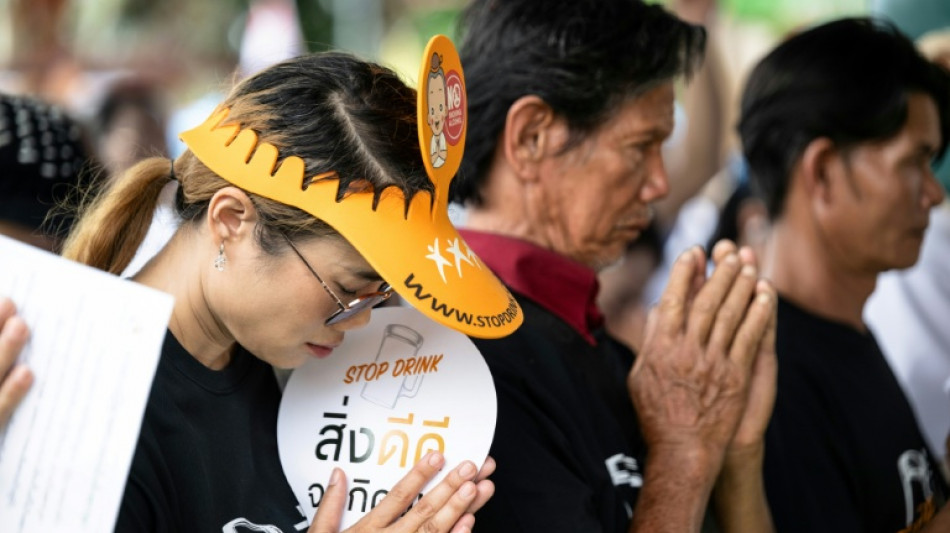
Millions of Thais banish the booze for Buddhist Lent / Photo: Lillian SUWANRUMPHA - AFP
 Dangote to launch $16bn refinery in Kenya

 North Korean leader 'extremely obese': Seoul spy agency

 Yankees and pope-backed White Sox start MLB playoffs with wins

 Malaysia's ex-PM Mahathir in hospital for observation

 'No limits': Marathon world record holder Sawe chasing history

 Countdown begins to biggest-ever Rugby World Cup

 Bangladesh women lose ground after quota reform

 Vietnam admits 'differing opinions' on Hanoi development
 Stocks temper gains as oil pares heavy losses, US data in focus

 New Zealand denies breaching climate commitments to EU

 Albert becomes youngest US scorer in 4-2 win over Chile

 Pirate island's plunging population shows Greece's demographic decline
 With elections ahead, Latvia's Russian-speakers reject Moscow's help

 Brazil football clubs face massive sponsorship blow from betting ban
 ChatGPT maker wants to be the App Store for AI as safety concerns grow

 Women fight fires and sexism in Indonesian Borneo

 Forsling's OT blast lifts Florida over Carolina in NHL opener

 Alpha Growth Management Opens Rep Office in Japan

 NBA close to picking new $12-13bn Vegas team owners: report
 LA28 Olympics torch relay to visit all 50 states

 Spain brush aside Croatia in Nations League, England down Czechs

 Trump hails 'morally binding' AI self-regulation pledge

 Yamal inspires Spain to Croatia romp on World Cup homecoming

 UN to hold fourth informal poll of secretary-general candidates

 Who are the Emiratis behind crisis-hit Manchester City?

With her palms pressed together and her head bowed, Wassana Nak-umma vowed to give up alcohol for three months, joining millions of Thais in an abstinence campaign blending public health with spirituality.
The 42-year-old housewife, who took the pledge at a Buddhist temple in Samut Sakhon, west of Bangkok, admitted she used to be a "heavy drinker".
"I used to get so drunk that my kids had to clean up my vomit," she told AFP candidly.
But a concerned relative persuaded her to join a campaign to give up alcohol during Khao Phansa, a three-month period of reflection observed by Buddhists akin to Christian Lent.
"I still craved it. Whenever I saw people buying liquor or beer at stores, I would look at them and want to drink like them," she said.
"But I held back, telling myself it was only three months. After that three-month period, I realised, 'Hey, I can do this! Next year, I must do it again'."
That was in 2024. Wassana went back to drinking, but in moderation, and this week joined hundreds in Samut Sakhon to pledge abstinence for her third year.
Avoiding drugs and alcohol is a key precept of Buddhism.
But Thailand, where more than 90 percent of the population identify as Buddhist, has the third highest per capita consumption of alcohol in Asia, according to 2024 data from the World Health Organization (WHO).
It was to address this paradox that the so-called Buddhist Lent campaign began in 2003, and last year it claimed more than eight million adherents.
- Spiritual anchor -
The start of Khao Phansa on Thursday was a joyous affair in the rural province of Samut Sakhon, featuring offerings to monks and traditional dances.
Dozens of people also paraded through the village on "salengs" -- scooters with sidecars used locally to transport coconuts -- brandishing placards featuring images of healthy, smiling livers.
Phayom Raksa solemnly recited a pledge that touched on the teachings of the Buddha, and mentioned Thailand's king and the well-being of the nation.
The 66-year-old former coconut farmer stopped drinking entirely after participating in the campaign for the first time six years ago.
"My kids were ashamed of me -- their dad got drunk every day and didn't care about them," he told AFP, saying that he also spent all his money on alcohol.
But he now urged others to follow his example, saying: "I'd like everyone to try doing what I did -- to think and look at positive things."
Abstinence campaigns have gathered ground in many countries in recent years, notably the trend to pursue a "Dry January" after Christmas and New Year's Eve excesses.
They are often linked to an increased focus on healthy behaviour.
But Ubolwan Kongsawang, a regional volunteer with Thialand's Stop Drinking Network, said the Buddhist Lent campaign provides a "spiritual anchor" that boosts motivation.
"When individuals take a pledge before a Buddha image, at a temple, or within their community, they feel bound to honour their word," she said.
- 'Beyond Lent' -
Organisers of the campaign have revamped their messaging this year, emphasising how giving up or even cutting down alcohol consumption can result in improved health, better relationships -- and crucially, save money.
"Our goal is not necessarily total abstinence for everyone," said Dr. Pongthep Wongwatcharapaiboon, director of the Thai Health Promotion Foundation, a government agency.
"Many reduce their consumption and discover the health benefits, which is already a success."
Thailand in December relaxed decades-old restrictions on selling alcohol in the afternoon, which were originally intended to stop government employees drinking on the job.
But it remains banned on religious public holidays and around elections.
One advertisement for the Buddhist Lent campaign focuses on the social pressure to drink, in a culture where alcohol is everywhere, from funerals to festivals.
"We are trying to transform the drinking culture itself, not just reduce individual consumption," says Teera Wacharaprannee, head of the Stop Drinking Network.
"Our strategy is to continue beyond Lent, supporting villages and communities to reduce alcohol in daily life."
Y.Kobayashi--AMWN