Self-taught Turkish 'linguist' keeps dead language alive / Photo: Ozan KOSE - AFP
 Dangote to launch $16bn refinery in Kenya
 North Korean leader 'extremely obese': Seoul spy agency
 Yankees and pope-backed White Sox start MLB playoffs with wins
 Malaysia's ex-PM Mahathir in hospital for observation
 'No limits': Marathon world record holder Sawe chasing history

 Countdown begins to biggest-ever Rugby World Cup
 Bangladesh women lose ground after quota reform
 Vietnam admits 'differing opinions' on Hanoi development
 Stocks temper gains as oil pares heavy losses, US data in focus
 New Zealand denies breaching climate commitments to EU

 Albert becomes youngest US scorer in 4-2 win over Chile
 Pirate island's plunging population shows Greece's demographic decline
 With elections ahead, Latvia's Russian-speakers reject Moscow's help
 Brazil football clubs face massive sponsorship blow from betting ban
 ChatGPT maker wants to be the App Store for AI as safety concerns grow
 Women fight fires and sexism in Indonesian Borneo

 Forsling's OT blast lifts Florida over Carolina in NHL opener
 Alpha Growth Management Opens Rep Office in Japan

 NBA close to picking new $12-13bn Vegas team owners: report
 LA28 Olympics torch relay to visit all 50 states
 Spain brush aside Croatia in Nations League, England down Czechs

 Trump hails 'morally binding' AI self-regulation pledge
 Yamal inspires Spain to Croatia romp on World Cup homecoming

 UN to hold fourth informal poll of secretary-general candidates
 Who are the Emiratis behind crisis-hit Manchester City?

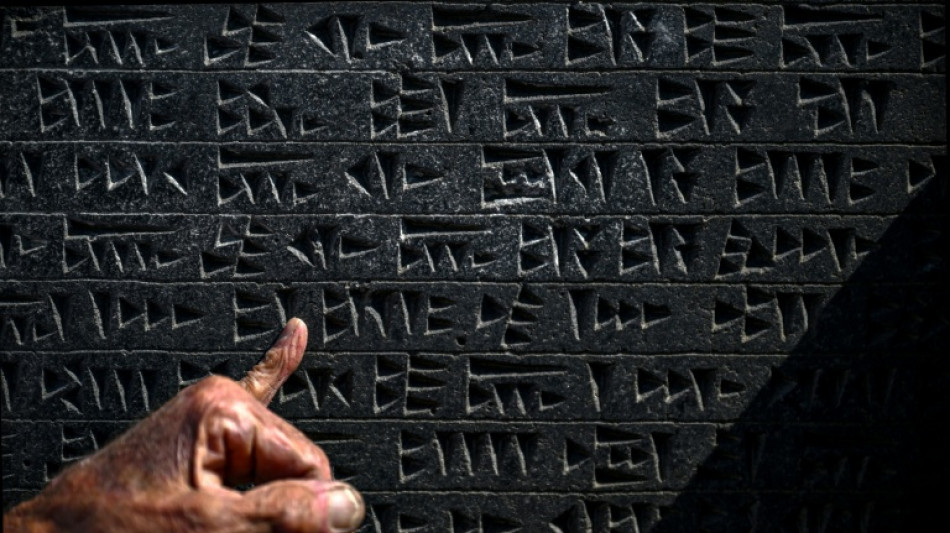
Mehmet Kusman did not spend very long at school, but he traced the ancient inscriptions chiselled into the black basalt rock and read: "Before me there was nothing. But by the power of the god Haldi I founded this city."
Kusman, 86, has dedicated his life to the fortress of Cavustepe in eastern Turkey, and to learning the language of the vanished kingdom of Urartu, to honour its forgotten gods and rulers.
Brisk of step and sharp of mind despite his years and the hot winds that whip the castle, he stood at the foundations of a temple dedicated to Haldi, the warrior god of gods. Kusman wore a cap bought in Los Angeles on which he has written "USA 2009" in the cuneiform script typical of the region's ancient civilisations.
Kusman was hired as a labourer on the Cavustepe excavations after his military service in the 1960s and there encountered his first stele.
"The inscription was very beautiful," he told AFP. But the head of the dig discouraged him from learning this "very difficult" script, which borrowed its cuneiform alphabet from Assyrian.
"His telling me 'No' hurt me," he said. "I became relentless, thinking: 'In my lifetime, I will learn it.'"
Despite a lack of formal education, Kusman began copying the inscriptions found during excavations carried out in eastern Turkey, Iran and Armenia, over which Urartu once stretched.
In three years, he said, he mastered the alphabet, but "it took me 22 years to master 650 words" of vocabulary.
- One of the last -
Academics contacted by AFP praised Kusman's enthusiasm and devotion. He has become something of a local curiosity, calling himself "one of the last seven people in Turkey to speak the Urartian language."
Erkan Konyar, professor of ancient history at Istanbul University, describes the kingdom as "one of the most powerful states of the ancient Near East, between the 9th and 7th centuries BC."
Urartu -- more recent than the great Mesopotamian kingdoms of Assyria, Sumeria and Babylon -- brought the tribal mountain communities together under a centralised state, building cities, fortresses, irrigation networks and vast food storage facilities, Konyar said.
Despite retiring in 2005, Kusman continues to watch over Cavustepe, said Konyar, a specialist on Tuspa, the kingdom's founding capital.
"For 60 years, he has lived amid the excavations and introduced thousands of visitors to the history of Urartu."
But Konyar is careful to qualify Kusman's claims to speak the language. In fact, historians do not really know how it was pronounced, he said.
"The available inscriptions allow us to understand it up to a certain point, but we lack vocabulary and texts," he said. "Only the meaning of certain words is known with certainty. So no one can claim to speak Urartian."
"Even in the time of Urartu, people did not speak this language; it was only written," said Mehmet Isikli, director of the Department of Near Eastern Archaeology at Ataturk University in Erzurum.
- 'Grandson of the Urartians' –
Kusman's passion for the language has made him a local celebrity. His lectures have taken him "to America, five times, to Germany, the Netherlands, Belgium," he said, reeling off the list with a touch of showmanship.
"Now, I'm thinking of going to Japan," he added.
Isikli is excavating the fortress of Ayanis, the last of the great strongholds built in the kingdom before it collapsed, 35 kilometres (22 miles) north of Van, with a commanding view of the lake.
"Our excavations may tell us something about the end of Urartu," he said, noting that researchers have found "the traces of a very powerful earthquake."
Isikli admits to a certain respect for the old guardian.
"I admire him," he added. "He has worked hard and brought Urartian culture to light.
"Mehmet Kusman provides a sort of publicity for Urartu, but it has nothing to do with academic work: he knows only a few alphabetical signs, or a few letters, and some very, very general information about them."
In his small stone hut at the entrance to the Cavustepe site, Kusman is undaunted by the doubters.
"I am a descendant of the Urartians, their grandson," he said. "They disappeared, but look, they are not all dead," he declared, as he stood to welcome visitors.
P.Silva--AMWN