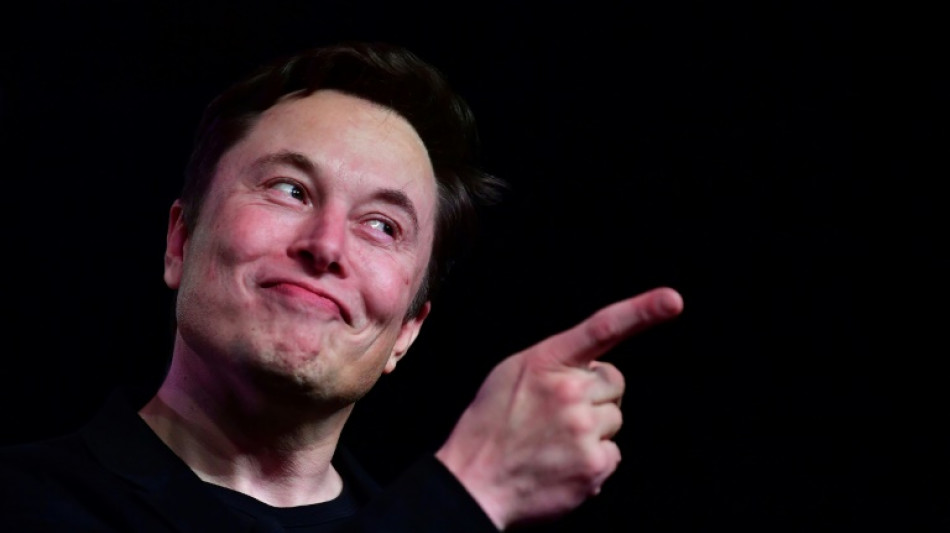
Musk vows interface implants in human brains within six months / Photo: Frederic J. BROWN - AFP/File
 Teatro Mayor Unveils 152-Performance 2027 Season Highlighting Beethoven and García Márquez

 Rutgers Defeats NJIT 101-64 Behind Francis and Mark Scores

 Thukukile Zuma Resigns from ANC Johannesburg Leadership Amid Disciplinary Dispute

 CM Mohan Yadav Meets Bohra Spiritual Leader to Discuss Simhastha 2028 and Development

 Eli Crane Defeats Jonathan Nez in Tight Arizona Congressional Race

 Sherilyn Smith Encourages Women to Embrace Scars as Symbols of Resilience
Tech billionaire Elon Musk said on Wednesday one of his companies would in six months be able to implant a device into a human brain that would allow communication with a computer.
The interface, produced by Musk's start-up Neuralink, would allow the user to communicate directly with computers through their thoughts, he said.
"We've submitted I think most of our paperwork to the FDA (US Food and Drug Administration) and we think probably in about six months we should be able to have our first Neuralink in a human," he said in a company presentation.
"We've been working hard to be ready for our first human (implant), and obviously we want to be extremely careful and certain that it will work well before putting a device in a human," he said.
Musk -- who bought Twitter last month and also owns SpaceX, Tesla and several other companies -- has been known to make ambitious predictions about his companies, with several not becoming reality.
In July 2019, he vowed that Neuralink would be able to perform its first tests on humans in 2020.
The prototypes, which are the size of a coin, have been implanted in the skulls of monkeys.
At the Neuralink presentation, the company showed several monkeys "playing" basic video games or moving a cursor on a screen through their Neuralink implant.
Musk said the company would try to use the implants to restore vision and mobility in humans.
"We would initially enable someone who has almost no ability to operate their muscles... and enable them to operate their phone faster than someone who has working hands," he said.
"As miraculous as it may sound, we are confident that it is possible to restore full body functionality to someone who has a severed spinal cord," he said.
Beyond the potential to treat neurological diseases, Musk's ultimate goal is to ensure that humans are not intellectually overwhelmed by artificial intelligence, he said.
Other companies working on similar systems include Synchron, which announced in July that it had implanted the first brain-machine interface in the United States.
O.Johnson--AMWN