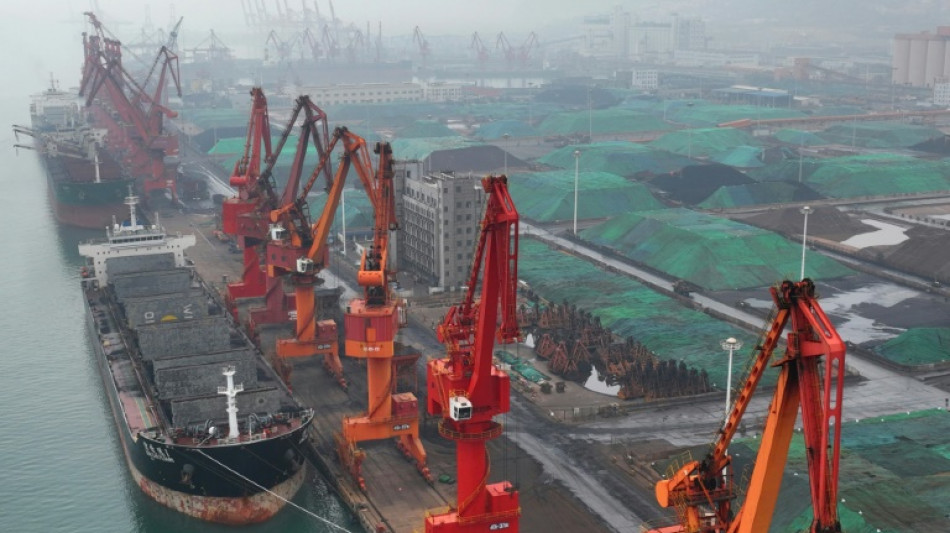
China's November imports, exports plunge due to Covid rules / Photo: STR - AFP
 Teatro Mayor Unveils 152-Performance 2027 Season Highlighting Beethoven and García Márquez

 Rutgers Defeats NJIT 101-64 Behind Francis and Mark Scores

 Thukukile Zuma Resigns from ANC Johannesburg Leadership Amid Disciplinary Dispute

 CM Mohan Yadav Meets Bohra Spiritual Leader to Discuss Simhastha 2028 and Development

 Eli Crane Defeats Jonathan Nez in Tight Arizona Congressional Race

 Sherilyn Smith Encourages Women to Embrace Scars as Symbols of Resilience
China's imports and exports plunged in November to levels not seen since early 2020, official figures showed Wednesday, as severe Covid restrictions hit the economy hard.
The last major economy still wedded to a zero-tolerance virus policy, Beijing's snap lockdowns, travel curbs and mass testing have stifled business activity, disrupted supply chains and dampened consumption.
Imports in November fell 10.6 percent year-on-year, the biggest drop since May 2020, according to the General Administration of Customs.
Meanwhile, exports fell 8.7 percent over the same period -- the steepest decline since February 2020, when the country was mired in the early stages of the pandemic.
"Weakening domestic and foreign demand, Covid disruptions and a rising comparison base lead to a perfect but well-expected storm to China's exports and imports," Bruce Pang, chief economist at Jones Lang LaSalle, told Bloomberg News.
The figures are the latest in a string of gloomy economic indicators as the world's number two economy charts a faltering path out of zero-Covid.
Official data last week showed China's factory activity shrank for a second straight month in November, as large swathes of the country were hit by lockdowns and transport disruptions.
The Purchasing Managers' Index -- a key gauge of manufacturing -- fell to 48.0 from 49.2 the month prior, well below the 50-point mark separating growth from contraction, according to the National Bureau of Statistics.
"In November, the pandemic had a negative impact on the production and operation of some enterprises, production somewhat slowed, and product order volumes decreased," the bureau's senior statistician Zhao Qinghe said.
Some suppliers had complained of transport and logistics problems, while demand from both the domestic and overseas markets fell, he added.
- 'Bumpy reopening' -
China's ruling Communist Party has signalled a shift in Covid messaging since the country's largest protests in decades took aim last week at lockdowns and other measures.
Local authorities have begun easing testing requirements and other restrictions, but travel between provinces remains complicated and health measures continue to vary from place to place.
"The zero-Covid policy has been loosened, but mobility has not recovered much on the national level," said Zhiwei Zhang, chief economist of Pinpoint Asset Management.
"I expect exports will stay weak in the next few months as China goes through a bumpy reopening process," he added.
"As global demand weakens in 2023, China will have to rely more on domestic demand."
Chinese leaders have set an annual economic growth target of about 5.5 percent, but many observers think the country will struggle to hit it, despite announcing a better-than-expected 3.9 percent expansion in the third quarter.
Y.Nakamura--AMWN