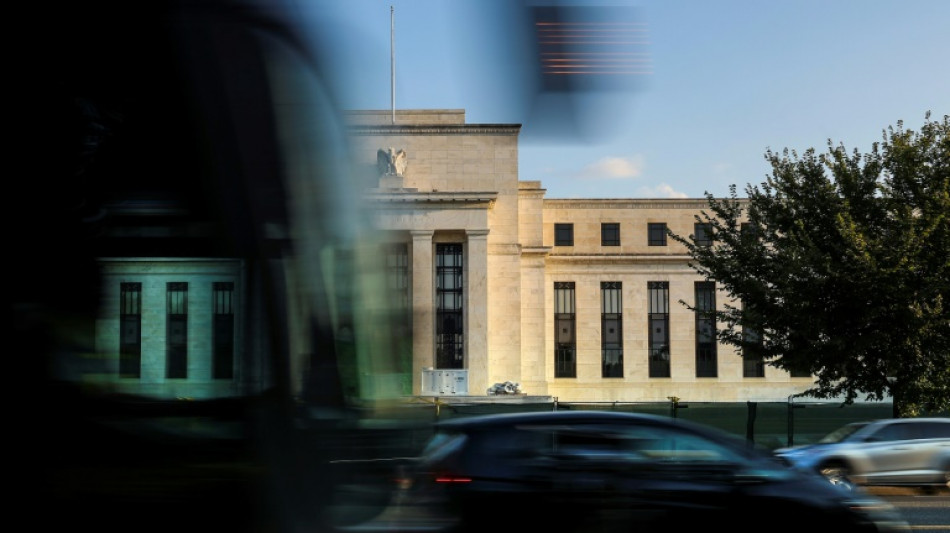
Fed opens meeting with smaller rate hike in the cards / Photo: Kevin Dietsch - GETTY IMAGES NORTH AMERICA/AFP/File
 Teatro Mayor Unveils 152-Performance 2027 Season Highlighting Beethoven and García Márquez

 Rutgers Defeats NJIT 101-64 Behind Francis and Mark Scores

 Thukukile Zuma Resigns from ANC Johannesburg Leadership Amid Disciplinary Dispute

 CM Mohan Yadav Meets Bohra Spiritual Leader to Discuss Simhastha 2028 and Development

 Eli Crane Defeats Jonathan Nez in Tight Arizona Congressional Race

 Sherilyn Smith Encourages Women to Embrace Scars as Symbols of Resilience
US central bankers started a two-day policy meeting Tuesday, with all eyes searching for clear signs that decades-high inflation in the world's biggest economy is definitively slowing.
The Federal Reserve is widely expected to implement a smaller hike than previous ones in the benchmark lending rate after officials convene, with consumer prices easing and sectors like housing already reeling from tightening policy.
Indeed, US consumer inflation eased in November, according to government data released Tuesday, bringing some relief to policymakers with the smallest annual increase in nearly a year.
The consumer price index (CPI), a closely-watched measure of inflation, jumped 7.1 percent from a year ago, down from 7.7 percent in October, the Labor Department said.
As costs rocketed this year, worsened by Russia's invasion of Ukraine and China's zero-Covid measures, the US central bank hiked interest rates six times, bringing its range from close to zero to between 3.75 percent and four percent.
The aim was to make borrowing more expensive and lower demand, eventually reining in price increases.
With the pace of inflation ticking down in recent months, analysts expect policymakers to opt for a 0.5-point rate hike this week.
While this is still a steep rise, it marks a step down after four bumper 0.75-point hikes.
A Fed spokesperson confirmed the policy-setting Federal Open Market Committee (FOMC) started its meeting as scheduled on Tuesday, and it is scheduled to announce its decision on Wednesday afternoon.
"Inflation seems to have peaked... We've seen goods inflation become negative recently. But we need service price inflation to come down," said Marc Giannoni, chief US economist at Barclays.
Wage pressures will have to ease, he told AFP, adding that it will be hard to have "sustainably low inflation without having some slowing on the labor market, and some slowing in particular on the demand for services."
Policy makers are watching wage changes, given concerns that fast-growing salaries will add to the costs of delivering services.
But economists caution that a lower headline number does not mean the Fed will immediately step on the brakes in its forceful campaign to cool the economy.
"Powell recently noted there hasn't been clear progress toward returning inflation to the (longer-term) two percent target," said Oren Klachkin of Oxford Economics.
Even with inflation cooling in November, "it doesn't mean the Fed is finished raising interest rates," he said.
"Inflation is the Fed's sole focus at the moment, and will dictate the trajectory of monetary policy," he added.
To get inflation to two percent over time, month-on-month readings need to average 0.17 percent for several months, added economist James Knightley of ING.
"We are not there yet... It is too soon for the Fed to relax," he said.
P.Santos--AMWN