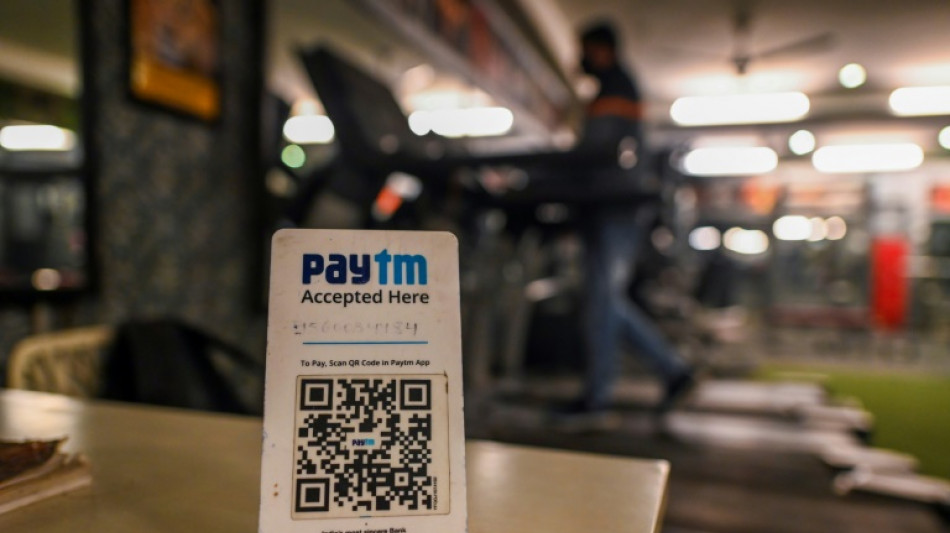
India's Paytm to buy back shares after 75% stock rout / Photo: Sajjad HUSSAIN - AFP
 Teatro Mayor Unveils 152-Performance 2027 Season Highlighting Beethoven and García Márquez

 Rutgers Defeats NJIT 101-64 Behind Francis and Mark Scores

 Thukukile Zuma Resigns from ANC Johannesburg Leadership Amid Disciplinary Dispute

 CM Mohan Yadav Meets Bohra Spiritual Leader to Discuss Simhastha 2028 and Development

 Eli Crane Defeats Jonathan Nez in Tight Arizona Congressional Race

 Sherilyn Smith Encourages Women to Embrace Scars as Symbols of Resilience
Indian mobile payments giant Paytm will launch a share buyback, it said Tuesday, offering investors little more than a third of what they paid just over a year ago in the country's then-biggest IPO.
Paytm's shares have nosedived 75 percent since its $2.5 billion flotation in November 2021, demonstrating the risks of overpriced share offers in loss-making tech firms.
Its market debut came in the midst of an IPO frenzy in Asia's third-largest economy last year, with start-ups attracting billions of dollars in investment in a bright spot in the Covid-battered economy.
But the shares nosedived 27 percent on their first day of trading due to concerns about losses, dropping further in subsequent months before settling to trade at a quarter of their IPO value.
Paytm said it will buy shares back at 810 rupees ($9.80) each, a steep 62 percent discount to the IPO price of 2,150 rupees, but a 50 percent premium on Tuesday's closing price.
Founder Vijay Shekhar Sharma, once named India's youngest billionaire, has dropped off Forbes' list of 100 richest Indians after his personal net worth -- $2.4 billion at the IPO price -- eroded in line with his company's stock price.
The stock collapse raises concerns for Paytm's biggest shareholders, which include Softbank, Alibaba, Berkshire Hathaway and Canada Pension Plan Investment Board, many of which are also grappling with a global tech stock meltdown.
"We value our shareholders and their journey with us in the public markets," Sharma said in a statement, promising that the $103 million buyback "will be immensely beneficial for our stakeholders and will drive long-term shareholder value".
The firm remains deeply in the red, reporting a net loss of 5.7 billion rupees in the quarter ended September 30, despite a 76 percent jump in revenues.
But in a disclosure to stock exchanges, it insisted it was "on a clear path to deliver cash flow profitability".
Paytm's platform was launched in 2010 and quickly became synonymous with digital payments in a country traditionally dominated by cash transactions.
It has benefited from the government's efforts to curb the use of cash -- including the demonetisation of nearly all banknotes in circulation five years ago -- and most recently, from the pandemic.
Indian shop owners, taxi and rickshaw drivers and other vendors accept payments as low as 10 rupees ($0.13) using Paytm's ubiquitous blue-and-white QR code stickers.
Merchant payments rose 37 percent year-on-year to $28 billion in the months of October and November, the company said in a business update released Monday.
More than 84 million customers used Paytm's diversified marketplace and payments app in the months of October and November, the company said, up from 80 million in the quarter ended September 30.
Y.Kobayashi--AMWN