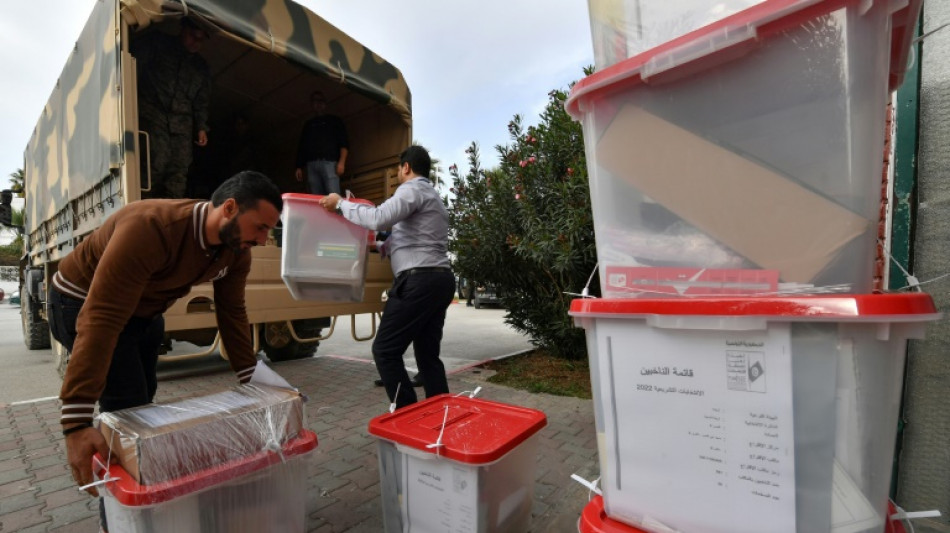
Tunisians to vote on toothless parliament in poll shunned by opposition / Photo: FETHI BELAID - AFP
 Teatro Mayor Unveils 152-Performance 2027 Season Highlighting Beethoven and García Márquez

 Rutgers Defeats NJIT 101-64 Behind Francis and Mark Scores
 Guardian Metal Resources PLC Announces Proposed Spin-Out of Non-Tungsten Projects

 Fulcrum Metals PLC Announces New Critical Mineral Recoveries Expand Potential

 Thukukile Zuma Resigns from ANC Johannesburg Leadership Amid Disciplinary Dispute

 CM Mohan Yadav Meets Bohra Spiritual Leader to Discuss Simhastha 2028 and Development

 Eli Crane Defeats Jonathan Nez in Tight Arizona Congressional Race

Tunisia holds a lacklustre election on Saturday for a parliament with virtually no power, the final pillar in President Kais Saied's political overhaul in the birthplace of the Arab Spring.
The vote comes after three weeks of barely noticeable campaigning, with few posters in the streets and no serious debate among a public largely preoccupied with pressing financial concerns.
Opposition political groups in the North African country have called for a boycott, saying the poll is part of a "coup" against the only democracy to have emerged from the 2011 wave of uprisings across the region.
Last year, after months of political deadlock and economic crisis exacerbated by the coronavirus pandemic, Saied suspended parliament and sent tanks to surround it in a dramatic power grab more than a decade after a popular revolution unseated dictator Zine El Abidine Ben Ali.
Saied, a former law professor, has since pushed through a new constitution giving the presidency almost unrestrained powers and laying the ground for a 161-seat rubber-stamp legislature.
His moves were initially supported by many Tunisians tired of the messy and corrupt democratic system in the post-Ben Ali era.
But almost a year and half on, the country's economic woes have gone from bad to worse, with 10 percent inflation and frequent shortages of milk, sugar and petrol fuelling a growing wave of emigration.
- 'No political weight' -
The previous legislature had far-reaching powers in the mixed presidential-parliamentary system enshrined in Tunisia's post-revolution constitution.
But candidates in Saturday's poll are standing as individuals under a system that neuters political parties including Saied's nemesis, the once powerful Islamist-leaning Ennahdha party.
The new chamber "won't be able to appoint a government or censure it, except under draconian conditions that are almost impossible to meet," said analyst Hamadi Redissi.
Analyst Hamza Meddeb told AFP the election was a "non-event" and predicted that few Tunisians would turn out to vote.
"This election is a formality to complete the political system imposed by Kais Saied and concentrate power in his hands," he said.
"Tunisians know that this parliament will have no political weight and will be stripped of all power."
Meddeb added that most of the candidates are "political newcomers" unable to mobilise a public struggling with "extremely difficult" economic conditions.
The Tunisian Observatory for Democratic Transition, a non-governmental organisation, said around half the candidates are either teachers or mid-level civil servants.
And in contrast with the previous gender-equal system, women represent less than 15 percent of all candidates for the new parliament, according to the official list released by the election board.
- IMF bailout 'easier' -
Almost all of Tunisia's political parties, including Ennahdha, have said they will boycott the vote.
The powerful UGTT trade union federation has called the poll meaningless.
Al Bawsala, a civil society group that has monitored Tunisia's parliamentary politics since 2014, said it would boycott the activities of what it called a "puppet parliament" whose only role would be to "back the president's programme".
Hamish Kinnear of risk intelligence firm Verisk Maplecroft said the vote would "serve primarily as a tool for President Kais Saied to legitimise his grip on power".
But it would also "ease Tunisia's relations with key external partners by closing out 17 months of constitutional and governance uncertainty", Kinnear added.
Tunisia is in the final stages of negotiating a nearly $2-billion bailout package from the International Monetary Fund (IMF) to rescue its crisis-hit public finances.
Kinnear said the vote meant "securing financial assistance... will be easier now that greater political predictability is returning, even if the democratic legitimacy of the (constitutional) referendum and upcoming legislative elections is weak."
The IMF's top committee was set to approve next week the country's fourth loan in 10 years, but has postponed its decision until early January at the request of the Tunisian government pending final measures, a source close to the talks told AFP.
P.Costa--AMWN