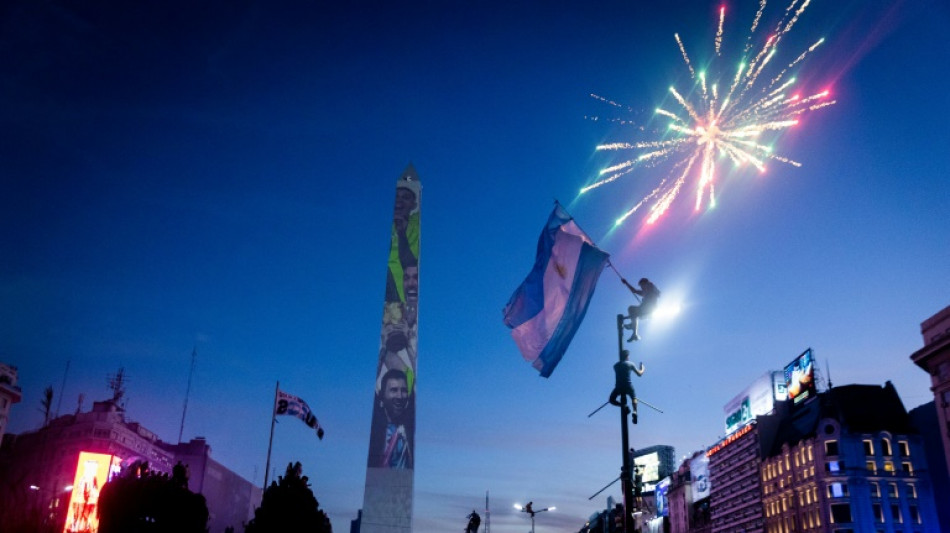
Argentina lauds united footballers in divided crisis-riven country / Photo: TOMAS CUESTA - AFP
 Teatro Mayor Unveils 152-Performance 2027 Season Highlighting Beethoven and García Márquez

 Rutgers Defeats NJIT 101-64 Behind Francis and Mark Scores
 Guardian Metal Resources PLC Announces Proposed Spin-Out of Non-Tungsten Projects

 Fulcrum Metals PLC Announces New Critical Mineral Recoveries Expand Potential

 Thukukile Zuma Resigns from ANC Johannesburg Leadership Amid Disciplinary Dispute

 CM Mohan Yadav Meets Bohra Spiritual Leader to Discuss Simhastha 2028 and Development

 Eli Crane Defeats Jonathan Nez in Tight Arizona Congressional Race

For the last month, Lionel Messi and his Argentina teammates have brought success and unity to their fans, in stark contrast to the country's economic woes and polarized political landscape.
Years of economic crisis weighs heavily on the daily lives of people in a country where some 40 percent live in poverty as rampant inflation and a depreciating currency have decimated ordinary people's savings and purchasing power.
And yet on Sunday the whole country was draped in the national blue and white colors as political and sporting rivalaries were put to one side and 45 million people celebrated a first World Cup success in 36 years.
But experts say the elation will not last.
"What happens is that sport, and particularly football in Argentina, has the ability to unite us through emotion, and that is very important in terms of national symbolism," sociologist Rodrigo Daskal told AFP.
"But that does not mean that it can be effectively transferable to other fields."
- 'United we can achieve much more' -
During Sunday's match, supporters of bitter city rivals such as Boca Juniors and River Plate in Buenos Aires, or Rosario's Newell's Old Boys and Rosario Central, stood shoulder to shoulder during the thrilling and at times torturous penalty shoot-out victory over France in Qatar.
"This passion and this unity, hopefully it will serve as an example for the future and to make us realize that we are better together," said fullback Nicolas Tagliafico.
The team's success and their tangible togetherness has created a sense of hope amongst some Argentines.
"It's not about forgetting our problems, it's about reminding us that we can unite, and when we're united we all pull in the same direction," said Julio Berdun, 50, as he walked through the iconic Plaza Mayo in front of the Casa Rosada presidential palace with his family.
"We have to close this rift that makes us so divided as a country," he said, his face painted blue and white, wearing a curly wig and draped in the Argentine flag.
At the same time, there is skepticism and weariness that comes from decades of broken promises and shattered dreams.
"We're world champions, but nothing more. I have to go to work, everyone has to go work. The situation won't change, it will be like always, only that in the sporting domain we're world champions," said architect Ricardo Grunfeld, 65.
- 'Playing for the people' -
What resonated with fans was the players' emotional commitment, embodied in Messi's brilliance, his team-mates' joy and the tears of coach Lionel Scaloni.
"This team plays for the people, for the Argentine fans, there are no individual egos, everyone plays for the team and for the country," said Scaloni.
The political class is the polar opposite, and not just because of the fractious relationship between the Peronist government and right-wing opposition.
The current administration has been beset by an ever growing fissure between President Alberto Fernandez and his vice-president and former leader Cristina Kirchner.
"This competitive, effective and humble team with good vibes contrasts with a political class fighting amongst itself that doesn't improve things in the country," said political scientist Carlos Fara.
"Society is very tired with this rift. They feel like it's political business and a barrier to development."
But, he added, "I don't see the political class reflecting on this. Most probably, after the euphoria passes, things will be the same again.
"The economic problems are long-term and the World Cup win doesn't mitigate that."
- 'They stay away from politics' -
The victorious team will celebrate on Tuesday with fans at the capital's iconic Obelisk monument.
But there are no plans to meet the president or hold celebrations at the presidential palace.
"The people feel that this is a triumph for the national team and the people themselves, and it's better for politics to stay out," said Fara.
While Argentina's greatest football hero, the late Diego Maradona -- who led the country to World Cup triumph in 1986 -- was vocal in his support for various left-wing Latin American causes, the current squad is apolitical.
"Maradona got involved in politics but this team stays away," said Lucrecia Airaldi, 50, who works in human resources.
"They carry the flag, they represent everyone. That's what's great,"
For many, the fact that no political force will try to capitalize on the football team's glory is in itself a victory.
"This is a sporting success, it's an example for all children," said architect Grunfeld. "That's essential."
O.Norris--AMWN