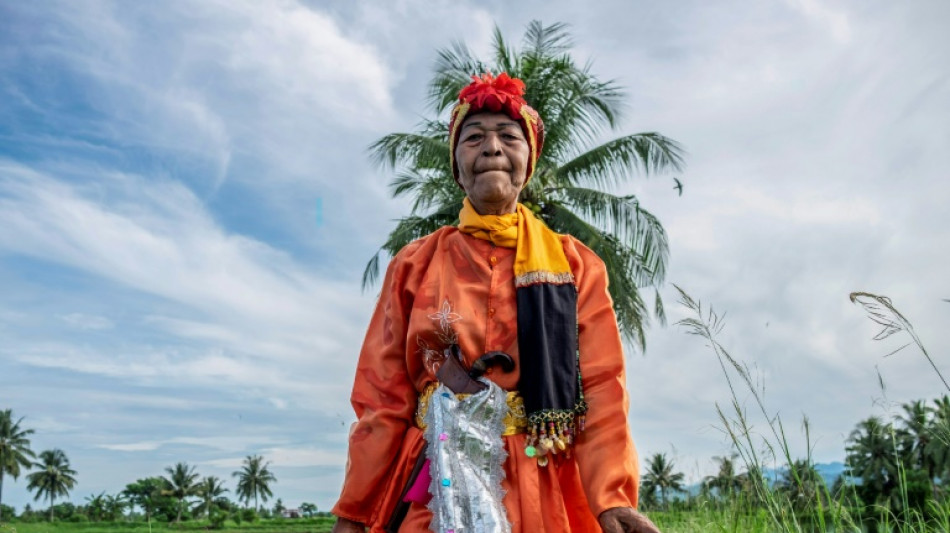
Indonesia's 'all-gendered' priests on verge of extinction / Photo: INDRA ABRIYANTO - AFP
 Teatro Mayor Unveils 152-Performance 2027 Season Highlighting Beethoven and García Márquez

 Rutgers Defeats NJIT 101-64 Behind Francis and Mark Scores
 Guardian Metal Resources PLC Announces Proposed Spin-Out of Non-Tungsten Projects

 Fulcrum Metals PLC Announces New Critical Mineral Recoveries Expand Potential

 Thukukile Zuma Resigns from ANC Johannesburg Leadership Amid Disciplinary Dispute

 CM Mohan Yadav Meets Bohra Spiritual Leader to Discuss Simhastha 2028 and Development

 Eli Crane Defeats Jonathan Nez in Tight Arizona Congressional Race

After dawn in a small eastern Indonesia town, a young man holds an ornate umbrella over non-binary priest Puang Matowa Nani, as they walk barefoot to a nearby pond to perform the annual ritual of Mappalili.
The ceremony marks the start of the planting season on the island of Sulawesi, where the androgynous Bissu community to whom they belong once held divine status, but are now fighting against extinction.
Less than 40 Bissu remain in just a few areas across South Sulawesi, according to anthropologists, and they now perform cultural and shaman-like roles to prevent their traditions from dying.
Nani, a Bissu in their 60s who was born male, said they faced opposition from their family when they experienced a gender identity crisis as a child, but was now at peace with who they are.
"My family disliked it, especially my older brother," they recalled. "He kept beating me to force me to be a real man.
"I've tried to change but I could not."
In the 1950s, a rebellion led by the Islamic State of Indonesia group sought to create a caliphate in the country, leading to many Bissu being accused of violating Islamic principles and facing persecution.
They were hunted, murdered, or forced to behave as masculine men.
"Since then, Bissu no longer wanted to show themselves, they disappeared, and they didn't want to do any cultural activities," Halilintar Lathief, an anthropologist at Makassar State University, told AFP.
"They were scared and decided to hide."
The community is now on the brink of extinction, seeing their numbers dissolve into the majority Bugis ethnic group in South Sulawesi.
Bugis people believe in five genders: "makkunrai" or cis woman; "oroane" or cis man; "calabai" or men who take on traditional roles for women; "calalai" or women who take on traditionally male roles; and the "Bissu", who are neither male nor female but embody all genders.
Older Bissu have died and without financial or cultural support, not enough of the younger generation are replacing them.
The remaining few, however, are trying to keep their heritage alive.
- A 'floating soul' -
At the pond, bordering a lush green rice field, Nani led the Mappalili ritual and chanted a prayer as other Bissu in bright silk blouses, headdresses and embroidered skirts walked behind in a parade.
The Bissu performed a dance to the beat of a drum before stabbing themselves with a slim, long dagger known as a keris, appearing as if they were in a trance.
To become a Bissu, one must receive "Pammase", or a direct calling from God. You cannot join the community by marriage or birth.
They must then undergo extensive training to perform different rituals and learn a secret language only Bissu can understand.
Many Bissu say they receive enlightenment from God through their dreams.
In one such dream, Julaeha, who goes by one name, told AFP they were sick for two months in a delirious state in which they saw a man riding a horse telling them to join the community.
"I felt like my soul was floating," they said.
- 'Messengers of God' -
The Bissu once lived a prosperous life. They were revered and owned lands granted by the Bugis Kingdom that preceded the modern-day Indonesian state.
"Bissu held a very important role during the kingdom era. They were considered the intermediaries between God and the people," anthropologist Lathief said.
But now, with little money to be made, the attraction of joining the community has dwindled.
Some of the Bissu community now make a living working regular jobs such as doing bridal make-up.
"Not many are interested in becoming a Bissu because there is no salary from the government," Nani said.
Despite the past persecution and split opinion on the community, the non-binary figures still have a place in the staunchly Islamic Bugis society.
"Since I became a Bissu, I have always been accepted by the public," Julaeha said.
"I've never been insulted or ostracised. I even got called a lot to perform (rituals)."
An eager Muslim spectator at the Mappalili ceremony, Pattola Ramang, said Jakarta must do all it can to prevent the community's extinction.
"What they do is culture and tradition which we must preserve," the 66-year-old said.
"The government should pay attention and support the Bissu so they will survive."
S.F.Warren--AMWN