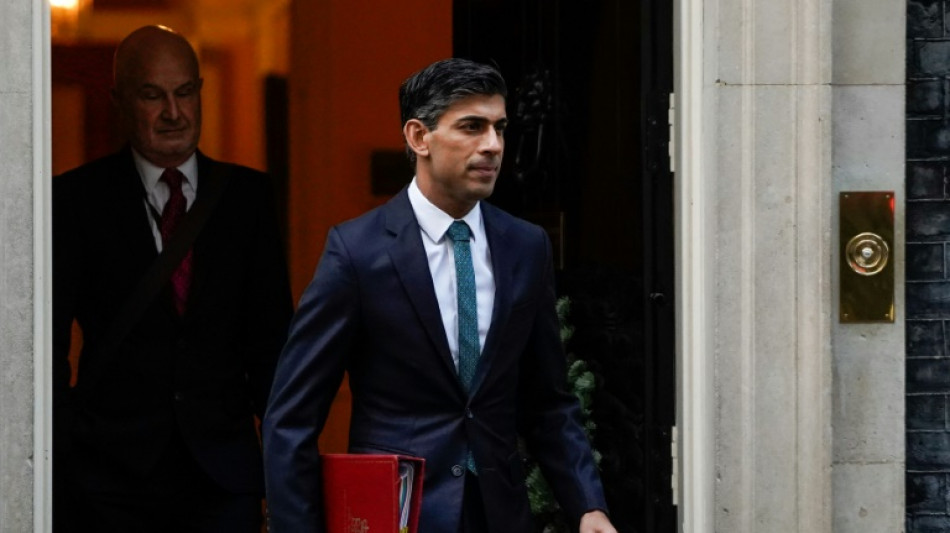
UK PM Sunak says 'reasonable' to review Scottish gender change law / Photo: Niklas HALLE'N - AFP
 Teatro Mayor Unveils 152-Performance 2027 Season Highlighting Beethoven and García Márquez

 Rutgers Defeats NJIT 101-64 Behind Francis and Mark Scores
 Guardian Metal Resources PLC Announces Proposed Spin-Out of Non-Tungsten Projects

 Fulcrum Metals PLC Announces New Critical Mineral Recoveries Expand Potential

 Thukukile Zuma Resigns from ANC Johannesburg Leadership Amid Disciplinary Dispute

 CM Mohan Yadav Meets Bohra Spiritual Leader to Discuss Simhastha 2028 and Development

 Eli Crane Defeats Jonathan Nez in Tight Arizona Congressional Race

Prime Minister Rishi Sunak said Friday it is "completely reasonable" for the UK government to review a newly-passed gender recognition law in Scotland, setting it on a potential collision course with Edinburgh.
The contentious legislation -- passed Thursday by the devolved Scottish parliament -- will make it easier and faster for people to change their gender officially, dropping the requirement for a gender dysphoria medical diagnosis.
The possible move to stop the law from coming into force could ratchet up already tense relations with Scotland's regional government, following stymied efforts by the ruling Scottish National Party (SNP) to hold an independence referendum.
"I think that lots of people have got concerns about this new bill in Scotland, about the impact it will have on women and children's safety," Sunak told British news broadcasters.
"So I think it's completely reasonable for the UK government to have a look at it, understand what the consequences are for women and children's safety in the rest of the UK, and then decide on what the appropriate course of action is."
Under devolution rules which led to the establishment of the Scottish parliament in 1999, London can block legislation if ministers believe it will conflict with UK-wide laws.
But that power has never been yielded by successive British governments, and any attempt now would likely lead to a court challenge by Edinburgh.
Scotland's Social Justice Secretary Shona Robison warned Friday it will "vigorously contest" any attempts by Westminster to "undermine the democratic will of the Scottish Parliament" and block the gender reform.
The legislation allows people aged 16 and 17 to change their gender, despite efforts by some Scottish lawmakers to keep the age at 18.
It reduces from two years to three months -- or six months for 16-17 year-olds -- the time needed for an applicant to live in their new gender before it is officially recognised.
Opponents of the law fear it could be a danger to women and girls, particularly around the provision of single-sex spaces.
But the Scottish government insists it will not impact the UK's Equality Act, which allows for trans people to be excluded from single-sex spaces such as changing rooms and shelters.
Scotland's First Minister Nicola Sturgeon -- who has faced one of the biggest internal rebellions of her eight-year tenure over the issue -- said the previous system to change gender was "intrusive, traumatic and dehumanising".
F.Bennett--AMWN