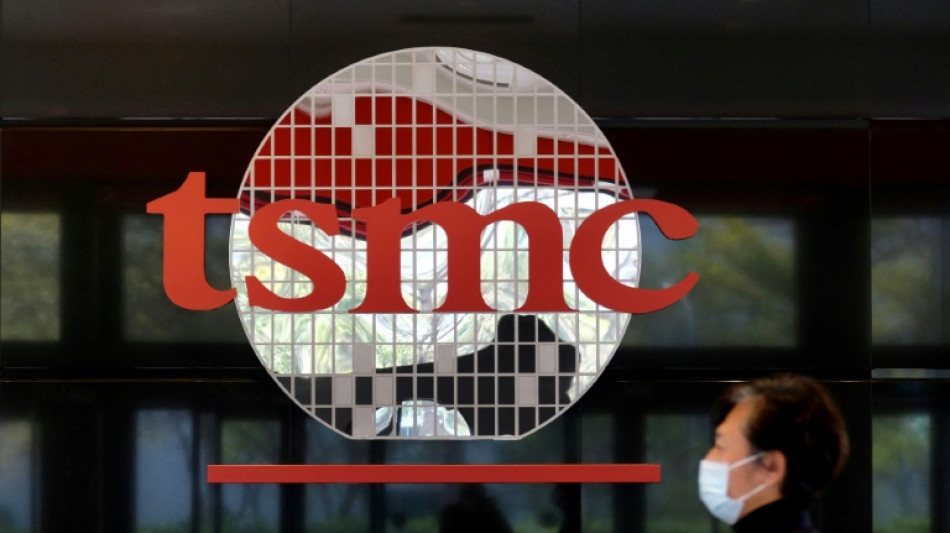
Taiwan's TSMC begins mass production of 3nm chips / Photo: Sam Yeh - AFP/File
 Teatro Mayor Unveils 152-Performance 2027 Season Highlighting Beethoven and García Márquez

 Rutgers Defeats NJIT 101-64 Behind Francis and Mark Scores
 Guardian Metal Resources PLC Announces Proposed Spin-Out of Non-Tungsten Projects

 Fulcrum Metals PLC Announces New Critical Mineral Recoveries Expand Potential

 Thukukile Zuma Resigns from ANC Johannesburg Leadership Amid Disciplinary Dispute

 CM Mohan Yadav Meets Bohra Spiritual Leader to Discuss Simhastha 2028 and Development

 Eli Crane Defeats Jonathan Nez in Tight Arizona Congressional Race

Taiwanese tech giant TSMC said Thursday it has started mass production of its 3-nanometre chips, among the most advanced to come to market.
The Taiwan Semiconductor Manufacturing Company operates the world's largest silicon wafer factories and produces high-performance chips used in everything from smartphones and cars to missiles. It is also Apple's primary chip supplier.
Its 3nm-process chips are expected to have more processing power while using less power, boosting battery performance.
"3nm technology has successfully entered volume production with good yields," the company said in a statement as it held a topping-off ceremony for its new foundry in the southwestern city of Tainan.
3nm chips are seen as a key component for future 5G smartphones and other state-of-the-art wireless tech.
TSMC's South Korean rival Samsung began mass production of its 3nm chips in June.
Taiwan, along with South Korea, plays an outsized role in the global chip industry.
TSMC alone accounts for nearly 50 percent of the world's production of chips below 10nm.
The concentration of such a crucial industry in one place has begun to cause geopolitical jitters, especially as China increasingly threatens Taiwan, a self-ruled democracy that the Chinese Communist Party claims and has vowed to one day seize.
The global chip shortage during the coronavirus pandemic deepened those concerns.
D.Moore--AMWN