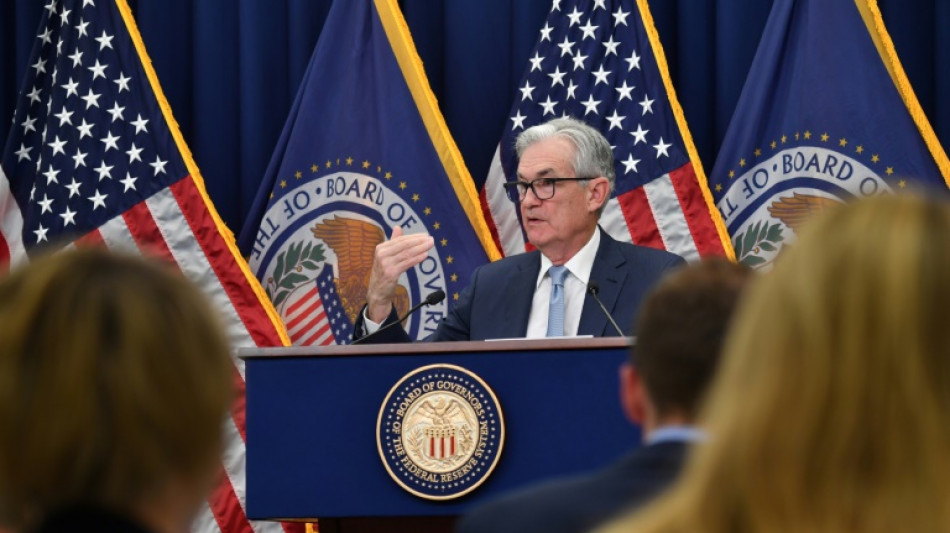
Fed officials do not expect US interest rate cuts this year / Photo: Nicholas Kamm - AFP/File
 Teatro Mayor Unveils 152-Performance 2027 Season Highlighting Beethoven and García Márquez

 Rutgers Defeats NJIT 101-64 Behind Francis and Mark Scores
 Guardian Metal Resources PLC Announces Proposed Spin-Out of Non-Tungsten Projects

 Fulcrum Metals PLC Announces New Critical Mineral Recoveries Expand Potential

 Thukukile Zuma Resigns from ANC Johannesburg Leadership Amid Disciplinary Dispute

 CM Mohan Yadav Meets Bohra Spiritual Leader to Discuss Simhastha 2028 and Development

 Eli Crane Defeats Jonathan Nez in Tight Arizona Congressional Race

US central bankers do not expect it will be "appropriate" to start cutting interest rates this year with inflation remaining high, according to minutes of the latest Federal Reserve policy meeting released Wednesday.
The Fed has waged an all-out campaign to cool the world's biggest economy as inflation surged to a 40-year high last year, raising the benchmark lending rate seven times to ease demand.
This brought the rate to a range between 4.25 and 4.50 percent after the Fed's December meeting, the highest level since 2007.
But Fed policymakers believe "a restrictive policy stance would need to be maintained" until data shows inflation is on a sustained downward path, according to minutes from the gathering last month.
The aim is to return inflation to two percent.
"No participants anticipated that it would be appropriate to begin reducing the federal funds rate target in 2023," the meeting minutes added.
While the Fed had slowed its pace of rate increases in December after several steep rate hikes, the latest report shows officials were also concerned about any "misperception" of their moves.
Officials warned that an "unwarranted" easing of financial conditions, especially if driven by public misperceptions, would complicate efforts to restore price stability.
This is because monetary policy works importantly through financial markets, the report said.
A number of meeting participants also emphasized the need to "clearly communicate" that a slowing in the pace of rate hikes was not a sign of weakening in resolve when it came to the inflation fight.
- Tight labor market -
For now, inflation remains "persistent and unacceptably high," and a "sustained period of below-trend" GDP growth is needed, the report said.
In the past months, spending has likely been helped by a strong labor market and households tapping their excess savings from the pandemic, and this could continue.
But some officials also noted that budgets are being stretched in lower-income households, with many consumers shifting to less expensive alternatives.
This points to considerable uncertainty around the consumer spending outlook overall, according to the Fed.
The labor market also remains "very tight" with low unemployment, robust payroll gains and elevated wage growth.
This has been a cause for concern, with officials worried that elevated wages will feed into higher services costs for consumers.
There are tentative signs of improvements on this front, but officials expect labor market supply and demand will "come into better balance" with an appropriately restrictive monetary policy path, the minutes said.
- Risk of pain -
"Reading the tea leaves, the minutes stress that the Fed is going to reduce inflation at the risk of hurting the labor market and the broader economy," said Ryan Sweet of Oxford Economics in a note.
He added that the Fed plans to rein in cost increases, and "whether they can accomplish that without a recession remains up for debate."
In the minutes, policymakers also stressed the need to balance restrictive policy with "an unnecessary reduction in economic activity, potentially placing the largest burdens on the most vulnerable groups."
But for now, members of the policy-setting Federal Open Market Committee are focused on current inflation and inflation risks, said Ian Shepherdson, chief economist at Pantheon Macroeconomics.
Comparatively, "fear of overkill on monetary policy" receives less attention, he said.
"Don't expect them to soften their inflation line until it becomes blindingly obvious that a serious shift in the data is underway," Shepherdson added.
P.Martin--AMWN