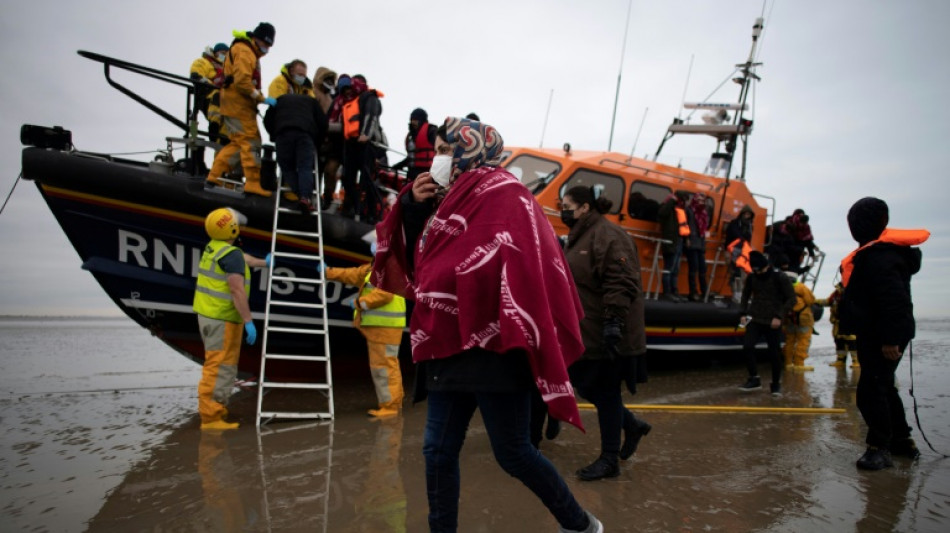
'No future': Eritrean seeking UK asylum fears deportation to Rwanda / Photo: Ben STANSALL - AFP
 Teatro Mayor Unveils 152-Performance 2027 Season Highlighting Beethoven and García Márquez

 Rutgers Defeats NJIT 101-64 Behind Francis and Mark Scores
 Guardian Metal Resources PLC Announces Proposed Spin-Out of Non-Tungsten Projects

 Fulcrum Metals PLC Announces New Critical Mineral Recoveries Expand Potential

 Thukukile Zuma Resigns from ANC Johannesburg Leadership Amid Disciplinary Dispute

 CM Mohan Yadav Meets Bohra Spiritual Leader to Discuss Simhastha 2028 and Development

 Eli Crane Defeats Jonathan Nez in Tight Arizona Congressional Race

At just 23, Hayat fears her long quest for a new life in Britain will come to nothing and she will be sent to Rwanda.
The Eritrean woman travelled through several countries before crossing from France to the UK in a flimsy boat, hoping to find safety.
But now she has a new fear: the UK government's plan to fly out all the immigrants who like her arrived illegally with a one-way ticket to Rwanda in central Africa.
The woman, who asked for her first name to be changed, spends her days in or near the London hotel where she is staying.
She arrived in the UK in a small boat from France in July 2021.
While applying for asylum, she has no right to work and lacks money to travel around the city, where she has no relatives.
"I wait now for the second interview" over the asylum application, she explains in hesitant English, sitting in a park in east London.
"Every day I wait for new day and new life. But it doesn't come... For refugees, there is no future."
Hayat left Eritrea in northeast Africa in 2016 when she was just 16.
"I have big problem with the government," she says.
Hayat had to leave school early to earn money for her family, but soon afterwards she received a letter calling her up to join the army and decided to leave.
"I want to finish school, not go to soldier," she recalls.
Her long journey was just beginning.
"I go to Sudan in foot. Difficult way. I live in Sudan four months, then Egypt by small car, Italy by boat. Fifteen days in the sea."
She spent five years in Switzerland, where authorities twice rejected her asylum claim, and then travelled to France, she says.
"I see a lot of people come here in UK," she says, with hopes of gaining "papers and a new life".
"I try. I don't know what happen."
Hayat waited two months in the French port of Calais to cross the Channel.
"In France no food, no place to sleep. I slept in a park," she says. Then she attempted her first crossing in an inflatable boat.
She recalls a "lot of problem in the sea" with fuel leaking into the plastic boat along with seawater.
Eventually, the migrants were picked up by French rescuers.
Hayat says she spent eight days in hospital before trying a second time.
Once more, she travelled in "a small boat with a lot of people" after paying 500 euros (around $530). And this time she was successful.
- 'Finished for me' -
This gruelling journey has become the standard route into the UK for migrants lacking visas. Last year a record of more than 45,000 made the crossing.
On Wednesday British Prime Minister Rishi Sunak presented a five-point list of promises for 2023, including a pledge to "stop the boats".
"We will pass new laws to stop small boats, making sure that if you come to this country illegally, you are detained and swiftly removed," he said.
The UK government has signed a deal with Rwanda to fly illegal arrivals there before their asylum claims are even considered.
If eventually granted refuge, they will remain in Rwanda rather than return to the UK.
No one has been flown out yet, but in December the High Court in London ruled the plan was lawful following a legal challenge by migrants and campaigners.
This prospect is in the minds of all asylum seekers such as Hayat.
"When I think about Rwanda, I cannot sleep in the night because I have had a lot of problems in my life before and now comes a new problem."
She has found a kind of stability. For the last year and a half she has lived in the same hotel, which is clean and in an area she likes.
"The government does a lot of things. The food. Hotels. Doctors. Money. 40 pounds a week," she says.
Now she fears being sent to "a new country. I don't think it's a safe country".
Asked if she would have made the trip if she had known she risked ending up in Rwanda, she exclaims: "It's better to live in park in France for me, better than go to Rwanda."
"Now I'm tired", she says. "I think no, no come to the UK."
"I think it is finished for me."
Asked what she would do if the British government decides to send her to Rwanda, she says: "When I think this, I cannot take (in) oxygen. I think oxygen stops."
G.Stevens--AMWN