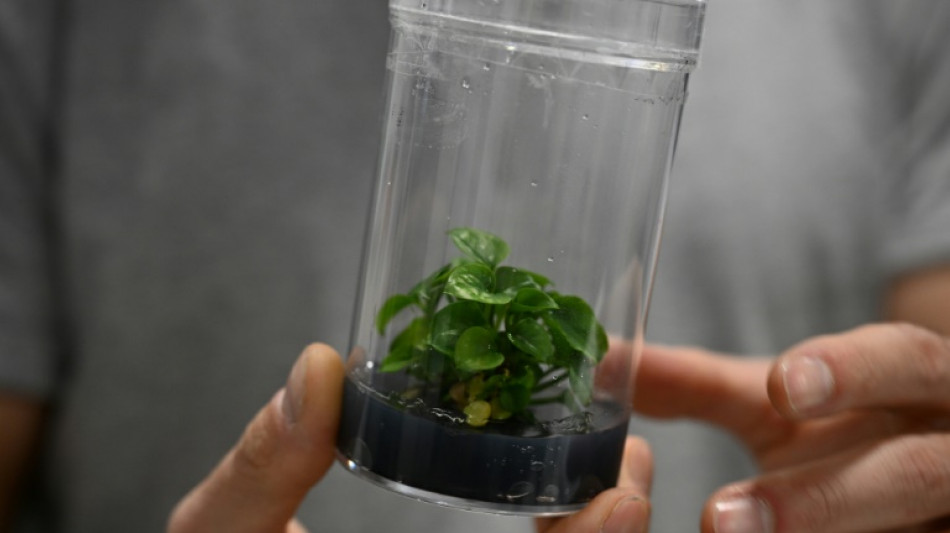
Green tech fights for limelight at CES gadget fest / Photo: Robyn BECK - AFP
 Teatro Mayor Unveils 152-Performance 2027 Season Highlighting Beethoven and García Márquez

 Rutgers Defeats NJIT 101-64 Behind Francis and Mark Scores
 Guardian Metal Resources PLC Announces Proposed Spin-Out of Non-Tungsten Projects

 Fulcrum Metals PLC Announces New Critical Mineral Recoveries Expand Potential

 Thukukile Zuma Resigns from ANC Johannesburg Leadership Amid Disciplinary Dispute

 CM Mohan Yadav Meets Bohra Spiritual Leader to Discuss Simhastha 2028 and Development

 Eli Crane Defeats Jonathan Nez in Tight Arizona Congressional Race

At the CES tech megashow in Las Vegas, it is unusual to see an entrepreneur hold up a plant and present it as the latest breakthrough in consumer technology.
But for NeoPlants co-founder Patrick Torbey, the gathering held annually just after the new year should not be thought of as "only about machine technology and electronics."
"It's also about natural technology that we can leverage using these really cool engineering techniques," Torbey told AFP.
NeoPlants, a Paris-based startup, was showing off a bioengineered plant capable of purifying indoor air of toxic pollutants "by doing the work of 30 regular houseplants," according to its website.
Technology geared towards helping the environment has steadily increased in number at CES since the Sin City expo began fifty years ago.
But observers often doubt the seriousness of the consumer tech industry's commitment to protect the environment, with all the real excitement focused on smart TVs and robots instead of the more complicated and less profitable project of saving the planet.
"Until it really, really matters for consumers, it's just going to kind of be this trend that's over here on the side," said Ben Arnold, research firm NPD’s consumer electronics analyst.
"As somebody who studies the market, I'm just not seeing yet where (environmental-minded tech) makes a difference in terms of units and dollars," he added.
Ran Roth, the head of tech company Sensibo, agreed that successful devices were the ones that made financial sense and believed his products did just that.
Roth's devices use artificial intelligence and sensors to better manage air conditioning, an important concern in the often blistering heat of Israel, where his company is based.
Sensibo's sensors measure humidity and temperature, and use software that learns a user's habits, thereby saving energy and money.
Roth said new technology should have a "path to profitability" if it is going to thrive, a recurrent shortcoming of so called green tech that so often fails to be bankable.
"What is good about smart thermostats is that they are readily available and they offer the highest return on investment," said Roth, who called air conditioning a "human right."
- 'What matters' -
But as the climate emergency worsens, industry observers said major tech companies were under more pressure to commit to sustainability goals.
"We have seen the public naming and shaming of organizations who indulged in greenwashing over the past year," said Abhijit Sunil of Forrester Research.
"So a lot of organizations are kind of careful in what they mention as their sustainability initiatives and they are now as transparent as possible," he said.
Sunil said that the real advances on the environment were to be seen in the industrial sector, agreeing that the consumer gadget business may be a step behind when it came to doubling down on going green.
Product design, manufacturing and packaging with an eye on a company’s waste and carbon footprint were the low hanging fruits when it came to environment technology, he said.
One such company, ACWA Robotics, won plaudits at CES for a robot dedicated to the detection and prevention of water leaks in underground pipes.
In France, where the startup is located, 20 percent of drinking water is estimated to be lost due to leaky pipes.
Fighting for the environment "is the challenge of a century," ACWA Robotics engineer Elise Lengrand told AFP.
"I mean sure it's really cool to make big TVs and stuff, but this is really what matters," she said.
P.Costa--AMWN