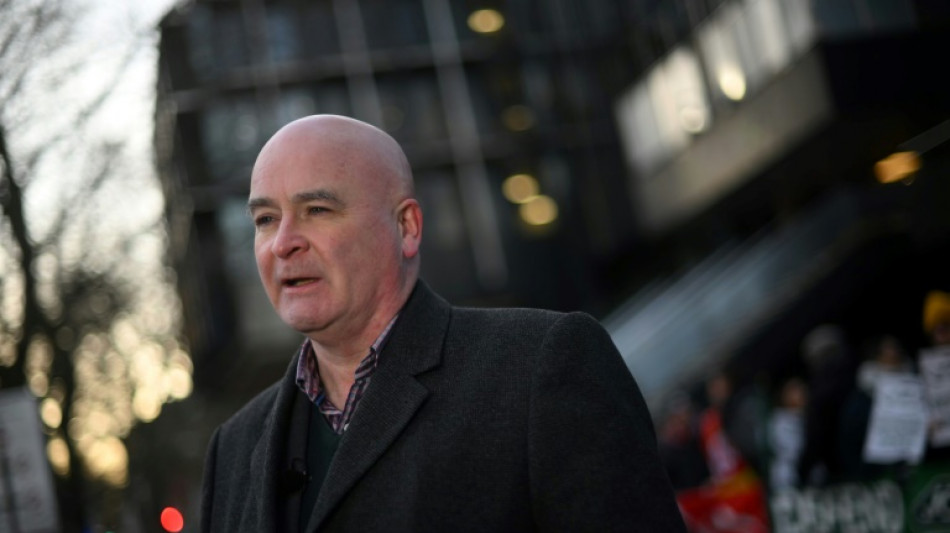
Mick Lynch: doughty union boss defending UK rail strikers / Photo: Daniel LEAL - AFP
 Teatro Mayor Unveils 152-Performance 2027 Season Highlighting Beethoven and García Márquez

 Rutgers Defeats NJIT 101-64 Behind Francis and Mark Scores
 Guardian Metal Resources PLC Announces Proposed Spin-Out of Non-Tungsten Projects

 Fulcrum Metals PLC Announces New Critical Mineral Recoveries Expand Potential

 Thukukile Zuma Resigns from ANC Johannesburg Leadership Amid Disciplinary Dispute

 CM Mohan Yadav Meets Bohra Spiritual Leader to Discuss Simhastha 2028 and Development

 Eli Crane Defeats Jonathan Nez in Tight Arizona Congressional Race

For some in the UK he is The Grinch behind rail strikes that stole Christmas, yet others praise him for helping a crisis-hit workforce.
Mick Lynch, the general secretary of the RMT rail workers' union, has been a highly visible figure during mass industrial action in recent months.
Facing strikes on a scale not seen since the 1980s, the government has agreed to meet union leaders on Monday in a bid to break the deadlock.
Prime Minister Rishi Sunak hinted at a more conciliatory approach in a BBC interview Sunday.
"When it comes to pay, we've always said we want to talk about things that are reasonable, that are affordable and responsible for the country," he said.
The meeting comes after 40,000 rail workers resumed strike action last week, seeking wage hikes, to reflect soaring inflation, and better working conditions.
With his blue eyes and shaved head, often clad in a tweed cap, Lynch, 60, has become the best-known public face of the strikers.
The rail workers' industrial action caused periods of mass train cancellations over the summer and autumn and in the run-up to Christmas.
Other groups such as ambulance staff and nurses in the public health service and postal workers have also gone out on strike, eliciting more public sympathy.
"Most of our people haven't had a pay rise for four years" and "there's not many people can put up with a 20% cut in their income" in real terms, Lynch told AFP on a picket line outside Euston station in London.
- 'Straightforward' -
His caustic, sometimes sarcastic responses to politicians and journalists have proved popular and are widely shared on social media.
A YouTube poll in December found him to be far more popular than Sunak or the ruling Conservative party.
Lynch says his role in protests is simply "what needs to be done at the minute".
He says people respond well to his "frankness" and "straightforward talking", while insisting: "I don't want to (have a public) profile."
The Brexit supporter and passionate football fan grew up in a family of five children with little money.
After leaving school at 16, he became involved in the trade union movement while training as an electrician.
Lynch then moved into construction but was blacklisted for having been a union member.
He later entered the rail sector and worked for Channel train operator Eurostar in the 1990s, gradually rising up the trade union hierarchy.
He is married to a nurse in the public health service and they have three children.
He took charge of the powerful RMT union in May 2021.
- 'Union baron' -
Lynch has become a scourge of right-wing media, which depicts him as a Marxist agitator hellbent on destroying society.
The Daily Mail tabloid nicknamed him Mick "the Grinch" Lynch, after the children's book character who hates Christmas.
Business minister Grant Shapps likened him to "1970s union barons", invoking a time when powerful unions brought the country to a standstill.
Lynch dismisses such attacks as "ridiculous" and "lazy", although he once told left-wing broadsheet The Guardian he wanted "a bit of socialism".
He links the cost-of-living crisis gripping the UK to "a lot of reactionary policies that go back to (Margaret) Thatcher", prime minister from 1979 to 1990.
With a lack of affordable housing, zero-hours contracts and inflation, "a lot of people feel really insecure", he said, with "fairly middle class" groups such as lawyers joining pickets.
Hence the failure, he says, of government efforts to turn the public against the strikers -- even if the rail workers face greater hostility than nurses or paramedics.
Ordinary people, seeing the strikers, "think 'Oh, well, they've got an argument. And actually, all of this is happening to me in my job'," he said.
He wants to see greater coordination between strikers, particularly to protest against proposed legislation setting minimum levels of work that must be done in various public sectors.
S.Gregor--AMWN