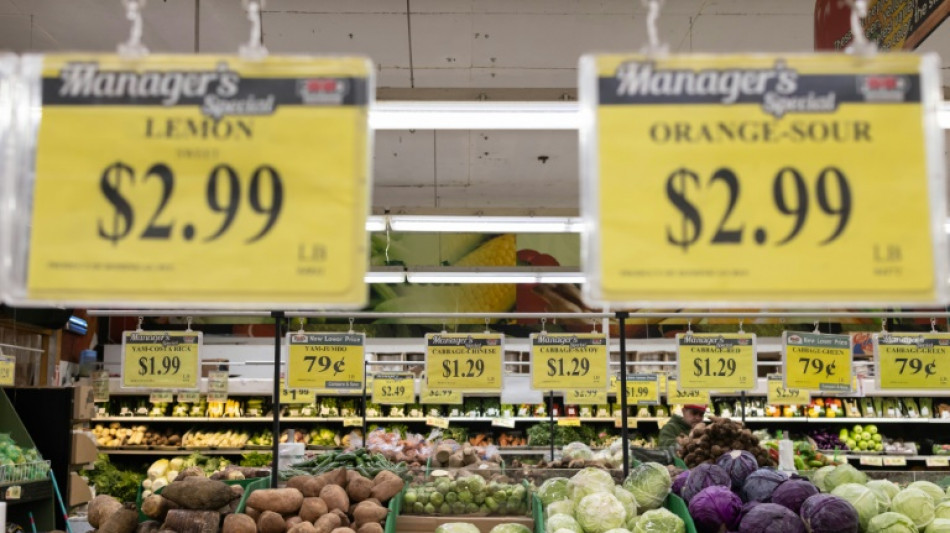
Analysts expect slowing US inflation, fueling hopes of less hawkish Fed / Photo: Yuki IWAMURA - AFP/File
 Teatro Mayor Unveils 152-Performance 2027 Season Highlighting Beethoven and García Márquez

 Rutgers Defeats NJIT 101-64 Behind Francis and Mark Scores
 Guardian Metal Resources PLC Announces Proposed Spin-Out of Non-Tungsten Projects

 Fulcrum Metals PLC Announces New Critical Mineral Recoveries Expand Potential

 Thukukile Zuma Resigns from ANC Johannesburg Leadership Amid Disciplinary Dispute

 CM Mohan Yadav Meets Bohra Spiritual Leader to Discuss Simhastha 2028 and Development

 Eli Crane Defeats Jonathan Nez in Tight Arizona Congressional Race

Consumer inflation in the United States is set to ease further in December, analysts say, in an encouraging trend that could bring some reprieve from rising interest rates.
As American households struggle with decades-high inflation, the Federal Reserve hiked its benchmark lending rate at a pace unheard of since the 1980s in hopes of cooling the world's biggest economy.
But analysts expect the consumer price index (CPI), a key inflation gauge, to flatline between November and December in figures due to be released Thursday.
The data point could add to signs that the worst of surging prices may be over.
"The trend is an encouraging one," Moody's Analytics economist Matt Colyar told AFP, noting that figures have come down from a recent peak.
But Rubeela Farooqi of High Frequency Economics warned that "rates of change remain well above levels Fed officials are comfortable with."
US consumer inflation climbed rapidly to a blistering 9.1 percent last June, a 40-year high, as the war in Ukraine sent global food and energy costs rocketing.
While annual CPI growth eased to 7.1 percent in November, it remains a far cry from the Fed's two-percent target.
- 'Steep drop' -
"A steep drop in gas prices" is behind the easing trend in December, said Ian Shepherdson of Pantheon Macroeconomics.
Prices at the pump -- a key symbol for US consumers -- dropped last month on lower global demand and falling oil prices, in welcome news to policymakers.
Airline fares and health insurance prices are set to fall too, said Shepherdson.
But stripping out the volatile food and energy segments, the "core" CPI index likely rose 0.3 percent thanks to elevated rents, he said.
This would be a slight pick-up from November's 0.2 percent reading, signaling that more work needs to be done.
Colyar of Moody's Analytics added that although motor fuel prices have fallen, policymakers cannot rely on its momentary downward trend to bring down overall inflation.
For now, the Fed is keeping a close eye on the labor market and the pace of wage growth, as rapidly rising earnings could provoke a continued increase in the costs of services.
Fed Chair Jerome Powell cautioned Tuesday that "restoring price stability when inflation is high can require measures that are not popular in the short term as we raise interest rates to slow the economy."
The Fed's moves aim to raise the costs of borrowing, lowering demand by making it more expensive to get funds for big-ticket purchases or to expand businesses.
Fed governor Michelle Bowman added in a separate address Tuesday that despite a decline in some measures of inflation, "we have a lot more work to do."
In December, the Fed's policy-setting Federal Open Market Committee said it expected "ongoing increases" in the target range of rates.
Minutes from the committee's latest meeting also suggested there would not be rate cuts this year.
"I expect that once we achieve a sufficiently restrictive federal funds rate, it will need to remain at that level for some time," said Bowman.
P.Silva--AMWN