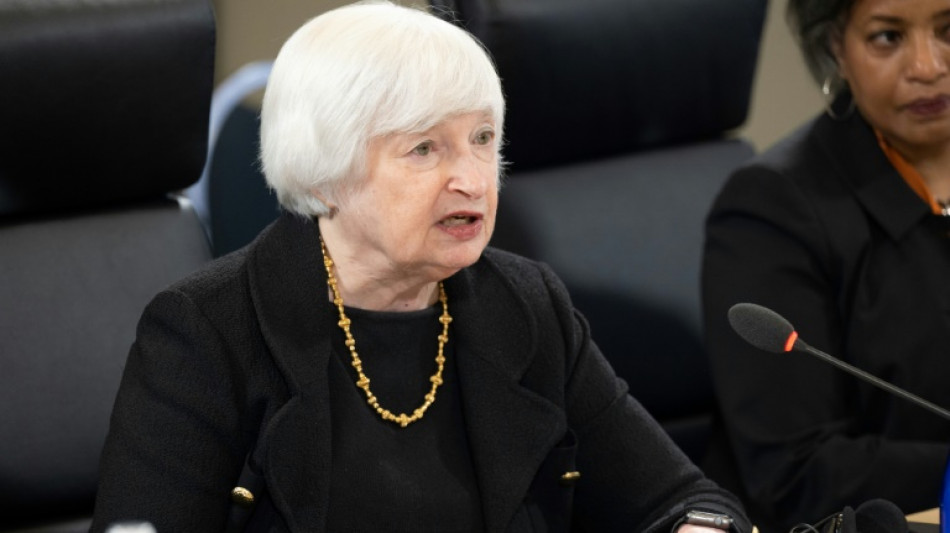
US eyes 'extraordinary measures' to avoid default next week: Yellen / Photo: SAUL LOEB - AFP/File
 Teatro Mayor Unveils 152-Performance 2027 Season Highlighting Beethoven and García Márquez

 Rutgers Defeats NJIT 101-64 Behind Francis and Mark Scores
 Guardian Metal Resources PLC Announces Proposed Spin-Out of Non-Tungsten Projects

 Fulcrum Metals PLC Announces New Critical Mineral Recoveries Expand Potential

 Thukukile Zuma Resigns from ANC Johannesburg Leadership Amid Disciplinary Dispute

 CM Mohan Yadav Meets Bohra Spiritual Leader to Discuss Simhastha 2028 and Development

 Eli Crane Defeats Jonathan Nez in Tight Arizona Congressional Race

The US Treasury Department said Friday it will likely begin "extraordinary measures" next week to prevent a default on government debt, setting up a high-stakes showdown in Congress over raising the nation's borrowing limit.
Secretary Janet Yellen, in a letter to congressional leadership, said that the United States was projected to reach its legal borrowing limit -- set at $31.4 trillion -- as soon as next Thursday.
It would therefore need to "start taking certain extraordinary measures" to prevent a default.
Any such measures would only help for a limited time, likely no longer than six months, she warned.
Congressional lawmakers have found themselves gridlocked over raising the debt limit, with some Republican policymakers pushing for it to be used as leverage in hopes of gaining spending cuts.
If the Democratic-controlled Senate and Republican-controlled House cannot come to an agreement, the world's largest economy could risk defaulting on its debt.
"Failure to meet the government's obligations would cause irreparable harm to the US economy, the livelihoods of all Americans, and global financial stability," Yellen warned.
"It is therefore critical that Congress act in a timely manner to increase or suspend the debt limit," she urged.
House Speaker Kevin McCarthy told reporters on Thursday that "we've got to change the way we are spending money wastefully in this country."
But the White House rebutted that raising the debt ceiling was not up for "negotiation," saying the process was not meant to be "political football."
- 'Enormously concerning' -
The debt limit refers to the amount of money the US government is allowed to borrow to meet existing legal obligations, including Social Security and Medicare benefits.
Yellen noted Friday that "increasing or suspending the debt limit does not authorize new spending commitments or cost taxpayers money."
"It simply allows the government to finance existing legal obligations that Congresses and Presidents of both parties have made in the past," she said.
The Treasury Department is unable to estimate precisely how long the extraordinary measures will allow it to continue paying the government's obligations, Yellen said.
But she cautioned that cash and the measures could be exhausted after early June.
Congressman Brendan Boyle, top Democrat on the House Budget Committee, called the situation "enormously concerning."
"Republicans need to do the right thing and come to the table to raise the borrowing limit before it's too late," he said in a statement.
J.Williams--AMWN