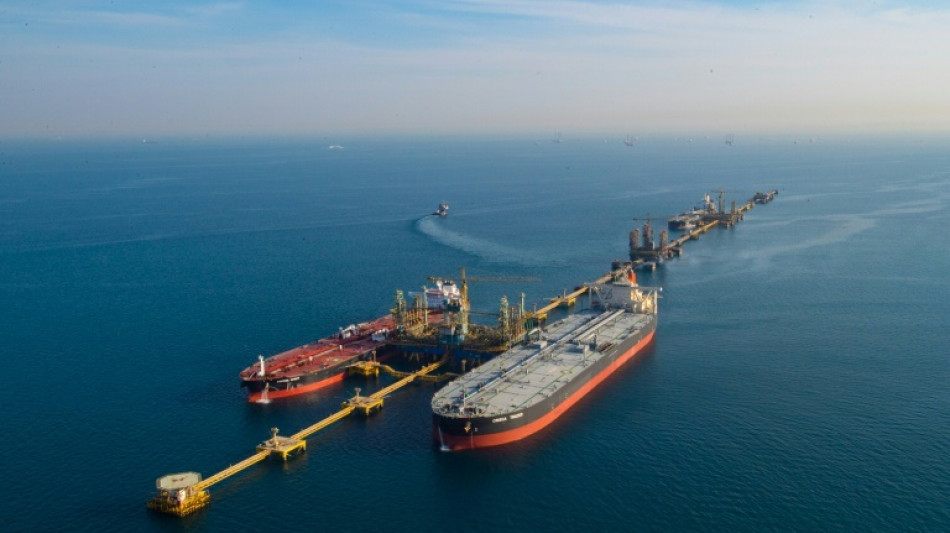
At Davos, Saudi Arabia says curbing oil dependency a priority / Photo: AHMAD EL ITANI - Saudi Aramco/AFP
 Teatro Mayor Unveils 152-Performance 2027 Season Highlighting Beethoven and García Márquez

 Rutgers Defeats NJIT 101-64 Behind Francis and Mark Scores

 THIEAUDIO Introduces Clairvoyance MKII: The Evolution of a Signature Sound
 Guardian Metal Resources PLC Announces Proposed Spin-Out of Non-Tungsten Projects

 Fulcrum Metals PLC Announces New Critical Mineral Recoveries Expand Potential

 Thukukile Zuma Resigns from ANC Johannesburg Leadership Amid Disciplinary Dispute

 CM Mohan Yadav Meets Bohra Spiritual Leader to Discuss Simhastha 2028 and Development

 Eli Crane Defeats Jonathan Nez in Tight Arizona Congressional Race

Saudi Arabia is working to reduce its reliance on oil exports, Economy Minister Faisal Al-Ibrahim said Wednesday, as the Middle East powerhouse sent one of the largest delegations to the Davos summit to make its case.
Despite its goal of achieving net zero carbon emissions by 2060, the country remains hugely dependent on crude oil exports that have powered its growth for decades, raising doubts about its potential for an economic makeover any time soon.
"We want to lessen our dependence on oil... We want to diversify our economy, it is important, it is essential," Al-Ibrahim told AFP at the World Economic Forum.
Riyadh has dispatched eight top-ranking officials to the gathering of business elite as it seeks more foreign investment and partners outside the all-important oil sector.
Soaring crude prices following Russia's invasion of Ukraine allowed the kingdom to post in 2022 its first budget surplus in nine years, giving it the financial firepower for economic development.
"It's never too late for sectors that are starting from scratch in Saudi Arabia. Tourism, culture, sports and entertainment -- they are going to bring a wealth of diversification," Al-Ibrahim said.
"But we also care about other sectors like mining and industry for it to be even more competitive."
Saudi Arabia is hoping to build on momentum from the high-profile visit by Chinese President Xi Jinping to Riyadh last month, where deals worth billions of dollars were signed in areas including energy and infrastructure.
"It's not advertising or showcasing, people are very interested in Saudi's growth story," the minister said, noting the kingdom's 8.5 percent expansion in GDP last year even as much of global economy struggled.
On the heels of the football World Cup in Qatar, Saudi Arabia could be a candidate to host the competition in 2030, recently hiring the Portuguese star Cristiano Ronaldo to promote the potential bid.
And at Davos on Tuesday, Saudi officials announced a joint initiative with the Davos forum organisers to accelerate high-tech innovation in the country via the virtual reality of the metaverse.
Crown Prince Mohammed bin Salman has been pushing to open up the country and enact economic and social reforms, although critics have denounced a crackdown on dissidents and the murder of critic Jamal Khashoggi inside the kingdom's Istanbul consulate in October 2018.
"We've opened up much more than before and that lets people see," Al-Ibrahim said.
"They see the culture, they see the values, they see the progress and they see that we are tackling a lot of challenges and issues regionally and globally."
D.Moore--AMWN