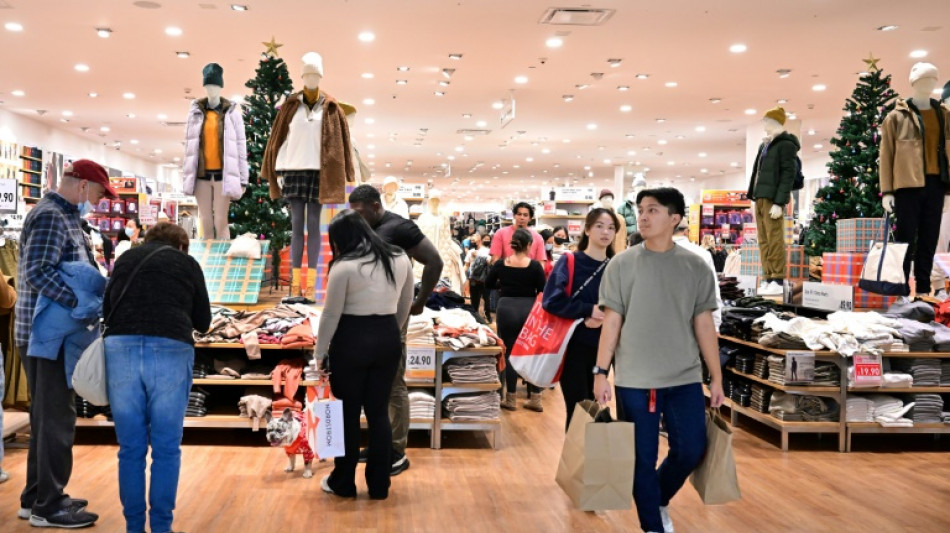
US retail sales shrinks by most in a year as growth engine falters / Photo: Frederic J. BROWN - AFP/File
 Teatro Mayor Unveils 152-Performance 2027 Season Highlighting Beethoven and García Márquez

 Rutgers Defeats NJIT 101-64 Behind Francis and Mark Scores

 THIEAUDIO Introduces Clairvoyance MKII: The Evolution of a Signature Sound
 Guardian Metal Resources PLC Announces Proposed Spin-Out of Non-Tungsten Projects

 Fulcrum Metals PLC Announces New Critical Mineral Recoveries Expand Potential

 Thukukile Zuma Resigns from ANC Johannesburg Leadership Amid Disciplinary Dispute

 CM Mohan Yadav Meets Bohra Spiritual Leader to Discuss Simhastha 2028 and Development

 Eli Crane Defeats Jonathan Nez in Tight Arizona Congressional Race

US retail sales slumped for a second straight month in December, said government data on Wednesday, with its largest drop in a year signaling a key growth engine is faltering.
This comes as separate reports released Wednesday as well showed industrial output plunging last month, while producer prices made the biggest slump since early in the pandemic.
The US central bank has been raising interest rates steeply to cool the world's biggest economy as households found themselves squeezed by decades-high inflation -- and the effects are rippling across sectors including previously resilient consumer spending.
Retail sales contracted more than expected by 1.1 percent in December from a month prior, to $677.1 billion, said the latest Commerce Department figures. This was down from a revised one percent drop in November.
Falling sales at department stores and gasoline stations proved to be major drags, while the auto and furniture segments also saw declines.
Gas prices plunged last month, and analysts said bad weather across the country could have temporarily held back vehicle sales.
Spending at restaurants and bars took a hit as well, dropping 0.9 percent between November and December, despite remaining strong previously in the face of high inflation.
But retail sales remains 6.0 percent up from December 2021.
For all of last year, total sales jumped 9.2 percent, the Commerce Department said.
- Growth engine hit -
In a separate report, the Labor Department said US producer prices fell 0.5 percent in December from November, the biggest drop since early in the pandemic.
This signals further easing in inflationary pressures, as gauges for goods and energy costs both fell.
Meanwhile, Federal Reserve data showed industrial production plunging 0.7 percent from November to December, a much larger fall than anticipated on the back of energy price declines.
Lower energy costs, a stronger greenback and slowing global economy are taking a collective toll on US manufacturing, economists said.
But strikingly, "weaker consumer spending momentum at the end of 2022 is a sign the economy's main growth engine is beginning to sputter," said Oren Klachkin of Oxford Economics.
He added that the Fed is "unlikely to unwind its recent monetary policy tightening any time soon," stressing the central bank is comfortable with allowing a recession if consumer inflation returns to its two percent target.
Ian Shepherdson of Pantheon Macroeconomics noted that the steep drop in December retail sales continues a downward trend since last spring.
Food service sales "outperformed" for much of last year, partly due to a shift in consumption towards services and away from goods, but he said the segment is now struggling.
This comes as "consumers start to reduce discretionary spending in the face of an uncertain economic outlook and sharply higher borrowing costs," Shepherdson added.
P.Mathewson--AMWN