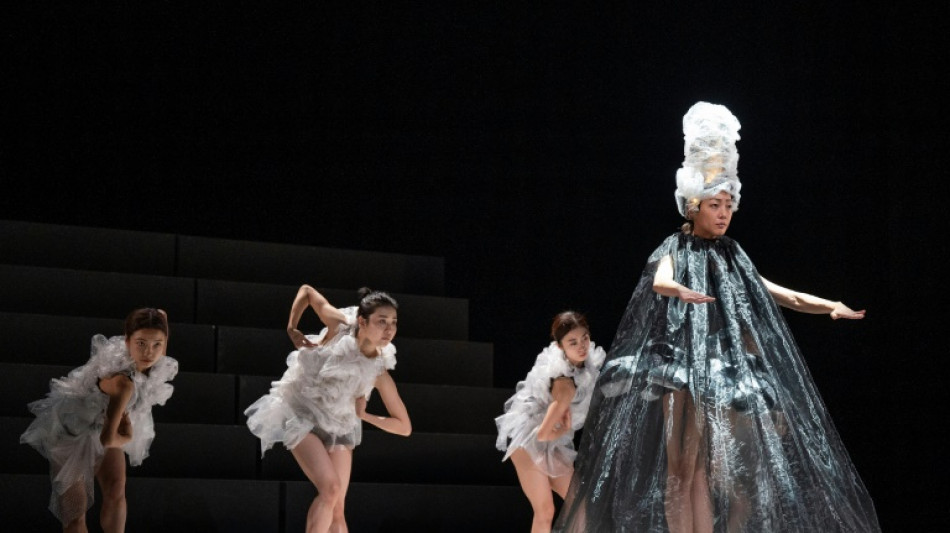
Plastic pirouettes: Japan's recycled bottle ballet / Photo: Richard A. Brooks - AFP
 Teatro Mayor Unveils 152-Performance 2027 Season Highlighting Beethoven and García Márquez

 Rutgers Defeats NJIT 101-64 Behind Francis and Mark Scores

 THIEAUDIO Introduces Clairvoyance MKII: The Evolution of a Signature Sound
 Guardian Metal Resources PLC Announces Proposed Spin-Out of Non-Tungsten Projects

 Fulcrum Metals PLC Announces New Critical Mineral Recoveries Expand Potential

 Thukukile Zuma Resigns from ANC Johannesburg Leadership Amid Disciplinary Dispute

 CM Mohan Yadav Meets Bohra Spiritual Leader to Discuss Simhastha 2028 and Development

 Eli Crane Defeats Jonathan Nez in Tight Arizona Congressional Race

The dancers' futuristic headgear glints under the lights at a top ballet show, but just two months ago their plastic costumes were sticky bottles tossed into a Tokyo recycling bin.
"Plastic", a new production by renowned Japanese company K-BALLET, aims to draw attention to a global pollution crisis through some unusual set and wardrobe design.
Tutus made from used bubble wrap, four huge recycled bottle walls and 100 transparent umbrellas left behind in the Japanese capital all feature in the performance, which drew a full house to its first short run in Yokohama.
Resembling space-age creatures with hand-cleaned PET bottles strapped to their bodies, a troupe including US guest star Julian MacKay leaped and spun their way through a shifting labyrinth on stage.
Plastic waste has doubled globally in 20 years and only nine percent is successfully recycled, according to the OECD group of developed countries.
The United Nations says the volume of plastic entering the oceans will nearly triple by 2040.
MacKay, 25, told AFP that the "huge problem" of plastic waste "really hasn't gotten that spotlight" in the dance world, and he believes performing arts can help inspire people to act.
"When you take a medium like ballet or dance, and you add it together with recycling or upcycling, you kind of force people to think, 'well, what else can I do, what else works?'"
Back in November, past midnight in Tokyo's Harajuku fashion district, K-BALLET's chief producer Taiju Takano and scenographer Naoya Sakata went rooting through recycling bins to find their plastic props.
Joining staff from waste management company Shirai Eco Center, they shook out tubs and sorted plastic bottles from piles of used coffee cups, aluminium cans and cigarette butts.
Sakata also used machine-recycled PET bottles provided by Shirai to construct the pixel-like bottle walls and huge letters that descended to spell "party people" in the upbeat finale of the show's first half.
Overall, more than 10,000 recycled and reused bottles were used in "Plastic", and 28-year-old Sakata said it made him realise the amount thrown away each day is "shocking".
- 'Almost heavenly' -
Single-use plastic remains a huge problem in Japan, where even individual pieces of fruit frequently come packaged.
But Japan's residents generate only a third of the plastic waste their American counterparts do, according to the OECD, and less than the average for the organisation's European members.
Japan also collects and recycles more plastic than many countries, although often for "thermal recycling" where waste is burned for energy.
Takano, 27, said some elements of "Plastic" are intended to evoke old Japanese ideas of sustainability.
"A key word in our culture is 'mottainai'," which describes what a shame it is to waste things, he told AFP.
In the past, it was believed the spirit of an object "would appear as a ghost if you mistreated things and threw them away", he said.
MacKay said the stage design helped him see the plastic items in a different way.
"There's a certain kind of beauty... when light goes through these bottles and creates something that looks almost heavenly," he said.
K-BALLET plans to keep its costumes and props for at least a year, with the hope of re-staging the show, after which Shirai will recycle the bottles.
As audience members filed out of the auditorium, Ayumi Kisaki, a 30-year-old actor, said the performance made her reflect on the problem.
"It's an issue I don't usually think about. But these dancers highlighting the issue of plastic helped me think of it as my own issue to tackle," she told AFP.
O.Johnson--AMWN

