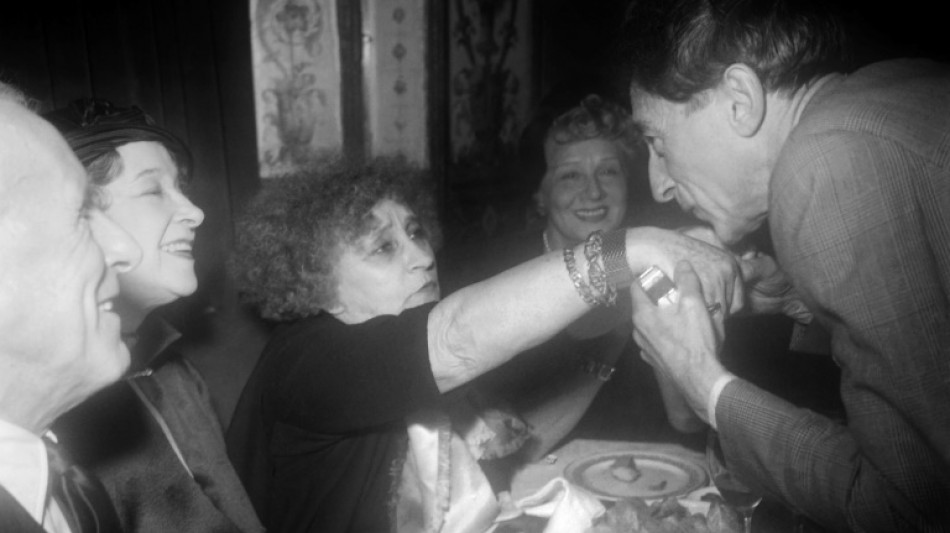
Why French novelist Colette still matters / Photo: - - AFP
 Teatro Mayor Unveils 152-Performance 2027 Season Highlighting Beethoven and García Márquez

 Rutgers Defeats NJIT 101-64 Behind Francis and Mark Scores

 THIEAUDIO Introduces Clairvoyance MKII: The Evolution of a Signature Sound
 Guardian Metal Resources PLC Announces Proposed Spin-Out of Non-Tungsten Projects

 Fulcrum Metals PLC Announces New Critical Mineral Recoveries Expand Potential

 Thukukile Zuma Resigns from ANC Johannesburg Leadership Amid Disciplinary Dispute

 CM Mohan Yadav Meets Bohra Spiritual Leader to Discuss Simhastha 2028 and Development

 Eli Crane Defeats Jonathan Nez in Tight Arizona Congressional Race

She caused a riot when she kissed her lesbian lover on stage and dared to talk about faking orgasms and domestic violence.
French novelist Colette is an icon of transgression and liberated womanhood whose work still remains bracingly relevant 150 years after her birth.
Her life and writing "resonate more than ever with our time", insisted Professor Diana Holmes of Britain's Leeds University as France prepares to mark the anniversary next week.
Colette's novels tackled fraught mother-daughter relationships, maternity, homosexuality, abortion and even menopause, long before these were considered appropriate subjects for public discussion.
But in some ways she is taken more seriously abroad these days, despite being the first woman to receive a state funeral in France in 1954.
In British and US universities, Colette has been part of the canon of French literature and feminism courses since the 1970s.
New translations of her best-known novel "Cheri" (1920) -- a love story between an older woman and a younger man -- and its sequel "The Last of Cheri" (1926), have recently been published in English.
- Reappraisal -
But back home there are signs of a reappraisal. Two of her books were for the first time included on the school curriculum this year: "Sido" (1930), an autobiographical account of her relations with her mother, and "The Tendrils of the Vine" (1908), in which she returns to her childhood village.
"The more we read her, the more we are convinced of her timelessness and especially of her modernity," French literature professor Dominique Brechemier told AFP.
This has helped make her a popular subject for cinema, from the Oscar-winning "Gigi" in 1958 through an adaption of "Cheri" with Michelle Pfeiffer in 2009 to a biopic, "Colette", in 2018 where Keira Knightley played the writer.
Her many careers -- novelist, journalist, cabaret dancer, actress -- and vivid love-life (three husbands, multiple male and female lovers) mark her out as a prototype of the modern emancipated woman.
"What fascinates is her story, her colourful life, full of transgressions," said Holmes.
Colette herself -- born Sidonie-Gabrielle Colette in rural Burgundy -- rejected the feminist label. She even famously said suffragettes (who campaigned for women's right to vote) deserved "the whip and the harem".
That may have been posturing with an eye on the bottom line, said Kathleen Antonioli of Kansas State University.
Colette was born relatively poor and could not rely on private wealth like her contemporaries Marcel Proust or Gustave Flaubert if the public and publishers turned against her,
Her actions speak louder.
"Throughout her life, she never stopped working for the freedom of women," said Brechemier.
"Let her have some complexity."
Y.Aukaiv--AMWN

