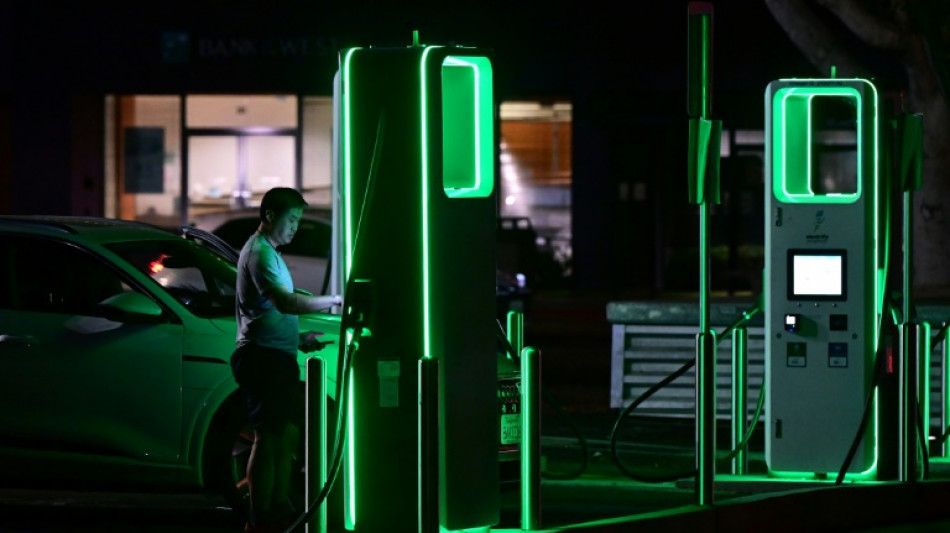
A fifth of new cars in California zero-emission in 2022: data / Photo: Frederic J. BROWN - AFP
 Teatro Mayor Unveils 152-Performance 2027 Season Highlighting Beethoven and García Márquez

 Rutgers Defeats NJIT 101-64 Behind Francis and Mark Scores

 THIEAUDIO Introduces Clairvoyance MKII: The Evolution of a Signature Sound
 Guardian Metal Resources PLC Announces Proposed Spin-Out of Non-Tungsten Projects

 Fulcrum Metals PLC Announces New Critical Mineral Recoveries Expand Potential

 Thukukile Zuma Resigns from ANC Johannesburg Leadership Amid Disciplinary Dispute

 CM Mohan Yadav Meets Bohra Spiritual Leader to Discuss Simhastha 2028 and Development

 Eli Crane Defeats Jonathan Nez in Tight Arizona Congressional Race

One-in-five new cars sold in California in 2022 was a zero-emission vehicle, the state said Friday, as the largest car market in the United States charges towards its goal of electrifying its fleet.
Last year officials set ambitious targets for boosting the number of electric vehicles (EVs) and plug-in hybrid vehicles (PHEVs) on the roads, as they look to slash planet-warming gases produced by combustion engines.
The California Air Resources Board announced in August the sale of new gasoline and diesel-powered cars would be eliminated by 2035, setting an aggressive timeline to phase them out.
On Friday the California Energy Commission said 18.8 percent of new cars sold in the state in 2022 were EVs, PHEVs or fuel cell electric vehicles, all of which California includes in its zero-emission category.
Ten years ago, that figure was two percent.
"California continues to lead the zero-emission vehicle revolution with groundbreaking policies and investments that drive innovation, create good jobs and expand (zero-emission vehicle) access and affordability across the state,” said Governor Gavin Newsom.
"Keeping our focus on the communities that are most impacted by the intensifying climate crisis, we’ll keep pushing ahead to make our clean transportation future a reality in California."
Data showed Tesla continued to dominate the market for EVs, with around two-thirds of the 346,000 zero-emission vehicles sold in the year being made by Elon Musk's company.
California already accounts for the lion's share of electric vehicles in the United States, with 1.4 million of them on the state's roads, and around 40 percent of all ZEV sales in the US are in the state.
Their popularity has mushroomed in the years since they were seen as little more than novelty golf carts for tree-huggers who were content to drive no more than a few dozen miles (kilometers).
Mainstream manufacturers like Ford and Mercedes are rushing headlong into the market, producing everything from small runarounds to luxury sedans to heavy duty pick-ups.
Still, the vehicles remain more expensive than their fossil fuel-powered equivalents, and critics say only federal subsidies of up to $7,500 make them viable for many buyers.
But supporters say the incentives are necessary short-term supports that will fade away as increased adoption boosts economies of scale and drives down prices.
As the biggest auto market in the United States, California has an outsized influence on national standards.
Environmentalists hope that as manufacturers fall into line with California's rules and produce more attractive, cheaper EVs, opposition from less liberal states will be overcome, and America can be weaned off its addiction to gas-guzzling cars.
Human-caused global warming has already raised average temperatures around the planet, affecting weather patterns and worsening natural hazards like wildfires and storms.
Scientists say dramatic action is required to limit the damage, and point to curbing emissions from fossil fuels as key to the battle.
F.Bennett--AMWN